
Aderyn y Corff: Aderyn y Corff is a ghostly, featherless bird from Welsh folklore known for portending death.
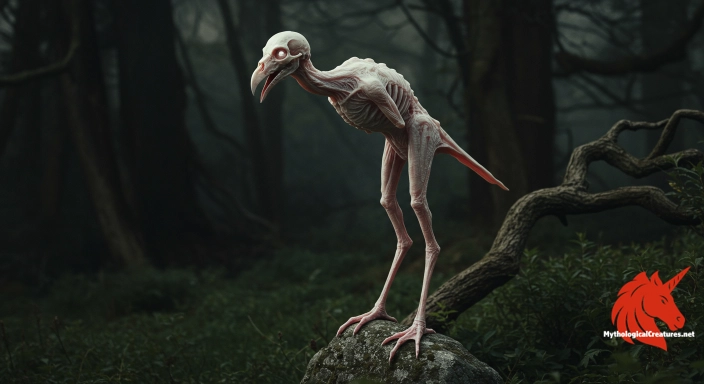
Aderyn y Corff
Aderyn y Corff - The bird's cry is believed to forewarn of an imminent death, making it a potent symbol of mortality within Welsh tradition.
Origins & First Encounters
Aderyn y Corff is a captivating yet eerie figure in Welsh folklore, imbued with the power to foreshadow death and transition. It is traditionally known by several variants including Aderyn corff and Deryn corff, each reflecting subtle shifts in its mythic resonance. Its origins lie deep within ancient Welsh traditions, where myth and spiritual warning coalesce in stories passed down through generations. The creature’s first attestations appear in folklore that interweaves pre-Christian and early Christian themes, giving it a timeless quality. Its role as a harbinger of death is underscored by its uncanny presence near the dwellings of those fated to pass away. The very name, meaning 'corpse bird', evokes a sense of grim inevitability that has both terrified and fascinated listeners. Over time, Aderyn y Corff has become emblematic of the mysterious boundary between the mortal world and a darker, unseen plane. The bird’s reputed cry, reminiscent of the Welsh word for 'come', adds a chilling invitation to the afterlife. Its narrative has been continuously refined by both oral tradition and literary interpretation. Ultimately, this spectral figure remains a potent symbol of mortality and the enigmatic passage between life and death.
Source Texts & Tale Variants
Ancient texts, including passages found in the Welsh-language Bible, provide some of the earliest written evidence of Aderyn y Corff, merging sacred literature with folk belief. Oral traditions have since enriched the myth, preserving details of its mournful call and ghostly appearance through generations of storytellers. Early ecclesiastical records and medieval manuscripts offer fragmented yet evocative descriptions that situate the creature as a portent of unavoidable fate. These documents reveal a complex intermingling of religious symbolism and indigenous supernatural lore. Local folklore, collected over centuries, presents diverse accounts in which the corpse bird's cry and appearance vary subtly from one region to another. Some narratives portray it as an ominous sign strictly reserved for impending death, while others grant it a more ambiguous, perhaps even redemptive, role. Contemporary scribes and folklorists have noted that such variants often reflect the cultural and spiritual anxieties of their times. In certain versions, its call is compared to the siren-like summons of otherworldly beings, blurring the lines between warning and invitation. The multiplicity of sources underscores the malleable nature of myth, where each retelling adapts to the evolving context of its audience. Collectively, these accounts cement the Aderyn y Corff as an enduring element of Welsh cultural heritage.
Form & Powers
The physical description of Aderyn y Corff departs strikingly from conventional images of birds, as it is said to lack both feathers and wings. This absence creates a spectral, almost skeletal appearance that contributes to its fearsome recognition as an omen. Its body is often depicted as emaciated and ghostly, conveying the transient nature of physical form in the face of death. The lack of plumage gives it a stark, barren quality that accentuates the association with decay and the supernatural. In various retellings, the creature is described as having an almost translucent quality, as if it were constructed of mist and shadow. Several accounts mention a faint luminescence about its outline, suggesting its connection to another, less tangible realm. The inconsistency in its described size further enhances its mystical ambiguity, with some narrations depicting it as nearly diminutive and others as imposing enough to command attention. Artistic renditions often enhance its haunting eyes to evoke a sense of deep, unspoken sorrow and predestination. Some sources even note that its call seems to resonate with a physical vibration, heralding its anomalous nature. In summary, the Aderyn y Corff is portrayed as a creature that defies biological norms, perfectly embodying the interstice between life and death.
Regional Faces
While the myth of Aderyn y Corff is firmly rooted in Welsh tradition, its narrative has undergone regional adaptations that reflect local cultural nuances. Within different parts of Wales, the bird is variously described, often with changes in its eerie vocalisation and the context in which it appears. In some rural communities, the corpse bird is interwoven with local spirit lore, merging seamlessly with pre-Christian faerie beliefs. These variations can include differences in the tone of its cry or subtle modifications to its physical depictions. Beyond Wales, adjacent Celtic traditions have adopted similar omens with local names and attributes, underscoring a shared mythological heritage. In parts of Ireland and Scotland, for example, analogous legends recount spectral birds that forewarn of death or spiritual transitions. Local artists and storytellers have also infused these creatures with additional cultural symbolism, sometimes imbuing them with gentle, even protective, qualities. Some recensions emphasise the bird’s role in guiding lost souls, thereby softening its otherwise morbid connotations. The interplay between a common mythic thread and unique regional interpretations highlights the dynamic nature of oral tradition. These local adaptations ensure that while the Aderyn y Corff remains a central figure in Welsh lore, its legend resonates across diverse cultural landscapes.
The variations demonstrate how myth evolves to mirror communal fears and beliefs, allowing each region to claim a unique version of the narrative. This geographical diversity is emblematic of how communities adapt broad mythic motifs to address specific cultural experiences and environmental phenomena.
Cultural Parallels
The Aderyn y Corff shares intriguing parallels with various mythological creatures found throughout the world, particularly those that serve as omens of death. In Norse mythology, for instance, ravens like Huginn and Muninn carry messages that reflect the inexorable march of fate. Similar to the banshee in Irish lore, this spectral bird signals impending loss, underscoring a universal motif in cultures confronting the mysteries of mortality. Many civilizations have long attributed the role of a death omen to birds, highlighting an innate human tendency to interpret the presence of avian figures in relation to the afterlife. The corpse bird’s disembodied, featherless form sets it apart visually, yet its role as a harbinger aligns it with a broader symbolic tradition. In several Native American myths, birds similarly act as mediators between the living and the spirit world, echoing the dual existence of Aderyn y Corff. Comparative mythology reveals that while the outward details may vary, the function of these creatures as symbols of transformation and transition remains consistent. Literary and artistic traditions have further cemented these bird omens as icons of both fear and profound understanding of life’s impermanence. The ongoing dialogue between different cultural interpretations enriches the myth, encouraging a deep exploration of death and rebirth. In this way, the Aderyn y Corff stands as a testament to the enduring human fascination with the liminal spaces between life and the hereafter.
This cross-cultural resonance emphasises that the symbolism embedded in such omens transcends geographical boundaries, uniting diverse traditions under a common narrative of existential mystery.
Legacy & Modern Evolution
The historical evolution of Aderyn y Corff reflects a fascinating shift in cultural attitudes towards death and the supernatural over the centuries. Early medieval depictions portrayed the bird in stark, foreboding terms, where its presence was an unambiguous signal of divine judgement and mortal demise. As time progressed, these early images were enriched by layers of literary and artistic interpretation, transitioning from raw portents to symbols saturated with metaphorical nuance. In earlier eras, religious texts intertwined with local folklore lent the myth a moral and existential dimension that emphasised the inevitability of death. Over time, however, societal views on the afterlife and mortal existence began to influence the narrative, leading to a gradual transformation in its portrayal. Modern interpretations have sought to balance traditional superstition with rational explanations, sometimes reattributing sightings to misidentified natural phenomena like screech owls. Contemporary artists and writers have embraced the corpse bird as a compelling symbol of existential transition and the enigma of mortality. Its enduring image has also spawned reinterpretations in cinema, literature, and visual art, where the eerie call of the bird is used to explore themes of loss and metamorphosis. The myth now serves as both a historical curiosity and a living emblem of the fears and fascinations that surround death. As modern discourse continues to blend scientific inquiry with mythological tradition, the legacy of Aderyn y Corff remains a dynamic dialogue between past and present. Its continuous evolution mirrors the broader human quest for meaning in the face of the unknown. Ultimately, the corpse bird endures as a potent symbol that bridges ancient superstition with contemporary cultural expression, inviting perpetual reexamination into the mysteries of life and death.
Interesting Fact
An intriguing aspect of the Aderyn y Corff is its dual interpretation; while some modern accounts suggest it might be a misidentified screech owl, its traditional portrayal as a spectral death omen firmly establishes its place in Welsh folklore.
Mythology-aligned partners
Showcase your myth-friendly brand here
Run a store, studio, or platform that lives in the world of myth and folklore? A curated sponsor panel on these pages may fit.
Explore partnership optionsQuick Creature Info
Features:
Associations:
Our Mythic Legendary Rating:

Also Sometimes Known As:
Habitat:
Supernatural Powers:
Physical Attributes:
Abilities:
Behavior:
Lore:
Related Creatures, Tales or Lore
- BBanshee (Irish folklore)
- RRaven (Celtic and Norse mythology)
- BBlack Crow (various cultural death omens)
References
Discover Another Mythical Legend You May Not Have Heard Of?
Uncover the mysteries of ancient folklore and expand your knowledge of legendary beings from cultures around the world.
Dare to Meet the Tuchulcha....
Curated by the Mythological Creatures Team
Series editor: Mythological Creatures Directory
Primary desk: Northern & European Folklore Desk
(rev. November 2025)