
Agogwe: The Agogwe is a small, human-like cryptid reported in East Africa.

Agogwe
Agogwe - The Agogwe has sparked interest among cryptozoologists and is a part of regional folklore despite its unverified existence.
Origins & First Encounters
The agogwe stands as one of East Africa’s most enigmatic figures, a creature that straddles the boundary between myth and possibility. Reverberating through generations of oral tradition, its story is told by those who dwell near the untamed lands of the continent. Local communities recount a being that, though diminutive in stature, possesses an unmistakably human-like carriage. Emerging from ancient lore, the agogwe is said to measure approximately 1.2 to 1.5 metres, a detail that both intrigues and mystifies its witnesses. Its presence has been interwoven with the fabric of the natural world, often seen as a reminder of nature’s mysteries. Over the years, its tale has been enriched by folklore that paints it as a silent wanderer within dense bushland. The rarity of any tangible evidence only strengthens the allure of its legend, positioning the agogwe as an emblem of nature’s hidden secrets. The creature’s integration into local myth has led to continuous reinterpretations, making it a dynamic part of East African cultural heritage. Many see it as a symbol of the unknown, a keeper of ancient woodland wisdom. Even as modern science seeks concrete proof, the mysterious charm of the agogwe endures in the collective imagination.
Source Texts & Tale Variants
Traditional narratives and scattered traveller accounts serve as the primary sources of the agogwe legend. Tales of this small biped have been passed down through generations, with early colonial records offering brief mentions that have since spurred further curiosity. Written documentation is sporadic, often emerging from explorers’ journals and the notes of early naturalists traversing East Africa’s rugged terrains. Each narrative, whether from oral tradition or written reports, has contributed unique details, sometimes highlighting its elusive temperament or distinctive physical traits. Variations in the retelling have given rise to a rich tapestry of interpretations that differ from one community to another. Multiple regional compilations and cryptozoological surveys have since attempted to curate these accounts, even though many remain anecdotal. Some stories place the agogwe among other mystical denizens of the African wilderness, underscoring its spectral nature. Translations of local dialects and reinterpretations of ancient lore have only enhanced the multifaceted allure of this enigmatic creature. The diverse sources underscore an ongoing effort to capture its elusive essence while revealing the interplay between myth and documented observation. Although hard evidence is elusive, the narrative variants continue to inspire both academic inquiry and popular fascination.
Form & Powers
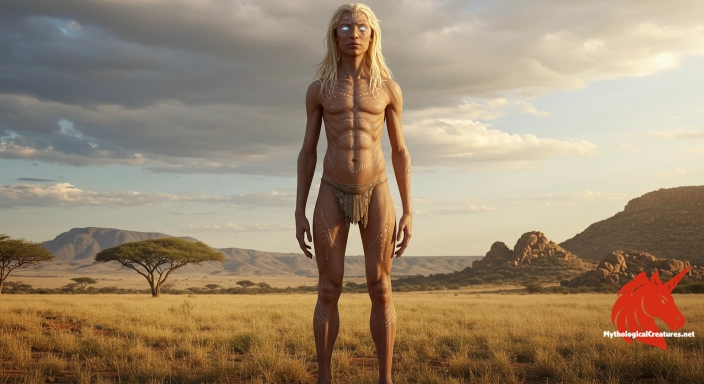
Descriptions of the agogwe portray it as a creature of modest size, usually standing between 1.2 to 1.5 metres tall. Eyewitness accounts often depict it with a predominantly human-like silhouette, yet marked by distinctly anomalous features. Its physique is said to be slender and agile, as if tailored for quick movements within dense foliage. The creature’s hair, described as brown or russet, is reported to blend seamlessly with the earthy tones of its natural environment. Observers have noted that its facial characteristics are subtly primitive, with features that evoke both familiarity and otherworldliness. Some narratives hint at a pair of keen, expressive eyes that seem to harbour a blend of curiosity and caution. Detailed accounts occasionally mention the unusual texture of its skin and the slight elongation of its limbs, alluding to an evolutionary divergence from modern man. The agogwe’s overall posture is upright, yet imbued with a restless nimbleness that sets it apart from ordinary human movement. Variability in descriptions across different sightings has added layers of mystery to its seldom-seen countenance. In sum, the physical portrayal of the agogwe resists definitive categorisation, maintaining an aura of ambiguity that continues to captivate observers.
Regional Faces
Regional interpretations of the agogwe offer a fascinating glimpse into the adaptive nature of folklore across East Africa. In some localities, it is portrayed as a secretive denizen of thick forests and remote highlands, while neighbours to other regions suggest it might inhabit the fringes of savannah woodlands. Coastal communities sometimes imbue it with traits that hint at a more lithe and agile form, perhaps influenced by the dynamic interplay between land and sea in their local narratives. In contrast, inland tribes often describe the creature as more robust and earthy, echoing the rugged environs of their surroundings. Variations in its alleged physical characteristics, such as subtle differences in hair colour or build, reflect local environmental influences and cultural perceptions. Some communities even ascribe supernatural qualities to the creature, framing it as a guardian spirit of the wilderness. The adaptability of the agogwe’s myth is evident in the way different regions incorporate it into their rituals and ceremonial practices. Its ability to metamorphose symbolically—from a fearful entity to a benign, even revered, presence—illustrates how local traditions shape its portrayal. Such regional diversities enable the agogwe to serve as a versatile symbol of the wild. Overall, these multiple perspectives highlight the enduring cultural resonance and regional dynamism of the agogwe legend.
Cultural Parallels
When set against the backdrop of global mythology, the agogwe revels in a shared narrative with many other enigmatic, small hominids. It finds a distant echo in various traditions that recount encounters with diminutive, elusive beings living on the fringes of human civilisation. Similar to cryptids such as the Himalayan yeti or the elusive Sasquatch of North American lore, the agogwe exists in a liminal space between myth and potential reality. The creature’s modest stature and human-like features invite comparisons with wild men and lesser-known primate legends found across continents. These cross-cultural narratives underscore a universal human tendency to mythologise unexplained phenomena and to reveal parts of the natural world as imbued with mystery. Its portrayal in East Africa, brimming with earthy simplicity and enigmatic allure, resonates with themes recurrent in global cryptozoological myths. In some European medieval traditions, wild men depicted as uncivilised yet oddly captivating share an intangible kinship with the agogwe. The comparative analysis illuminates an underlying commonality wherein human beings across disparate cultures find comfort and intrigue in the unknown. Both the similarities and the differences among these legends highlight a universal dialogue on the nature of the human condition and our relationship with the wild. Ultimately, the agogwe’s place within a broad spectrum of myth serves as a testament to the rich, interwoven fabric of global folklore.
Legacy & Modern Evolution
The legend of the agogwe has evolved significantly over time, transforming from a local folk tale into a subject of modern cryptozoological interest. Its early roots in oral tradition have given way to a rich narrative presence in both literature and popular culture. As colonial accounts and tribal stories converged, the agogwe became recognised as a tantalising emblem of East Africa’s untamed wilderness. Modern enthusiasts and researchers have drawn on these diverse historical interpretations to further ignite interest in the creature, even inviting contemporary scrutiny through field investigations and digital mapping projects. Artists, writers, and documentary makers have reimagined the agogwe in various forms, often highlighting its mysterious allure and its ambiguous place in the natural world. In doing so, the creature has come to symbolise not only the perennial human fascination with the unknown but also a reverence for an environment that is both beautiful and untamed. This modern reinterpretation underscores the way ancient myth adapts to new cultural contexts, remaining relevant despite the march of scientific progress. The enduring appeal of the agogwe reflects broader societal concerns about heritage, nature conservation, and the mysteries that still lurk beyond modern understanding. As digital communities and local festivals celebrate its legend, the agogwe endures as a living myth, evolving along with the times. In contemporary discourse, it serves as a reminder of the delicate interplay between history, myth, and modern science, continually inspiring wonder and debate.
Interesting Fact
Despite being largely anecdotal, some local legends suggest that the Agogwe might represent a remnant of an ancient, unclassified hominin group, adding an extra layer of mystery to its legend.
Curated sponsor space
One subtle banner. Thousands of myth lovers.
We offer a small number of curated sponsor spots for relevant books, courses, games, and art. No clutter, just well-matched partners.
Partner with usQuick Creature Info
Origin:
Features:
Our Mythic Legendary Rating:

Habitat:
Physical Attributes:
Abilities:
Behavior:
Lore:
References
Discover Another Mythical Legend You May Not Have Heard Of?
Uncover the mysteries of ancient folklore and expand your knowledge of legendary beings from cultures around the world.
Dare to Meet the Utixo....
Curated by the Mythological Creatures Team
Series editor: Mythological Creatures Directory
Primary desk: African & Diaspora Traditions Desk
(rev. November 2025)