
Allocamelus: Allocamelus is a mythological creature depicted in heraldry.
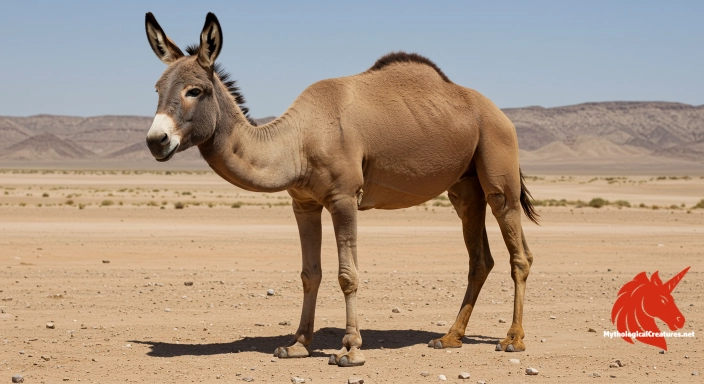
Allocamelus
Allocamelus - The Allocamelus served as a symbolic emblem in heraldry, representing unique identity and possibly commerce, as evidenced by its adoption by both the English Eastland Company and the Russia Company.
the legend in five swipes.
the legend in five swipes.
When did people first speak of the Allocamelus?
The Allocamelus emerges as a fascinating emblem within the realm of heraldry, intriguing believers and scholars alike with its unusual combination of features. Its hybrid form, boasting the head of a donkey and the body of a camel, immediately captures the imagination with its paradoxical symbolism. The creature was originally adopted as a crest by the English Eastland Company, laying the groundwork for its later use by the Russia Company. Its initial appearance in the heraldic tradition coincided with a period of expansive trade and exploration, where emblems were used to encapsulate the virtues of perseverance and adaptability. The Allocamelus, with its disparate animal elements, appears to symbolise the union of practicality and mystique, merging stubborn endurance with the resilience needed for long journeys. Over time, its presence evolved into a subtle metaphor for balancing opposites, later gaining a cult following among heraldic enthusiasts. The unique narrative of the Allocamelus invites a reconsideration of its role in both esoteric symbolism and the pragmatic world of commerce. Emerging from a context of economic ambition, it has since evolved into a richly layered symbol that continues to spark curiosity and debate.
How was the story of the Allocamelus recorded?
Historical records indicate that the Allocamelus first graced the crests of influential trading companies amidst a burgeoning age of exploration, with early mentions appearing in the heraldic descriptions of the English Eastland Company. Various emblems and seals from the period offer artistic variations of the creature, each version reflecting the nuanced perspectives of its creators. Although direct literary sources remain scarce, the creature’s depiction has been preserved in numerous heraldic manuscripts and archival documents that celebrate the art of symbolism. Some accounts suggest that the Allocamelus was not only a badge of commerce but also a talisman against misfortune on perilous voyages. As trade routes expanded, the creature’s image was reproduced in a number of registered crests, ensuring that its legend was passed on through visual and practical means. The Russia Company later adopted the creature as part of their heraldic repertoire, further broadening its narrative across geographical borders. Subtle differences in the illustrations over time have led to multiple story variants, each reflecting local interpretations of its symbolic power. Debates among historians and heraldists continue to enrich the lore of the Allocamelus, ensuring that its origins and variants remain an open field for interpretation.
What did the Allocamelus look like?
The physical depiction of the Allocamelus is as striking as it is unconventional, with its most prominent feature being the mismatched anatomy that merges a donkey head with a camel’s body. The head is rendered with pronounced, elongated ears and a steadfast gaze that conveys both determination and a hint of mischief. In contrast, the body is robust and elongated, mirroring the enduring qualities of a camel with features such as a sloping profile and occasionally a modest hump that evokes the harsh terrains it symbolically traverses. Its fur is often portrayed as coarse yet enduring, evoking the real-world challenges of desert travel with a textured, almost purposefully rugged appearance. Artistic depictions sometimes accentuate the transitional neck area, where the lean, agile form of the camel merges with the more grounded, steadfast attributes of a donkey’s head. The creature’s silhouette is intentionally ambiguous, crafted to evoke the dual nature of burden and endurance. Variations in size and detail occur across different illustrations, with some artists opting for grander, more imposing dimensions while others prefer a subtler representation that fits a more refined heraldic style. Each rendition highlights a careful balance between practicality and whimsy, ensuring that every detail contributes to its overarching narrative of unusual resilience.
Allocamelus Across Different Regions
The Allocamelus has travelled far beyond its original English heraldic roots, undergoing intriguing modifications as it was embraced by different cultures. In northern realms, its features were sometimes exaggerated to produce a more formidable and eccentric image, while in southern depictions, the emphasis shifted towards elegance and subtle refinement. In Russian heraldic traditions, its image was adapted to resonate with local values of endurance and the arduous nature of long-distance trade routes. Some artisans in Eastern Europe even imbued the creature with an air of mysticism, presenting it as a guardian of both prosperity and cautionary wisdom. Local adaptations often modified the balance between the donkey’s robust head and the camel’s enduring body, thereby reflecting regional aesthetic preferences and symbolic priorities. Within these cultural variants, the Allocamelus has been portrayed as both a benevolent protector and a reminder of the unpredictable fortunes of commerce. These adaptations not only highlight the flexibility of heraldic symbols but also underscore the creature’s capacity to embody diverse qualities. Despite these regional differences, its core attributes remain recognisable, uniting disparate interpretations under a common emblematic legacy.
Is the Allocamelus unique, or found elsewhere?
In the broader spectrum of mythological hybrids, the Allocamelus invites comparison with other chimeric creatures whose composite forms serve symbolic functions. Its unusual combination of a donkey’s head and a camel’s body resonates with a long-standing tradition of amalgamating different animal traits to convey complex narratives. Similar to how griffins or chimeras were used to blend qualities of various animals in other cultures, the Allocamelus echoes these themes through its embodiment of both stubborn practicality and resilient endurance. While many hybrid creatures in myth are designed to invoke awe or fear, the Allocamelus carries a uniquely ironic charm that straddles both the utilitarian and the mystical. Its juxtaposition of seemingly incompatible features bears a subtle reminder of the unpredictable outcomes of cultural fusion. Some Eastern myths also present hybrid creatures that pay homage to the virtues of adaptability and resourcefulness, thereby establishing a cross-cultural dialogue. Comparatively, its representation stands apart by firmly rooting itself in the realm of trade and commerce, symbolising the blend of challenge and opportunity inherent in long journeys. In this way, the Allocamelus forms a bridge between the fantastical realm of myth and the grounded realities of historical merchant endeavours.
Allocamelus: The Legend's Second Life
The Allocamelus has evolved considerably since its early appearances in the crests of influential trade companies. Its transition from a practical emblem in the age of exploration to a subject of modern reinterpretation demonstrates its enduring allure. Over the centuries, artists and heraldists have continually reimagined its form, adapting its imagery to reflect changing aesthetic sensibilities and cultural values. In contemporary settings, the creature is often celebrated as a quirky yet thoughtful nod to the rich interplay of historical symbolism and myth. Modern graphic designers have embraced the Allocamelus, incorporating its distinctive features into logos, artworks, and even literary illustrations that celebrate heritage. This evolving narrative has allowed the creature to maintain a presence far beyond the confines of traditional heraldry, influencing modern iconography and cultural commentary. Its hybrid form has come to represent themes of resilience, versatility and the complex interplay between tradition and modernity. Today, the Allocamelus endures as a potent reminder of the power of myth, forging links between past and present and continuing to inspire a wide range of creative expressions.
Interesting Fact
Allocamelus is a rare example of a creature created purely for heraldic purposes, demonstrating how myth and art can combine to form unique corporate identities.
Mythological Treasures
Norse Sagas: A field guide to the beasts of the Viking world
Drawn from the saga accounts themselves, with the powers, weaknesses and doom of each being set out.
Greek Myths: A field guide to the monsters of ancient Greece
Every monster here earned its place in legend, and each gets a full page of artwork and the story behind it.
Egyptian Legends: A field guide to the gods and monsters of ancient Egypt
Guardians of the living and devourers of the dead, with the role each played in judgement.
the legend in five swipes.
Mythology-aligned partners
Showcase your myth-friendly brand here
Run a store, studio, or platform that lives in the world of myth and folklore? A curated sponsor panel on these pages may fit.
Explore partnership optionsQuick Creature Info
Features:
Our Mythic Legendary Rating:

Also Sometimes Known As:
Physical Attributes:
Lore:
Related Creatures, Tales or Lore
References
Discover Another Mythical Legend You May Not Have Heard Of?
Uncover the mysteries of ancient folklore and expand your knowledge of legendary beings from cultures around the world.
Dare to Meet the Aungzwamagyi....
The Mythological Creatures Book Series
Yokai, Greek, Norse, Egyptian & Chinese. Five illustrated field guides to the creatures the old stories either warned or told you about.

Curated by the Mythological Creatures Team
Series editor: Mythological Creatures Directory
Primary desk: Northern & European Folklore Desk
(rev. November 2025)