
Amanozako: Amanozako is a monstrous Japanese goddess born from Susanoo's ferocious spirit, also known as Tengu Kami.
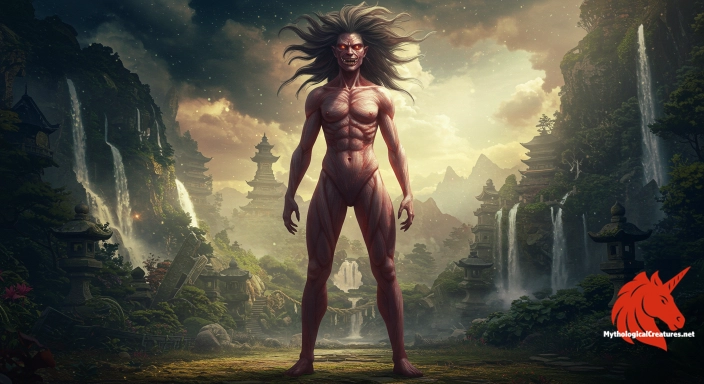
Amanozako
Amanozako - Originated from Susanoo's ara-mitama, symbolizing the uncontrolled and chaotic forces within the divine, and represents the duality of creation in Shinto mythology.
Origins & First Encounters
Amanozako emerges in the ancient Japanese mythos as a formidable goddess whose very name – meaning 'heaven opposing everything' – encapsulates her defiant nature. Her epithet, sometimes rendered as 'tengu kami', hints at a connection with fierce, otherworldly spirits that blur the line between divinity and wild chaos. She is born from a dramatic act in which the storm god Susanoo, overwhelmed by his own volatile energy, expelled his ferocious inner spirit. This extraordinary occurrence not only symbolises a break from conventional divine order but also marks the inception of an entity capable of challenging both heaven and earth. Her creation represents the potent mixture of cosmic disorder and sacred power that colours early Shinto cosmology.
Recorded in ancient texts such as the Kujiki, her myth was integrated into the larger tapestry of the eight million gods revered in the celestial realm. Early portrayals present her as a being of both awe-inspiring beauty and formidable terror, exemplifying the paradox of creation emerging from chaos. The narrative surrounding her birth reflects a broader cultural acceptance of dualistic forces in nature—a balance between nurturing order and disruptive rebellion. Over time, her mysterious presence has inspired a spectrum of interpretations that celebrate the unpredictable nature of divine power. In modern recounting, Amanozako remains an enduring symbol, inviting renewed exploration and reinterpretation among scholars and enthusiasts alike.
Source Texts & Tale Variants
The oldest textual reference to Amanozako is found in the Kujiki, a seminal chronicle that records the intricate genealogy and deeds of Japan's myriad deities. Her origin is vividly recounted as the unintended consequence of Susanoo’s inner turmoil, where an expelled fragment of his ferocious spirit gave rise to her being. Such an account boldly illustrates how the forces of chaos and passion could be transmuted into a divine manifestation. Early records present her as both a personification of unrestrained cosmic energy and a testament to the unpredictable nature of the divine. This early documentation firmly positions her amongst the vast company of celestial beings in the Shinto pantheon.
Subsequent oral traditions and local folklore have enriched her story by introducing subtle variations and additional layers of symbolism. In some regional accounts, her myth merges with elements of the tengu tradition, further emphasising her connection to hybrid and liminal figures. Manuscripts discovered over the centuries add contrast and nuance, sometimes portraying her as a benevolent guardian as much as a terror-striking force. These variant narratives highlight the adaptive quality of myth, where divine figures evolve to mirror the shifting values of their communities. Collectively, the multiplicity of sources underscores Amanozako’s status as an enigmatic and dynamic presence in mythology.
Form & Powers
Amanozako is traditionally envisioned as a being who fuses an arresting beauty with an unmistakable aura of otherworldly menace. Her visage is frequently portrayed with sharp, angular features that communicate both grace and an underlying ferocity. In many depictions, her eyes seem to burn with an inner fire, suggesting the tumultuous energy from which she was born. Artistic representations sometimes hint at an avian influence, subtly integrating a beak-like structure reminiscent of tengu motifs. Intricate symbols and enigmatic markings often adorn her face and body, imbuing her countenance with layers of celestial significance.
Her hair is commonly shown as wild and unrestrained, cascading in a manner that mirrors the chaotic forces of nature. The garments she is depicted in frequently flow with abstract, fluid patterns that evoke the ephemeral qualities of both the sky and the natural world. Some traditions assert that her form is not fixed; she is capable of shifts in size and appearance, moving between monstrous and ethereal states. This fluidity in physical description underscores the inherent duality of her nature. Ultimately, every aspect of her physical portrayal serves to reinforce her role as a living embodiment of the interplay between order and chaos.
Regional Faces
Across various regions of Japan, the portrayal of Amanozako is shaped by local beliefs and environmental influences, resulting in a tapestry of diverse interpretations. In mountainous areas, she is sometimes revered as a guardian spirit, a protector of the rugged wilds and the liminal spaces between the mortal and the divine. Rural communities often infuse her story with agrarian symbolism, casting her as a force that both challenges and safeguards the natural cycles that govern their lives. In these local narratives, her fearsome characteristics are balanced by a resonant sense of ancient wisdom and protective capability. Regional artisans and shrine custodians have, over time, adapted her iconography to reflect the distinctive spiritual needs and aesthetics of their communities.
Along the coasts, traditions occasionally cast her as an entity linked to the volatile energies of the sea and storms, mirroring the unpredictable temperament of maritime weather. Festivals and ritual performances in certain locales invoke her dual nature, celebrating her both as a warning of nature’s caprice and as an emblem of renewal. Local legends frequently intertwine her story with that of other regional deities, further diversifying the interpretations of her myth. This patchwork of regional adaptations underscores her versatility as a symbol and her capacity to resonate deeply with varied cultural experiences. Through these adaptations, Amanozako has seamlessly integrated into multiple local traditions, each endowing her legacy with new dimensions of meaning.
Cultural Parallels
A comparative analysis of mythological figures reveals that Amanozako occupies a niche where the interplay of chaos and order is a central motif. Her genesis from the discarded, ferocious spirit of Susanoo bears a striking resemblance to other global narratives in which deities are born from the disruptive forces of nature. Similar to the Hindu goddess Kali, who embodies both creation and destruction, Amanozako illustrates the inherent ambivalence of divine power. In the European pantheon, the duality seen in creatures like the Gorgon mirrors her capacity to enchant and terrify in equal measure. Such cross-cultural parallels underscore the universality of mythic themes, where the emergence of life from chaos is a recurring narrative.
Her association with the tengu tradition further aligns her with hybrid archetypes that straddle the boundaries between human and beast. Distinct from more conventional deities, her layered imagery invites comparisons with other liminal figures whose identities reject simple categorisation. The dynamic synthesis of animalistic and human features in her representations resonates with similar motifs found in various cultural legends. This interplay of opposing elements encourages a deep reflection on the nature of power, transformation, and transcendence. In essence, Amanozako serves as a compelling example of how myths across cultures address the eternal tension between order and chaos.
Legacy & Modern Evolution
Over the centuries, Amanozako’s myth has undergone significant evolution, mirroring changes in cultural and artistic sensibilities across Japan. Early Shinto records depicted her as a fearsome embodiment of untamed cosmic energy—a symbol of divine rebellion forged in the heat of elemental chaos. As time progressed, her image evolved from that of a purely monstrous figure into one that is imbued with complex symbolism and ambiguous morality. Historical art and literature began to frame her as a multifaceted personality, capable of inspiring both awe and caution. This gradual refinement in her portrayal reflects a broader shift towards embracing the nuanced interplay between destruction and regeneration in myth.
In contemporary times, Amanozako has been revitalised in a variety of media, including manga, anime, and modern art installations, where her legend is reinterpreted for new audiences. Modern adaptations often cast her as an icon of resistance, echoing themes of empowerment and the subversion of established order. Academic studies now explore her story as a rich metaphor for the dialectic between chaos and structure in both nature and society. Her enduring presence in popular culture is a testament to the timeless allure of myth, bridging ancient traditions with modern creative expression. Through ongoing reinterpretation, Amanozako continues to resonate as a dynamic and transformative figure in the landscape of contemporary mythology.
Interesting Fact
Despite her fearsome and chaotic origins, Amanozako is revered as a vital embodiment of divine balance, illustrating the complex duality of creation where both order and chaos coexist.
Advertising opportunity
Showcase your mythology project
We offer limited sponsor placements for books, courses, games, and creators aligned with our audience.
View partnership optionsQuick Creature Info
Our Mythic Legendary Rating:

Also Sometimes Known As:
Habitat:
Supernatural Powers:
Physical Attributes:
Behavior:
Lore:
Related Creatures, Tales or Lore
- TTengu
- YYamata no Orochi
- AAmatsu-Mikaboshi
References
Discover Another Mythical Legend You May Not Have Heard Of?
Uncover the mysteries of ancient folklore and expand your knowledge of legendary beings from cultures around the world.
Dare to Meet the Baba Yaga....

Curated by the Mythological Creatures Team
Series editor: Mythological Creatures Directory
Primary desk: Asian & Pacific Myth Cycles Desk
(rev. November 2025)