
Bai Ze: Bai Ze is a divine creature from ancient Chinese legends, renowned for its unique, hybrid appearance that combines features of a dragon and a tiger.
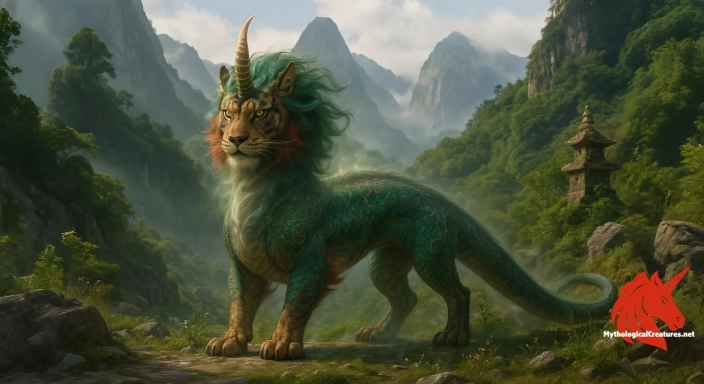
Bai Ze
Bai Ze - Bai Ze is celebrated for its encyclopedic knowledge of ghosts and spirits and its protective function in warding off evil, making it a vital figure in Chinese folklore.
Origins & First Encounters
Bai Ze emerges from the tapestry of ancient Chinese myth as a being endowed with profound insight into the supernatural realm. Its origins are entwined with a period when the boundaries between the mystical and the mortal were deeply blurred. The legend recounts that the creature was entrusted by the Yellow Emperor to record and delineate the myriad spirits that inhabit the world. Early documentation in texts such as the Book of Song introduces Bai Ze as a divine chronicler of ghostly phenomena. As centuries passed, the lore surrounding Bai Ze expanded, reflecting both awe and the pragmatic need to ward off evil influences. The creature’s narrative was further enriched during the Tang Dynasty, when its legend journeyed to Japan, retaining its mystique and name. Bai Ze’s story is not only one of myth but also of cultural significance, embodying ancient perceptions of the unknown. Its legacy has been preserved through a series of evolving depictions that resonate with themes of protection and cosmic wisdom. The enduring appeal of Bai Ze mirrors the ancient pursuit of understanding the interplay between human destiny and the forces beyond.
Source Texts & Tale Variants
The primary accounts of Bai Ze are interwoven in historical texts that have been handed down through the ages. Classical sources such as the Book of Song provide early glimpses into the creature’s role as an archivist of supernatural entities. A notable legend is encapsulated in the Bai Ze Tu, wherein it is said to have documented the forms and habits of ghosts and spirits. An incomplete Dunhuang manuscript from the 9th or 10th century offers further layers to the story, albeit without any accompanying illustrations of the creature itself. Records from the Ming Dynasty and the History of Yuan add alternative visions, each emphasising distinctive physical traits and roles. Folklore traditions often portray Bai Ze as not merely an observer but a guardian who neutralised malevolent energies. Variants of its story accumulate details that link its wisdom with practical measures to avert calamity. Each source, despite its fragmentary nature, enriches the multifaceted character of Bai Ze. These layered testimonies have paved the way for a flexible myth that continues to influence cultural practices and interpretations.
Form & Powers
Descriptions of Bai Ze paint a vivid picture that bridges the fantastical with the tangible. The creature is depicted as a seamless fusion of draconic and leonine features, embodying both ethereal grace and formidable might. Early texts describe its head as that of a loong adorned with striking green hair and crowned by a prominent horn. Alternative narratives portray it with the head of a tiger and a red, flowing mane, thereby emphasising ferocity and regality. Its body is often rendered in serpentine form, suggesting an almost otherworldly fluidity and power. The horn, whether solitary or spiralled, serves not just as an ornamental feature but as a symbol of its divine authority. Some accounts even allude to delicate, shimmering scales that hint at an iridescence beneath its skin. The amalgamation of these traits symbolises the unification of various natural forces. This hybrid anatomy not only captivates the imagination but also reinforces Bai Ze’s role as both a recorder of the unseen and a protector against evil.
Regional Faces
The myth of Bai Ze travelled far beyond its original Chinese borders, adapting with noticeable variations to suit local cultural contexts. In China, regional folklore imbued the creature with attributes that resonated with local religious and protective practices. Northern traditions, for instance, incorporated Bai Ze into rituals designed to combat seasonal misfortunes and malevolent spirits. In southern areas, its presence was more intimately linked with domestic well-being and the safeguarding of the family. When the legend crossed into Japan during the Tang Dynasty, the creature’s core attributes were preserved, yet it was interpreted through the lens of Japanese artistic conventions. Local adaptations sometimes blended Bai Ze with indigenous mythic beings, subtly altering its iconography to align with regional cosmologies. In some regions, artistic portrayals emphasised its aerial abilities and majestic presence, while in others the focus lay on its role as a spectral chronicler. The regional reinterpretation of Bai Ze thus reflects a dynamic dialogue between a shared myth and local cultural identity. These variations ensure that the legend remains both a unifying and diverse element in East Asian folklore.
Cultural Parallels
Bai Ze occupies a unique position amid global mythological creatures, inviting comparisons with hybrid beings from various cultural traditions. Its blend of draconic and feline traits is reminiscent of the chimeric creatures found in other ancient mythologies, where composite forms symbolise a convergence of natural forces. Much like the Chinese qi-lin, Bai Ze represents an ideal of auspicious power and moral rectitude. Its role as a guardian against malevolent entities draws parallels with protective spirits in both Eastern and Western mythologies, such as the griffin or even certain aspects of Hindu deities. These interwoven narratives highlight a universal human impulse to understand and tame the chaotic elements of the unknown. The meticulous recording of supernatural phenomena, as attributed to Bai Ze, echoes similar efforts in other cultures, where bestiaries and folklore serve as compendia of the mysterious. The synthesis of various animal characteristics in Bai Ze underscores a broader motif of transformation and transcendence across myth. Such cross-cultural comparisons reveal that, while the specifics of each myth differ, the underlying functions of these creatures—as protectors and mediators between worlds—remain strikingly similar. This comparative exploration enriches our understanding of how ancient societies conceptualised the interplay between the visible and the invisible.
Legacy & Modern Evolution
The legacy of Bai Ze has undergone a dynamic evolution, reflecting shifts in cultural priorities and artistic expression through the centuries. Initially revered as a divine chronicler of spectral entities and a pragmatic protector against dark forces, it gradually transformed into a symbol of ancient wisdom in a modern context. Its image has been reinterpreted in various art forms, from classical ink paintings to contemporary digital graphics and popular media. The creature’s myth has been adapted to reflect the changing understanding of the supernatural and the role of guardian spirits in society. Modern reinterpretations often present Bai Ze as both a cultural artefact and a living emblem of East Asian mythic tradition. Contemporary exhibitions, literature, and even animation have revived its story, merging historical reverence with fresh creative narratives. This evolution underscores a broader trend of reimagining traditional lore to address present-day questions of identity and protection. Bai Ze continues to inspire discussions about the enduring power of myth and the ways in which ancient symbols can adapt to modern life. As a result, the creature remains a potent reminder of the enduring dialogue between past and present, myth and reality.
Interesting Fact
An intriguing element of Bai Ze's legacy is the Bai Ze Diagram, an expansive manuscript cataloguing 11,520 supernatural entities, which underscores ancient China's efforts to understand and counter the mysterious forces of the spirit world.
For authors, artists, and makers
Created something from the realm of myth?
If your book, deck, game, or artwork draws from legendary creatures and lore, you can showcase it here in a tasteful, year-round placement.
Share your projectQuick Creature Info
Associations:
Our Mythic Legendary Rating:

Also Sometimes Known As:
Habitat:
Supernatural Powers:
Physical Attributes:
Abilities:
Behavior:
Lore:
Related Creatures, Tales or Lore
- QQilin
- CChinese Dragon
- BBixie
References
Discover Another Mythical Legend You May Not Have Heard Of?
Uncover the mysteries of ancient folklore and expand your knowledge of legendary beings from cultures around the world.
Dare to Meet the Shingwa....

Curated by the Mythological Creatures Team
Series editor: Mythological Creatures Directory
Primary desk: Asian & Pacific Myth Cycles Desk
(rev. November 2025)