
Bakunawa: The Bakunawa is a mythological serpent-dragon from Philippine folklore, known as the moon-eating dragon.
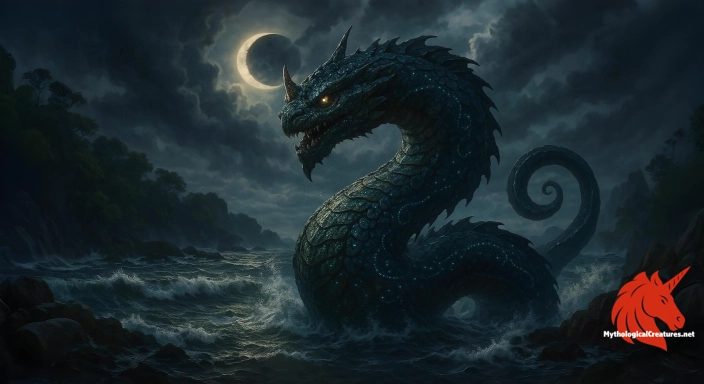
Bakunawa
Bakunawa - Integral to ancient Filipino rituals and calendrical systems, symbolising the mysterious cycles of nature.
Origins & First Encounters
The Bakunawa is a majestic creature from Philippine mythology known for its association with the moon and celestial phenomena. Believed to be a moon-eating dragon, it has long fascinated local communities with its power to swallow a celestial body whole. Its origins can be traced back to ancient oral traditions that interwove nature and the divine, forming a composite image of cosmic mystery. Early narratives depict the creature as both a destructive force and a keeper of the natural order, deeply embedded within indigenous ritual practices. The Bakunawa's myth was often used to explain natural events such as lunar eclipses, earthquakes, rains, and strong winds. Rituals led by babaylan priestesses were closely tied to its movements, linking the creature to a geomantic calendar that regulated seasonal cycles and agricultural rites. This rich tapestry of lore illustrates not only the supernatural might of the Bakunawa but also its role in maintaining the balance between chaos and order in the universe. As time passed, the legend evolved to encapsulate dual themes of creation and destruction, reflecting the transformative forces of nature. Ultimately, the Bakunawa remains a potent symbol of cosmic balance and the enduring mystery of life in the Philippine cultural landscape.
Source Texts & Tale Variants
Traditional narratives and oral lore form the backbone of the Bakunawa’s mythology, with tales passed down through generations in various Philippine communities. Storytellers and priestesses preserved accounts of the moon-eating dragon through engaging oral recitations and dramatic ritual performances. Some of the earliest attestations of the Bakunawa come from indigenous folklore while later accounts were documented by early travellers and chroniclers. These sources describe its role in triggering eclipses and other natural phenomena with a vivid blend of allegory and mysticism. Variants of the myth differ from one region to another, with some communities portraying the creature as a fearsome destroyer while others invoke its image as a guardian of cosmic order. Oral epics, folk songs, and ritualistic chants have all contributed to a diverse body of narratives that celebrate and question the Bakunawa's enigmatic nature. As external influences increased through trade contacts, elements of the story were reinterpreted and integrated with broader Asian mythological themes. The dynamic nature of these accounts demonstrates how folklore can adapt and thrive, ensuring that the Bakunawa remains a living part of cultural memory. In essence, the multiplicity of sources enriches the myth and highlights the interplay between historical tradition and creative reinterpretation.
Form & Powers
Descriptions of the Bakunawa over the centuries reveal a creature of striking and complex physical form. Traditionally, it is depicted as a colossal serpent with a sinuous, elongated body that effortlessly traverses the sky and the underworld. One of its most distinctive attributes is a single, prominent horn on its snout, which adds an element of mystical power and uniqueness. The creature’s body is often imagined to be covered in intricately patterned scales that shimmer with shifting hues, reminiscent of the deep night sky or the reflective surface of water. Its looped tail is rendered in art with a spiralling elegance symbolising the cyclical nature of time and the recurring phases of the moon. In many renditions, the Bakunawa’s eyes exude an intense, otherworldly glow, while its entire form is imbued with a sense of both awe and foreboding. Some interpretations include additional embellishments such as fin-like structures or subtle hints of winged forms, suggesting both aquatic and aerial prowess. The variance in its physical depiction also points to its evolution over time, with each rendition offering a unique perspective on its supernatural essence. Through these elaborate descriptions, the Bakunawa continues to captivate imaginations as a symbolic fusion of natural power and ethereal beauty.
Regional Faces
Across the Philippine archipelago, the portrayal of the Bakunawa exhibits notable regional variations that reflect local traditions and environmental influences. In Visayan regions, local lore often presents the creature as a celestial serpent whose appearance is intrinsically linked to the lunar cycle. In other parts of the islands, particularly in areas of Mindanao, the Bakunawa is depicted with an added layer of duality, symbolising both fertility and the potential for natural calamity. Unique regional adaptations sometimes introduce elements such as distinct markings or subtle shifts in body structure that correspond to the local cultural context. In many communities, ritual practices honouring the Bakunawa include colourful festivals and ceremonial dances that seek to appease its potentially disruptive force. These regional narratives are not static; they have been continuously reshaped by changing social conditions and environmental observations. The influence of neighbouring cultures, particularly through centuries of trade and exchange, has introduced new motifs into local depictions, blending indigenous beliefs with Hindu-Buddhist iconography. Consequently, the creature’s image has become a mosaic of interpretations, each coloured by the local relationship with nature and the cosmos. Such variations underscore the adaptability of the Bakunawa myth as it weaves itself into the diverse cultural fabric of the Philippines.
Cultural Parallels
When examined alongside mythological entities from other cultures, the Bakunawa reveals fascinating parallels that underscore a global human preoccupation with serpentine creatures and celestial events. Its overwhelming resemblance to the Naga of South Asia, with both beings sharing sinuous bodies and an affiliation with water and skies, is one striking example. Figures such as Rahu and Ketu in Hindu mythology, which also serve to explain the mysteries of eclipses, further echo the Bakunawa’s role in cosmic narratives. Similarly, the dragon motifs prevalent in various East Asian traditions offer complementary imagery that celebrates the intersection of nature and the supernatural. This cross-cultural synthesis highlights how disparate cultures have independently developed narratives that personify natural phenomena using formidable serpentine forms. Beyond physical similarity, there is a resonant thematic alignment in how these creatures embody the paradox of creation and destruction. In each tradition, the mythical serpent or dragon represents a duality—both nurturing and obliterative—mirroring the uncertainties of life and the vast forces of the universe. These parallels encourage a comparative exploration that enriches our understanding of how myth functions as a common language across human societies. Thus, the Bakunawa not only stands as a key figure in Philippine mythology but also as a participant in a broader narrative shared by many cultures across the world.
Legacy & Modern Evolution
The historical evolution of the Bakunawa reflects a dynamic interplay between ancient tradition and modern reinterpretation. Initially regarded as a fearsome devourer of the moon and a herald of natural upheaval, the Bakunawa's myth served as a means to explain otherwise inexplicable celestial events. Over time, increasing cultural exchange, particularly with South Asian influences, infused the legend with new layers of meaning and symbolism. Today, the creature has been embraced by contemporary artists and storytellers, who reimagine its narrative in ways that resonate with modern sensibilities. Modern depictions often elevate the Bakunawa from a mere explanation of natural phenomena to a broader symbol of cyclic renewal, transformation, and the intricate balance between order and chaos. This evolution is evident in various media, from digital art and films to literature and popular festivals that celebrate indigenous heritage. The myth has also found a place in academic and cultural dialogues that explore environmental and cosmic mysteries. In a modern context, the Bakunawa stands as a reminder of the timeless allure of myth; it continues to captivate those who seek to understand nature’s most profound secrets. Ultimately, the legacy of the Bakunawa is a vibrant testament to the enduring power of myth in shaping cultural identity and inspiring creative expression.
Interesting Fact
An intriguing aspect of the Bakunawa is its dual representation as both a natural phenomenon and a divine creature, with its movements once serving as an ancient calendar for the Filipino people.
Limited sponsor opportunity
One slot, carefully chosen partners
We only feature a small number of relevant sponsors at any time. If you create serious myth content, we would like to hear from you.
Partner with usQuick Creature Info
Origin:
Associations:
Our Mythic Legendary Rating:

Also Sometimes Known As:
Habitat:
Supernatural Powers:
Physical Attributes:
Abilities:
Behavior:
Lore:
Related Creatures, Tales or Lore
- NNāga
- RRahu
- KKetu
References
Discover Another Mythical Legend You May Not Have Heard Of?
Uncover the mysteries of ancient folklore and expand your knowledge of legendary beings from cultures around the world.
Dare to Meet the Aglaope....
-1dde7d3e-9ced-4297-9788-55805e36aff9_small.webp "Depiction of Aglaope")
Curated by the Mythological Creatures Team
Series editor: Mythological Creatures Directory
Primary desk: Asian & Pacific Myth Cycles Desk
(rev. November 2025)