
Berberoka: The Berberoka is a fearsome swamp creature from northern Luzon in the Philippines.
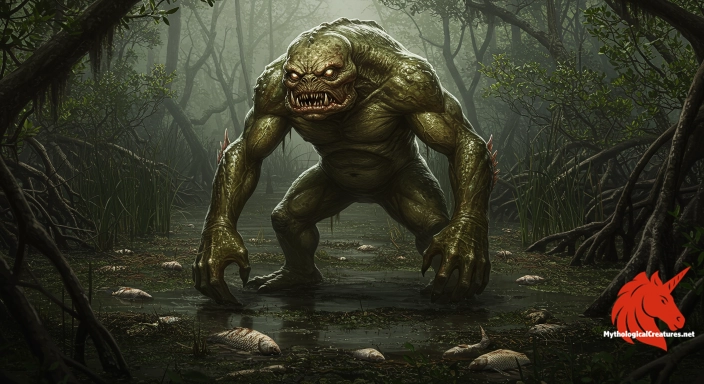
Berberoka
Berberoka - Serves as a cautionary tale about the dangers of swamps and the unpredictable nature of water, while its ironic fear of crabs adds a unique twist to its myth.
Origins & First Encounters
The Berberoka is a formidable presence within the mythic landscape of northern Luzon, described in local lore as a sinister water ogre that haunts the wetlands of provinces such as Apayao, Abra, and Ilocos Norte. It is a creature born of fascination and fear, emerging from the mists of ancient traditions and the remote swamps of the Philippines. Its legend is deeply interwoven with the natural rhythms of water and drought, reflecting the delicate balance between life and devastation. Villagers have long recounted tales of how this entity manipulates water to create deadly traps for the unwary, leaving behind scenes of eerie calm and unnatural desolation. The creature's origins appear to echo ancient animistic practices, where every natural element was suffused with spirit and meaning. Its ability to drain a pond of water, only to later release it in a lethal surge, symbolises nature’s dual capability for sustenance and destruction. Over generations, the recounting of these episodes has transformed the Berberoka into a complex emblem of environmental mystery and warning. Even as modernity reshapes cultural narratives, the myth endures as a reminder of nature’s unpredictable power. The creature’s eerie influence extends beyond mere physical menace, becoming a rich allegory for the forces that shape rural life. Its enduring legacy underscores an intimate and often ambivalent relationship between humanity and the natural world.
Source Texts & Tale Variants
Local oral traditions remain the bedrock of the Berberoka’s myth, with village elders and storytellers passing down detailed narratives that span generations. Written records, though sparse, appear in colonial-era manuscripts and early folkloric compilations that allude to water spirits and mysterious swamp entities. Many of these early accounts focused on its formidable ability to suck the very life from a pond, making for dramatic and cautionary storytelling. Variants of the tale have been collected by anthropologists, who note that the creature’s portrayal varies from a malevolent demon to a capricious spirit of nature. In several renditions, the Berberoka is depicted as unleashing water with explosive force, comparable to a mighty fire hose, a detail that has intrigued both locals and scholars alike. Some narratives even recount a peculiar fear of crabs, an ironic twist that enriches its mysterious character. The diversity in these accounts demonstrates how local experiences and environmental cues shape myth over time. Ritual songs and folklore chants dedicated to water spirits also reference similar attributes, further cementing the creature’s place in the cultural fabric. Each version of the story adds layers to its mythos, ensuring that no single account can fully encapsulate its eerie presence. This complex array of sources provides a window into the nuanced ways in which communities have historically related to the natural and supernatural realms.
Form & Powers
The Berberoka is envisioned as a creature whose physical form merges the grotesque with the uncanny, reflecting its aquatic dominion. It is commonly imagined as possessing a large, hulking frame that is both muscular and unsettlingly flexible, perfectly adapted to its swampy environment. Its skin is thought to be slick and mottled, taking on the cold, damp hues of murky water that help it blend seamlessly into its surroundings. Many depictions suggest that it has elongated limbs ending in webbed digits, which not only facilitate swift movement in water but also add to its feral appearance. The creature’s eyes are often described as deep and reflective, holding an inscrutable expression that hints at ancient wisdom and predatory instinct. An enormous, gaping mouth capable of expelling torrents of water has been noted in various illustrations, emphasising its dual function as both a seducer and destroyer. Some accounts portray it as bearing remnants of aquatic vegetation clinging to its form, as though nature itself sought to disguise its true identity. There is also a suggestion that its size and shape might be fluid, sometimes appearing as a shadowy giant and other times as a smaller, more deceptive presence. This mutable anatomy reinforces the idea that the Berberoka is not bound by natural law alone, but is rather a shape-shifter aligned with the unpredictable moods of water. Overall, its physical characteristics evoke a being that is as transient as the mist and as formidable as a raging flood.
Regional Faces
The legend of the Berberoka shows considerable variation across different locales in northern Luzon, mirroring the diverse landscapes and cultural influences of the region. In Apayao, tales depict it as a spectral guardian of isolated marshlands, a lone figure whose presence signals both danger and the strange beauty of untamed nature. In Abra, storytellers often imbue the creature with a mystical air, suggesting that it commands not only water but also the weather itself, thereby linking it to the cycles of seasonal change. Meanwhile, in Ilocos Norte, narratives tend to focus on its role as a relentless hunter that drains ponds with sudden, violent surges, highlighting its capacity for instant retribution. Local adaptations frequently incorporate unique characteristics, such as the creature’s ironic fear of crabs, which serves as a quirky counterbalance to its otherwise formidable powers. Some communities even hint at an organised ecosystem of water spirits, wherein the Berberoka plays a central role alongside other lesser-known entities. These regional variations underscore how the natural environment and local customs can alter the nuances of a myth, ensuring that each retelling resonates with the particularities of its community. Whether seen as a protector of sacred water sources or as a harbinger of drought, the creature’s portrayal adapts seamlessly to both highland and coastal settings. Such eclectic reinventions not only preserve the legend but also amplify its relevance in the everyday lives of local inhabitants. In this way, the Berberoka’s myth remains both profound and perpetually adaptable.
Cultural Parallels
The Berberoka shares many thematic similarities with water-based entities found in diverse mythological traditions around the globe. Like the kappa of Japan, it is intricately connected to bodies of water and exhibits both mischievous and malevolent traits. Its potent ability to manipulate water recalls legends of European water ogres and river monsters that have long symbolised nature’s destructive as well as nourishing aspects. In various folklore across Asia and Africa, similar creatures emerge as both guardians and harbingers of natural calamity, reflecting humanity’s awe of water’s dual nature. However, the Berberoka stands out with its unique narrative twist—a methodical draining and violent release of water that adds a dynamic, almost theatrical quality to its mythos. The creature is also comparable to other amphibious deities, whose mutable forms and supernatural powers emphasise the blurred boundary between the mortal world and the elemental forces of nature. While many water beings are portrayed predominantly as capricious, the Berberoka’s story underscores a calculated interplay of lure and ambush, marking it as a more complex figure. This cross-cultural comparison highlights how different societies use similar natural imagery to address universal fears and environmental mysteries. In each instance, water serves as a potent symbol of life's uncertainty, and the Berberoka embodies that intricate dance between creation and destruction. Thus, its myth resonates far beyond local boundaries, echoing a universal narrative about the power of water.
Legacy & Modern Evolution
Over time, the myth of the Berberoka has transformed from a localized cautionary tale into a broader symbol reflecting human interaction with nature. Early depictions rooted in oral tradition painted it as a singular terror of the swamps, a force that could drain ponds and ensnare the unwary with its water-wielding abilities. In modern reinterpretations, however, the creature has evolved into a complex emblem of environmental volatility and ecological imbalance. Contemporary artists and writers frequently draw upon the Berberoka’s image to comment on the fragile state of natural water systems in an era of climate change and resource scarcity. The once purely fearsome legend now carries an added layer of metaphorical significance, representing both the benevolence and destructiveness of water. Cultural events and local festivals in northern Luzon have embraced the myth, transforming it into a subject for creative expression and communal reflection. Modern retellings often highlight the irony inherent in a creature that, while embodying the power of water, is also vulnerable to something as modest as a crab. This evolution in portrayal reflects a broader trend in folklore where ancient stories are reimagined to address contemporary societal concerns. The Berberoka's enduring appeal lies in its ability to mirror the intricate and often ambivalent relationship between humankind and nature. Its legacy, therefore, continues to inspire both awe and introspection, standing as a timeless reminder of nature’s unpredictable essence.
Interesting Fact
An ironic twist in its legend is the creature's morbid fear of crabs, despite its overwhelming mastery over water.
For myth educators and toolmakers
Built a resource for mythology learners?
If you offer courses, teaching tools, or research platforms focused on myth and folklore, consider a discrete placement on our reference pages.
Introduce your resourceQuick Creature Info
Origin:
Features:
Associations:
Our Mythic Legendary Rating:

Habitat:
Supernatural Powers:
Physical Attributes:
Abilities:
Behavior:
Weaknesses:
Lore:
References
Discover Another Mythical Legend You May Not Have Heard Of?
Uncover the mysteries of ancient folklore and expand your knowledge of legendary beings from cultures around the world.
Dare to Meet the Udug....
Curated by the Mythological Creatures Team
Series editor: Mythological Creatures Directory
Primary desk: Asian & Pacific Myth Cycles Desk
(rev. November 2025)