
Bicorn and Chichevache: Bicorn and Chichevache are satirical, fabulous beasts from European medieval and Renaissance literature.
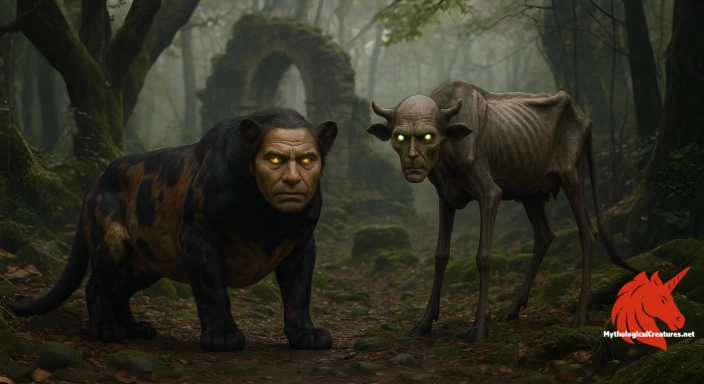
Bicorn and Chichevache
Bicorn and Chichevache - They serve as a satirical commentary on societal expectations of husbands and wives.
Origins & First Encounters
Emerging from the vibrant milieu of medieval and Renaissance satirical works, Bicorn and Chichevache captivate as emblematic figures intertwined with humour and critique. They were crafted during an era when mythic allegories offered a mirror to the social and marital conventions of the time. In these narratives, each creature was imbued with characteristics that symbolised particular virtues and vices within intimate relationships. Bicorn, a curious amalgam of feline, bovine, and human features, and Chichevache, noted for her lean form and contrasting nature, were not merely beasts but vehicles of pointed commentary on gender roles. Their first attestation in European literature reflects both a witty tradition and a subtle protest against the social mores of the period. The mythical beasts served as open canvases for authors who wished to illustrate the excesses and deficiencies within societal expectations. Their origins are firmly rooted in a cultural context that celebrated the absurdity of rigid marital ideals while exploring the interplay between nature and human behaviour. The duality of their portrayals underscores the era’s penchant for using fantastical imagery to illuminate real-world dilemmas. An enduring facet of their legacy is the way in which they continue to symbolise the ironic twists that underpin human relationships. The narrative of these creatures remains a testament to the enduring power of allegory in critiquing societal norms.
Source Texts & Tale Variants
Primary literary sources attest to the presence of Bicorn and Chichevache in a wide array of European satirical texts that spanned the Middle Ages and the Renaissance. Manuscripts and humorous bestiaries provided an imaginative playground for authors to explore themes of marital virtue and vice through the depiction of these fantastical beings. The accounts, steeped in allegory, often varied in detail, with one text portraying Bicorn as a plump, formidable beast and another describing Chichevache as a gaunt and malnourished figure. Several accounts subtly weave these creatures into larger discussions on social balance, using their exaggerated features as metaphors for the contrasts in human relationships. Variants found within regional manuscripts demonstrate the flexible nature of their stories, where details shift according to the satirist’s needs. Some narratives focus more on the moral symbolism, while others incorporate vivid physical descriptions to enhance the comedic effect. The recurrence of these creatures across disparate texts underscores their popularity in a period when moral commentary was couched in the fantastical. The blend of fact and fable allowed medieval audiences to engage with these stories on multiple levels, from simple amusement to deeper philosophical reflection. Each variant, though different in nuance, contributes to a composite picture of a more general cultural scepticism towards conventional marital roles. Collectively, these sources provide a textured and multifaceted understanding of how Bicorn and Chichevache contributed to a rich tradition of literary satire.
Form & Powers
Bicorn is visually striking, depicted as a confluence of a panther’s sleek power, a cow’s robust form, and a human-like face that confers an element of unsettling familiarity. His physique is accentuated by a plump, well-fed body that symbolically mirrors the abundance of the virtues he consumes. Artists have often emphasised formidable muscular contours juxtaposed with an expressive, almost ironic countenance. In contrast, Chichevache emerges as a creature of stark austerity, with a gaunt and emaciated frame that starkly highlights her portrayal as ever-starving. Her visual depiction leans towards a lean, angular structure, suggesting an existential hunger that mirrors her symbolic narrative. Both creatures are rendered with surreal features, creating an uncanny blend of human emotion and animalistic instinct. The attention to exaggerated anatomical details in their portrayals serves to underscore their allegorical functions. Variations in size and shape among different works hint at the artistic licence taken by medieval illustrators to dramatise moral imbalances. Each physical attribute, from texture to proportion, is carefully curated to evoke a specific moral response from the viewer. Their bizarre yet meticulously arranged forms invite ongoing reinterpretation in the cultural imagination.
Regional Faces
Regional depictions of Bicorn and Chichevache reveal a dynamic interplay between local traditions and overarching satirical themes in medieval Europe. In the north, portrayals often imbue these creatures with a heightened sense of mystique, aligning them with local folklore that celebrates nature’s whimsical justice. Southern European traditions, particularly those in France and Italy, tend to layer their images with additional traits that emphasise the absurdity of marital expectations. Different cultures have adapted the beasts' defining characteristics to mirror their distinct social and moral landscapes, thus amplifying their allegorical potency. In some regions, Bicorn is shown with even more pronounced hybrid elements, while Chichevache’s gaunt appearance is exaggerated to elicit stronger commentary on the scarcity of idealised virtues. The variation in their visual and narrative depiction serves as a reflection of local attitudes towards marriage, gender roles, and societal norms. Regional artistic renditions frequently introduce local symbolism, enriching the creatures with context-specific meanings. Such adaptations allowed the original satirical commentary to resonate more deeply with regional audiences. The regional diversity in depiction highlights the creatures’ flexibility as mythic symbols, able to traverse cultural boundaries. Ultimately, their varied regional portrayals emphasize how folklore evolves to reflect the mores and anxieties of its audience over time.
Cultural Parallels
When compared to other mythological entities, Bicorn and Chichevache occupy a unique space that blends satire with morality. Unlike more singularly themed creatures found within traditional bestiaries, their dualistic nature invites a comparative analysis with complementary figures across diverse mythologies. This pairing is reminiscent of dual embodiments in lore where contrasting forces, such as abundance and deprivation, serve to illuminate moral lessons. Their characteristics can be paralleled with hybrid creatures in other cultures that similarly merge disparate animal and human traits. In the broader context of European mythology, they diverge from the archetypal dragons or unicorns by embodying specific social critiques rather than universal fantastical ideals. The layered complexity of their portrayals invites comparisons with allegorical figures in both Eastern and Western traditions, where symbolism is used to dissect human conduct. They share common ground with other satirical constructs that challenge conventional narratives about gender and power dynamics. The interplay between their physical excesses and deficiencies echoes the dualities found in classical mythologies and fables across different cultures. Their role as moral exemplars provides an intriguing counterpoint to more straightforward heroic or monstrous figures. In this regard, Bicorn and Chichevache contribute to a broader conversation about how mythological narratives reflect and critique societal values.
Legacy & Modern Evolution
The legacy of Bicorn and Chichevache is one of transformation, mirroring broader shifts in cultural and social thought from the medieval era to the present. Originally conceived as mordant critiques wrapped in fantastical imagery, they have traversed centuries to become symbols open to re-interpretation and modern reflection. Their evolution from niche literary devices in satirical manuscripts to recognised icons in contemporary culture underscores an enduring fascination with allegory. With each reinterpretation, these creatures acquire new layers of meaning, reflecting the changing values surrounding marital roles and gender expectations. Modern artists and writers have found in them a rich source of inspiration, frequently reimagining their forms and roles in ways that speak powerfully to today’s audiences. Contemporary retellings often employ irony and postmodern sensibilities, playing with the stark juxtapositions that originally defined them. Academic discussions and popular media alike now examine their embodied critique as a mirror to modern social anxieties. As symbols, they have been repurposed in debates about authenticity, societal norms, and the complexities of relationships. Their narrative remains a fertile ground for exploring the intersection of myth, art, and social commentary. Today, Bicorn and Chichevache stand as enduring examples of how myth can continually evolve while retaining its capacity to illuminate the human condition.
Interesting Fact
An intriguing aspect of these creatures is that their physical condition directly mirrors the availability of their intended victims, offering a humorous yet biting commentary on marital demographics.
For myth educators and toolmakers
Built a resource for mythology learners?
If you offer courses, teaching tools, or research platforms focused on myth and folklore, consider a discrete placement on our reference pages.
Introduce your resourceQuick Creature Info
Features:
Our Mythic Legendary Rating:

Habitat:
Supernatural Powers:
Physical Attributes:
Abilities:
Behavior:
Lore:
Related Creatures, Tales or Lore
References
Discover Another Mythical Legend You May Not Have Heard Of?
Uncover the mysteries of ancient folklore and expand your knowledge of legendary beings from cultures around the world.
Dare to Meet the Gajamina....

Curated by the Mythological Creatures Team
Series editor: Mythological Creatures Directory
Primary desk: Hellenic & Ancient Mediterranean Desk
(rev. November 2025)