
Bishop-fish: The bishop-fish, also known as the sea bishop, is a legendary marine creature recorded in European folklore since the 16th century.
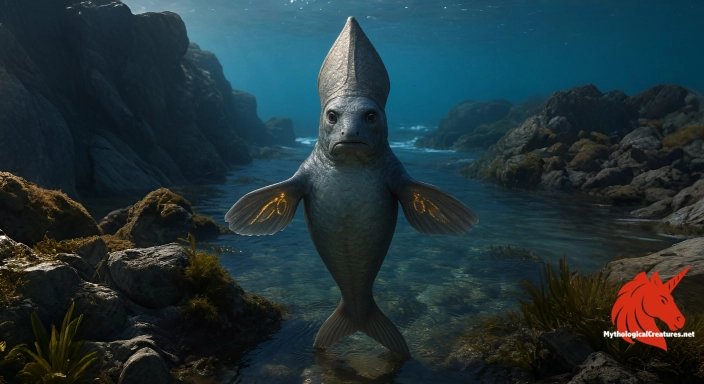
Bishop-fish
Bishop-fish - Represents the interplay of natural rarity and miraculous intervention, symbolizing divine presence in maritime legends
Origins & First Encounters
The bishop‐fish emerges in early modern lore as a mysterious aquatic creature that infuses nature with a hint of the divine. Born from stories circulating in the 16th century, it first made its mark in the courts of Poland where rulers were captivated by its peculiar demeanour. The creature’s debut in legend is marked by an encounter that featured interactions with both royalty and clerical figures, lending credence to its sacred reputation. Historical accounts describe it as displaying deliberate gestures that mimic the formalities of religious ceremony. Its presence in maritime folklore points to a broader tradition of attributing supernatural qualities to sea life. The bishop‐fish stands out for bridging the material and the spiritual, inviting interpretations that weave together elements of ecclesiastical ritual and natural wonder. Although details remain fanciful, its first attestation fuels ongoing debates about the intersection of myth and reality. Over time, the creature has captivated imaginations by symbolising the human impulse to assign deeper meaning to unexplained phenomena.
Source Texts & Tale Variants
Primary records of the bishop‐fish originate from a variety of 16th century sources that recount curious encounters with the enigmatic creature. Early narratives describe an episode in Poland where the animal was presented before authority figures, capturing the attention of both secular and religious elites. One prominent account details how a group of Catholic bishops were shown the creature and witnessed its almost ritualistic gestures, a moment that blurred the lines between the miraculous and the mundane. The bishop‐fish also appears in reports of a capture near Germany in 1531, where the animal’s refusal to feed culminated in its untimely demise. In the renowned fourth volume of Conrad Gesner’s Historiae animalium, the creature is both described and illustrated, further cementing its place in the annals of natural history. Other variants of the story stress different aspects of the animal’s conduct, especially its ability to perform a symbolic sign of the cross before returning to its watery habitat. Diverse accounts reflect regional embellishments and editorial liberties, indicating that the legend evolved with each retelling. As such, the primary sources do not merely document an anomalous animal but also weave a narrative rich in allegory and religious imagination.
Form & Powers
The bishop‐fish is often depicted with an elongated, streamlined body that hints at its marine origins while simultaneously evoking a sense of ritual grandiosity. Visual accounts suggest that it bears markings which resemble the ornate headwear of a bishop, an uncanny detail that fuels its namesake. Its head is frequently illustrated with a curvature reminiscent of a mitre, lending the creature an anthropomorphic quality that blurs the boundaries between man and nature. Fins and flippers are described in a way that implies the graceful drape of ecclesiastical vestments, enhancing its enigmatic appearance. The skin of the bishop‐fish is traditionally portrayed as having a pallid, almost spectral glow that accentuates its mysterious aura. Variations in size are noted across different accounts, with some depictions presenting a creature robust enough to command attention, yet inherently delicate in its movements. Detailed engravings from early natural histories emphasise a body pattern that some modern scholars liken to the intricate embroidery found on ceremonial robes. The fusion of natural marine anatomy with symbolic religious features continues to fascinate both art enthusiasts and historians alike.
Regional Faces
Regional interpretations of the bishop‐fish reveal an intriguing tapestry of local adaptations and cultural reinterpretations. In Polish records, the creature’s arrival is imbued with a sense of regal and sacred import, reflecting the country’s historical intertwining of state and church. Conversely, German traditions place a greater emphasis on the ominous aspects of the tale, recounting how one specimen met a tragic end after refusing sustenance. In several northern European narratives, the bishop‐fish is viewed not only as a marvel but also as an omen, where its appearance signals the intertwining of divine retribution and natural order. Rural folklore often presents the creature as a liminal figure that bridges the gap between the known world and the mysteries lurking beneath the waves. Local myths sometimes cast the bishop‐fish as a mediator between the spiritual and the earthly realms, a role that underscores the duality of its existence. Variations in its portrayal—from a benign miracle to a forewarning of misfortune—demonstrate how different communities have woven the creature into their cultural fabric. Ultimately, the regional diversity in its legend underscores the adaptability of myth to reflect localized religious and societal preoccupations.
Cultural Parallels
The bishop‐fish occupies a unique niche among legendary creatures, standing alongside various mythic beings that meld natural form with spiritual symbolism. Much like other curious entities chronicled in medieval bestiaries, it serves as an emblem of the period’s fascination with the interplay between divine intervention and natural phenomena. Its depiction, with gestures of piety and hints of mortal form, draws parallels to other miraculous animals that appear in stories meant to inspire introspection and reverence. The creature’s blend of terrestrial and celestial attributes invites comparisons with the miraculous appearances recorded in diverse cultural traditions from both European and non‐European mythologies. Similar to how certain sea serpents and fantastical marine animals are portrayed, the bishop‐fish challenges the boundaries of natural history and invites allegorical interpretation. In a broader cross-cultural context, its traits resonate with myths where the mysterious forces of the sea are seen as extensions of the divine plan. Identifiable motifs include the transformation of everyday nature into symbols of higher moral truths and the manifestation of sacred signs through the animal kingdom. This comparative lens highlights how diverse cultures have employed the motif of an enigmatic, symbolic creature as a means to explore existential questions and divine mysteries.
Legacy & Modern Evolution
The legacy of the bishop‐fish has evolved considerably from its early modern descriptions to its place in contemporary myth and cryptozoology. Its initial portrayal in texts such as Gesner’s Historiae animalium established a foundation for centuries of debate and reinterpretation. Over time, the story has been reframed through the lens of both scepticism and wonder, reflecting shifts in cultural attitudes towards the miraculous. During the Enlightenment, rationalist inquiries led many to view the bishop‐fish as a likely misidentification of a known marine species, prompting discussions about the boundaries of natural history versus myth. In more modern narratives, the creature has been embraced by cryptozoologists who are keen to explore the shadowy edges of marine biology and folklore. Contemporary depictions balance scientific inquiry with an appreciation for the rich allegorical traditions that surround the bishop‐fish. Its enduring presence in art, literature, and popular culture testifies to a lasting fascination with stories that blur the lines between phenomenal natural events and supernatural wonder. Today, the bishop‐fish remains a potent symbol, a reminder of a time when the natural world was seen as a repository of divine mystery and eternal intrigue.
Interesting Fact
The bishop-fish is one of the few legendary creatures that exhibits behavior mimicking human religious practices, blurring the lines between myth and miracle.
For publishers and studios
Your next readers are already here
Many of our visitors are looking for books, campaigns, and resources that deepen their journey into myth. Position your title or setting here.
Discuss a placementQuick Creature Info
Features:
Associations:
Our Mythic Legendary Rating:

Also Sometimes Known As:
Habitat:
Supernatural Powers:
Physical Attributes:
Abilities:
Behavior:
Weaknesses:
Lore:
Related Creatures, Tales or Lore
- GGrimaldi Scaled Squid
- SSea Serpent
- MMermaid
References
Discover Another Mythical Legend You May Not Have Heard Of?
Uncover the mysteries of ancient folklore and expand your knowledge of legendary beings from cultures around the world.
Dare to Meet the Nila....
-6e585ad9-6114-4e88-8d61-e5d8ec7a4b56_small.webp "Depiction of Nila")
Curated by the Mythological Creatures Team
Series editor: Mythological Creatures Directory
Primary desk: Northern & European Folklore Desk
(rev. November 2025)