
Boiuna: Boiuna, also known as Black Snake or Cobra-Grande, is a giant mythological serpent from Brazilian folklore.
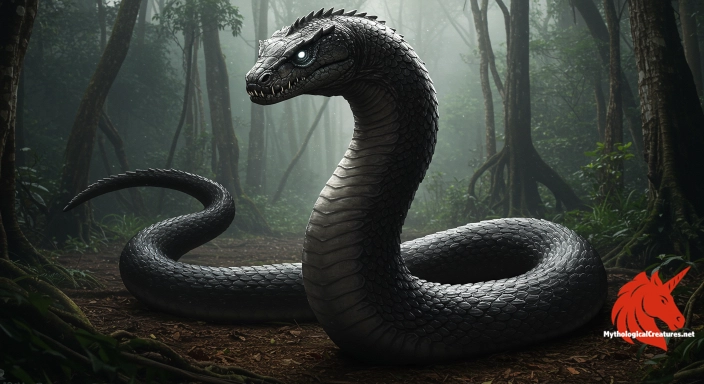
Boiuna
Boiuna - Represents the untamable forces of nature and serves as a cautionary figure in local myths
Origins & First Encounters
Boiuna emerges as one of the most enigmatic figures in Brazilian mythology, a creature whose presence has captivated the imagination of indigenous communities and later generations alike. Its captivating names, including 'Black Snake' and 'Cobra-Grande', evoke images of an immense, powerful serpent coiled within the depths of Brazil’s lush landscapes. Rooted in oral traditions, the legend of Boiuna began as whispered tales passed from elder to youth along the banks of mighty rivers and dense forests. Early encounters with this mythic being were recorded in the murmurs of local lore, blending a reverence for nature with the element of fear. The creature is often seen as a symbol of the untamed wilderness that characterises the vast Amazon, reflecting the intimate connection between the environment and cultural identity. Over time, European chroniclers also noted these accounts, adding layers of complexity to its mythos. The narrative of Boiuna intertwines the natural and the supernatural, encapsulating the mystery of a force that is both awe-inspiring and unpredictable. Its legend continues to shape the way nature is revered and feared in Brazil, embodying the perennial dance between beauty and menace in the natural world. Each telling reinforces its status as a timeless emblem of Brazilian folklore.
Source Texts & Tale Variants
The stories that feature Boiuna have been handed down through generations, forming an intricate mosaic of oral tradition and early recorded accounts. Indigenous communities, particularly in regions dense with riverine and forested landscapes, contributed rich variations of the tale through ritual and narrative. Although no single seminal text defines Boiuna’s legend, fragments of the lore are preserved in early colonial diaries and local narratives. These historical snippets recount sightings and encounters that imbued the creature with an aura of both divinity and dread. Different storytellers have portrayed Boiuna variously as a guardian spirit of water and a harbinger of nature’s fickle moods. The transmitted versions often carry subtle differences, echoing the unique experiences and values of their communities. Some accounts detail transformations of the serpent’s aspect, while others emphasise its role in heralding significant natural events. The diversity in these oral and written records speaks to the adaptive nature of myth, moulded by cultural exchange and regional experiences. Such accounts have made Boiuna a composite symbol, reflecting the dynamic interplay between myth and history in Brazil.
Form & Powers
Boiuna is frequently depicted as a titanic serpent whose very presence challenges the boundaries of nature’s scale. Its dark, lustrous skin is often described as having a sheen reminiscent of polished obsidian, melding effortlessly with the night and shadow. The creature’s sinuous form appears to ripple with both grace and latent menace, its body undulating like water itself. Legends portray its eyes as glowing with an almost otherworldly light, suggesting deep mystery and ancient wisdom. Along its back, subtle iridescent markings may shimmer with a spectral quality, hinting at powers beyond the physical realm. Some narratives even speak of slender, elegant ridges that accentuate the creature's formidable silhouette. The immense size attributed to Boiuna gives it a nearly mythical ability to blend into its natural habitat, whether it be a winding river or a dense forest. Each detail of its anatomy, from the texture of its scales to the fluid motion of its form, invites awe and caution in equal measure. In every retelling, the physical grandeur of Boiuna serves as a reminder of nature’s capacity to create beings of sublime beauty and terrifying power.
Regional Faces
The depiction of Boiuna shifts subtly as it moves through the varied landscapes of Brazil, acquiring different nuances in each locale. In the heart of the Amazon, local traditions often render the creature as a majestic deity of water, whose presence signals both abundance and potential peril in the environment. Some northern communities portray it as benevolent, an integral spirit that governs the lifecycle of the rivers and the surrounding flora. Conversely, in other regions the serpent is cast in a more ominous light, warning of natural disasters or times of ecological imbalance. Among tribes in the interior, Boiuna is sometimes revered as a mystical guardian whose intervention can either bestow fortune or bring caution. Its alternate name, Mboiaçu, reflects language-specific interpretations that emphasise its large and enigmatic form. Regional storytellers often blend the mythical with the real, merging swift river currents with the undulating movements of an immense snake. This geographical reimagining highlights not only environmental differences but also the varied cultural attitudes towards nature's raw power. In all these retellings, Boiuna remains a potent symbol, its character refracted through the vivid prism of local experience.
Cultural Parallels
The legend of Boiuna resonates on a global scale, sharing common threads with mythological serpents found in diverse cultures. Much like the colossal Jörmungandr of Norse mythology encircling the world, Boiuna embodies both the destructive and the regenerative forces of nature. In South Asia, serpentine beings known as Naga similarly straddle the realms of divinity and mortal dread, reflecting life’s complex dualities. Parallels can also be drawn with the Rainbow Serpent of Australian Aboriginal lore, whose multifaceted symbolism mirrors the balance between creation and destruction found in Boiuna’s narrative. Across these mythologies, great serpents serve as vivid metaphors for nature’s unpredictable power as well as its nurturing aspects. The cross-cultural pattern of venerating giant serpents underscores a universal human response to the wild and awe-inspiring aspects of the natural world. Such comparisons highlight how serpentine figures often function as bridges between the earthly and the divine. Each tradition infuses its version with local colour and significance, yet the underlying motif remains strikingly consistent. In this way, Boiuna not only exemplifies Brazilian folklore but also contributes to a broader, interconnected tapestry of myth across continents.
Legacy & Modern Evolution
Over the centuries, the myth of Boiuna has undergone a significant evolution, reflecting changes in societal values and environmental consciousness. Initially rooted in ancient indigenous lore, the creature’s narrative has been adapted and reimagined by successive generations. Early colonial records often portrayed Boiuna with an aura of mystical danger, intertwining it with the formidable aspects of Brazil’s natural world. In more recent times, contemporary literature and visual arts have embraced the serpent’s legend, reinterpreting it with modern allegories around ecological imbalance and the power of nature. Artists and filmmakers are drawn to its imposing imagery, using Boiuna as a metaphor for the environmental challenges that continue to shape Brazil’s identity. The creature’s depiction has also found new life in popular culture, where it is often portrayed as a symbol of resilience and the eternal conflict between progress and preservation. This transformation from folklore to modern myth illustrates the dynamic nature of cultural narratives. Today, Boiuna stands as a reminder of the rich, ever-changing interplay between myth, nature, and human interpretation. Its legacy continues to inspire both admiration and caution, urging contemporary society to heed the lessons embedded in its ancient story.
Interesting Fact
Boiuna is one of the most enigmatic and striking figures in Brazilian mythology, merging natural ferocity with an almost supernatural aura and serving as a reminder of nature’s profound mystery.
Curated sponsor space
One subtle banner. Thousands of myth lovers.
We offer a small number of curated sponsor spots for relevant books, courses, games, and art. No clutter, just well-matched partners.
Partner with usQuick Creature Info
Origin:
Features:
Associations:
Our Mythic Legendary Rating:

Also Sometimes Known As:
Habitat:
Supernatural Powers:
Physical Attributes:
Abilities:
Behavior:
Lore:
Related Creatures, Tales or Lore
References
Discover Another Mythical Legend You May Not Have Heard Of?
Uncover the mysteries of ancient folklore and expand your knowledge of legendary beings from cultures around the world.
Dare to Meet the Ixion....
Curated by the Mythological Creatures Team
Series editor: Mythological Creatures Directory
Primary desk: Americas & Indigenous Traditions Desk
(rev. November 2025)