
Cornflower Wraith: The Cornflower Wraith, also known as Habernitsa, is a noon demon from Slavic folklore who appears in rural fields during midday.
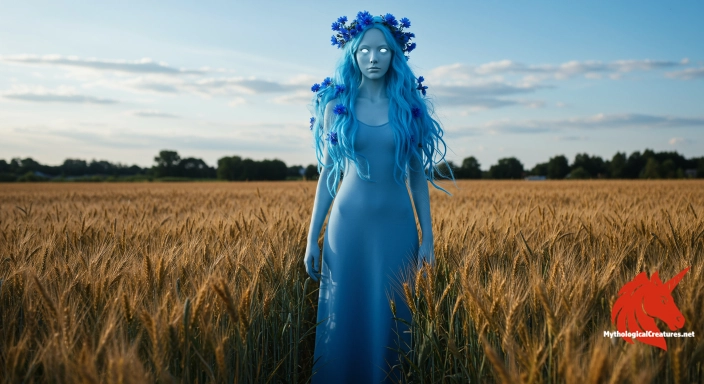
Cornflower Wraith
Cornflower Wraith - The Cornflower Wraith serves as a cautionary figure in rural communities, ensuring that farmers and workers respect the sanctity of the grain and the natural order.
Origins & First Encounters
The Cornflower Wraith, known also by the names Habernitsa and Lady Cornflower, emerges from the rich tapestry of Slavic mythology as an enigmatic spirit of the fields. Her legend is rooted in the agrarian traditions around Prudnik and reflects the deep connection between rural life and the supernatural. Many early attestations reveal that she was conceived as a cautionary presence for those who disrespected the sanctity of the harvest. Over time, her myth became intertwined with everyday practices, especially the ritual of taking a midday break during Angelus. Her character symbolises both beauty and warning, encapsulated in the image of a young, ethereal woman clad in azure garments and adorned with cornflowers. This persona was crafted from a blend of oral tradition and local lore, making her a living part of the cultural landscape. The evolving narrative of the Cornflower Wraith mirrors changing social values and the eternal tension between human industry and nature. Ultimately, her story continues to inspire awe and serves as a poignant reminder of the delicate balance between work, rest, and respect for the natural world.
Source Texts & Tale Variants
Early records of the Cornflower Wraith are found in regional folklore archives and the oral traditions passed down in rural communities. Texts from Polish and Russian sources refer to her as Chabernica and Habernitsa respectively, each adding distinct nuances to her character. Various ballads and local narratives capture her as both a gentle guardian of the fields and a fearsome agent of retribution. Folklorists have collected numerous variants that depict her interventions during the noonday hours, underscoring her unpredictable nature. Many of these accounts emphasise her involvement in punishing those who trample grain or misuse tools, thereby preserving the sanctity of the harvest. Some versions even blend her role with that of the Lady Midday, creating a complex figure who rewards caution and punishes negligence. The diversity in sources suggests a long history of regional reinterpretations, with nuances added by different communities over the centuries. In spite of the scarcity of formal historical documentation, the oral testimonies and collected tales provide a rich and varied portrait of this mythic figure. These collected sources together offer a layered insight into a myth that continues to fascinate both scholars and enthusiasts alike.
Form & Powers
Visual depictions of the Cornflower Wraith consistently highlight a figure of delicate yet unnerving beauty. She is portrayed as a young, slender woman whose attire is a flowing robe in a striking shade of azure, reminiscent of a clear midday sky. Cornflowers are intricately woven into her hair, providing a natural embellishment that reinforces her connection to the fertile fields. Observers often note the almost translucent quality of her skin, which lends her an otherworldly presence. Various renderings capture her with an ethereal glow, as if she is illuminated from within by the very light of the sun. Her eyes are described as deep and mesmerizing, capable of simultaneously enchanting and instilling fear. The elegance of her form combines with hints of spectral unpredictability, symbolising the merging of natural beauty and latent menace. Some local illustrations introduce subtle variations such as a soft luminescence around her, which suggests her transient existence within the realm of the living. In every depiction, the blend of fragility and formidable power remains central to her mysterious allure.
Regional Faces
The Cornflower Wraith holds a prominent place across various Slavic traditions, with her identity undergoing regional adaptations that reflect local customs and beliefs. In Polish accounts, she is commonly known as Chabernica, with narratives that emphasise her protective role over the harvest. In Russian folklore, where she appears as Habernitsa, her portrayal often incorporates deeper mystical elements that align with local superstitions. The region of Prudnik, in particular, sustains a detailed and vivid portrait of the wraith, linking her directly to the cycles of agricultural life. In some communities, her temperament is depicted with a dual nature—both nurturing and vengeful—depending largely on the moral context of human actions. Local rituals, such as the pausing of work at midday, have been adapted specifically to avert her perceived wrath. These regional variations not only highlight the adaptability of her legend but also illustrate how local environments and social practices shape mythic figures. The diverse interpretations serve as a testament to the dynamic exchange between traditional belief systems and everyday rural life. Overall, her recurring presence in regional folklore underscores the enduring power of local myth and the importance of cultural heritage.
Cultural Parallels
The narrative of the Cornflower Wraith resonates with a number of similar mythic figures found throughout Europe, creating a fascinating network of cultural parallels. Her identity as a noonday spirit shares striking similarities with the figure of Lady Midday, a motif that appears in various folklore traditions with a dual role of both punisher and protector. Her association with the agricultural cycle finds echoes in other agrarian deities and nature spirits who oversee the sanctity of the land. In several Celtic traditions, for instance, figures crowned with natural motifs function in roles that are both guardian and avenger of the harvest. The visual imagery of flowing robes and floral adornments connects her with other regional mythologies of Eastern Europe, where nature is personified in both tender and formidable forms. Similar to other earth-bound spirits, her narrative functions as a moral compass, guiding societal norms regarding the treatment of nature. Comparative analysis reveals that while the details of her appearance or actions may vary, the underlying theme of retribution against disrespect is universal. This cross-cultural reflection offers an enriched perspective on how different societies interpret the interaction between man and nature. Thus, the Cornflower Wraith stands as a compelling example of a mythic archetype that transcends regional boundaries while embracing unique cultural characteristics.
Legacy & Modern Evolution
The evolution of the Cornflower Wraith over the centuries illustrates how traditional myths can transform to remain relevant in modern society. What began as a cautionary tale in rural communities has blossomed into a broader symbol of the need to respect nature and labour. Over time, her image has been reinterpreted by artists, writers, and cultural historians, creating a multifaceted legacy that bridges past and present. Contemporary representations often blend her mythic origins with current environmental concerns, casting her as a guardian against ecological degradation. Festivals and local rituals continue to invoke her spirit, particularly through practices that emphasise a mid-day pause and the appreciation of the land. Modern literature and digital media have also embraced her narrative, ensuring that her myth remains vibrant in the public imagination. This enduring reinterpretation reflects how ancient symbols can be repurposed to critique modern societal challenges. The transformation of her image—from a feared demon to an emblem of natural balance—illustrates the dynamic nature of folklore. Ultimately, the Cornflower Wraith endures as a timeless reminder of the delicate interplay between human actions, natural cycles, and cultural continuity.
Interesting Fact
It is particularly fascinating that the Cornflower Wraith combines an aura of delicate beauty with a capacity for brutal punishment, embodying the paradoxical nature of many mythological figures who both charm and terror in equal measure.
Advertising opportunity
Showcase your mythology project
We offer limited sponsor placements for books, courses, games, and creators aligned with our audience.
View partnership optionsQuick Creature Info
Features:
Associations:
Our Mythic Legendary Rating:

Also Sometimes Known As:
Habitat:
Supernatural Powers:
Physical Attributes:
Abilities:
Behavior:
Lore:
Related Creatures, Tales or Lore
- LLady Midday (Poludnitsa)
- RRusalka
- BBaba Yaga
References
Discover Another Mythical Legend You May Not Have Heard Of?
Uncover the mysteries of ancient folklore and expand your knowledge of legendary beings from cultures around the world.
Dare to Meet the Oshiroibabā....
Curated by the Mythological Creatures Team
Series editor: Mythological Creatures Directory
Primary desk: Northern & European Folklore Desk
(rev. November 2025)