
Cyhyraeth: The cyhyraeth is a ghostly spirit from Welsh mythology, known for its disembodied, doleful moaning that heralds impending death.
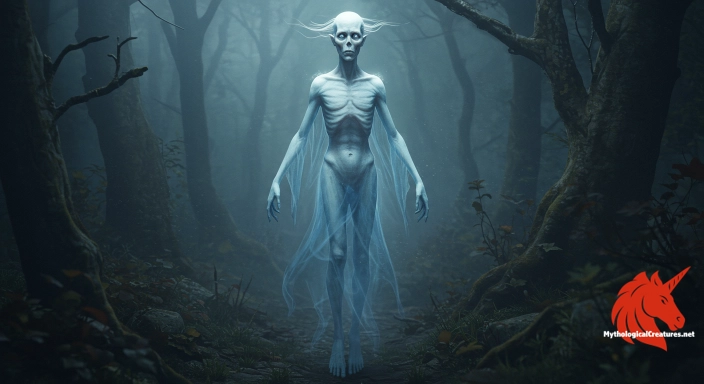
Cyhyraeth
Cyhyraeth - Acts as an omen warning of impending death and serves as a cultural symbol of mortality in Welsh folklore.
Origins & First Encounters
Cyhyraeth emerges as an enigmatic spectre within Welsh mythology, its presence woven into the fabric of local belief and cultural identity. This ghostly voice, long feared and revered, is said to act as a portent of imminent death, echoing through the mists of ancient Wales. Its origins are buried deep in the Celtic past, with oral traditions and regional lore providing the primary testimony of its existence. Early attestation in local ballads and folklore suggests that the cyhyraeth has long been seen as an intermediary between the living and the supernatural realm. Communities in eastern Dyfed and along the coast of Glamorganshire have nurtured an enduring belief in the spirit, linking its mournful cries to moments of profound loss. The phenomenon’s elusive nature places it in a liminal space where myth and reality converge, captivating listeners with its sorrowful melody. Over time, its tale has been adapted and enriched by successive generations, reflecting changing attitudes toward death and the unknown. The cyhyraeth thus stands as a culturally potent symbol of life's fragility and the inevitability of fate.
Source Texts & Tale Variants
Historical records of the cyhyraeth are dispersed among medieval Welsh manuscripts and oral histories, where its disembodied moan is meticulously recounted. In these primary sources, the ghostly voice is depicted as making three successive, waning sounds that portend death. Narratives collected in local folk songs and reborn in later compilations reveal a complex tradition that intermingles natural phenomena with supernatural omen. Certain texts highlight its connection to the River Tywi in eastern Dyfed, while others focus on coastal encounters along Glamorganshire. Variants of the story extend its influence to those Welsh natives residing far from home, suggesting a broader interpretive reach. Although the archival evidence is fragmentary, its persistent thematic resonance underscores the cyhyraeth’s role as a messenger of mortality. Supplementary records from the 18th and 19th centuries have enriched its lore, blending anecdotal testimony with ritualistic warning. Each version, whether inscribed in ancient documents or passed down orally, contributes layers of mystery to the legend, ensuring its continual evolution across time and communities.
Form & Powers
While the cyhyraeth is experienced primarily as an auditory phenomenon, the details of its physical manifestation are intimated through the environment rather than a corporeal form. Listeners describe its voice as doleful and resonant, evoking the laboured sighs of one who is grievously ill. This spectral entity is most vividly felt during moments when the natural world seems to hold its breath; a sudden chill or an inexplicable rustling of leaves may accompany its mournful call. Its sound, repeated in a threefold cadence, is often interpreted as a diminishing echo of a presence that grows fainter with each passing moment. In the absence of a body, the cyhyraeth is sometimes represented indirectly through atmospheric phenomena such as swirling mists or fleeting shadows at the edge of perception. The interplay between the intangible voice and the physical environment lends the legend a dynamic and multi-sensory quality. Even in artistic renditions, attempts are made to capture its ephemeral nature through abstract forms and muted colours. Such descriptions, though metaphorical, provide a vivid impression of a spirit whose physicality is felt more than seen, emblematic of the timeless border between life and the beyond.
Regional Faces
Regional interpretations of the cyhyraeth vary widely, reflecting the diverse cultural landscapes within Wales. In eastern Dyfed, the spirit is intimately linked with the flowing currents of the River Tywi, where its sorrowful moan is said to mingle with the sound of the water. Along the coast of Glamorganshire, local folklore imbues the voice with maritime significance, often positioning it as a harbinger of shipwrecks and coastal calamities. These coastal accounts frequently pair the cyhyraeth with a mysterious corpse-light, an ethereal glow that deepens its ominous reputation. In rural communities, variants of the legend speak of the spirit echoing for those who find themselves far from home, thus offering a personal connection to individuals' sense of displacement. Local storytellers have further adapted the myth to integrate regional natural landmarks and weather phenomena, tying the spirit’s lament to the landscape itself. Such localized renditions have not only enriched the narrative but also ensured its survival through participatory community memory. The regional differences in the portrayal of the cyhyraeth underscore the flexibility of folklore to mirror the unique character of each community, making the spirit a living part of Wales's cultural heritage.
Cultural Parallels
Comparative analysis reveals that the cyhyraeth shares intriguing similarities with other Celtic and European spectral phenomena. Its role as a precursor to death is akin to that of the Irish banshee, whose plaintive cries similarly warn of impending loss. Unlike the banshee, however, the cyhyraeth remains an auditory presence without a fixed gender or corporeal manifestation, adding a distinctive ambiguity to its identity. This difference highlights the unique ways in which local traditions adapt supernatural symbols to their cultural context. The legend also finds echoes in the Scottish Cailleach, especially in the portrayal of nature and death interwoven within folklore. Beyond the Celtic realm, analogous figures in European myth—spirits that foretell misfortune through ghostly communications—further attest to a widespread human impulse to give voice to the mysteries of mortality. Each tradition tailors these spectral omens to reflect its own environmental and social realities, yet the underlying motif of a warning cry persists across borders. This cross-cultural resonance not only reinforces the universal themes of life and death but also deepens our understanding of how disparate cultures perceive the boundaries of the natural world. In this light, the cyhyraeth occupies a significant position in a larger tapestry of mythological entities that warn, mourn, and perpetuate the enigma of existence.
Legacy & Modern Evolution
Over the centuries, the depiction of the cyhyraeth has transitioned from a simple omen of death to a rich symbol imbued with cultural introspection. Its haunting call, once confined to whispered warnings among rural folk, now resonates through modern reinterpretations in art, literature, and digital media. Contemporary Welsh narratives often reframe the cyhyraeth as both a lament for the departed and a profound metaphor for the transient nature of life. In museum exhibits and folklore festivals, the spirit is celebrated as an enduring aspect of the nation’s mythic heritage, drawing interest from both local communities and international scholars. Modern adaptations have explored its ambiguous identity, sometimes portraying it as a melancholic guardian of memory rather than merely a harbinger of doom. This evolution mirrors wider societal shifts in understanding death—not as an end, but as an intrinsic part of a cyclical, ever-renewing existence. Artistic renditions now capture its sorrowful beauty through evocative imagery that blends historical motifs with contemporary aesthetics. As Wales continues to rediscover and redefine its mythological past, the cyhyraeth remains a potent symbol that bridges ancient tradition with modern artistic expression. Its legacy is a dynamic reminder of the power of folklore to evolve while still speaking to fundamental human experiences.
Interesting Fact
An intriguing aspect of the cyhyraeth is its triadic sound pattern, which uniquely mirrors the gradual approach of death and has persisted as a potent symbol in Welsh folklore.
Mythology commerce, done carefully
Align your store with our global myth audience
If you sell myth-inspired jewellery, prints, decks, or collectibles, we can feature your brand without overwhelming the reading experience.
Partner with usQuick Creature Info
Features:
Our Mythic Legendary Rating:

Habitat:
Supernatural Powers:
Physical Attributes:
Abilities:
Behavior:
Lore:
Related Creatures, Tales or Lore
- IIrish Banshee
- SScottish Cailleach
- GGwrach y Rhibyn
References
Discover Another Mythical Legend You May Not Have Heard Of?
Uncover the mysteries of ancient folklore and expand your knowledge of legendary beings from cultures around the world.
Dare to Meet the Teka-her....
Curated by the Mythological Creatures Team
Series editor: Mythological Creatures Directory
Primary desk: Northern & European Folklore Desk
(rev. November 2025)