
Diting: Diting is a divine mythical steed in Chinese Buddhism, famed as the mount of bodhisattva Kṣitigarbha.
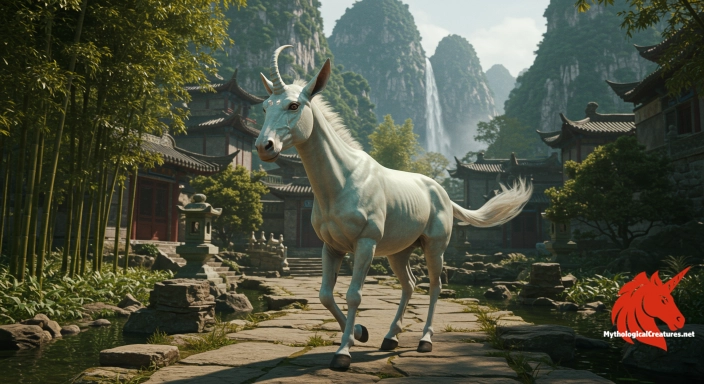
Diting
Diting - Symbolises the ability to receive universal information and the transmission of moral values among believers.
the legend in five swipes.
the legend in five swipes.
How did Diting enter folklore?
Diting is a divine mythical creature that proudly serves as the revered steed of the bodhisattva Ksitigarbha, standing as a unique symbol in Chinese Buddhist art and iconography. It emerged from a tradition rich with spiritual allegory and celestial microcosms, reflecting the profound interconnectedness of the cosmos. Its earliest attestations are found in artistic renditions and subtle textual allusions within temple artefacts, suggesting an ancient lineage of mythic symbolism. The creature is celebrated for its singular horn, which many believe channels cosmic energies and serves as a bridge between the mortal and divine realms. Equally striking are its hound-like ears, envisioned as sensitive receivers attuned to the moral vibrations of the universe. This combination of features has allowed Diting to captivate believers by embodying both the power to protect and the grace to communicate profound truths. In local narratives, its attributes extend to roles of both guardian and warrior, highlighting a delicate balance between martial prowess and spiritual benevolence. Over time, Diting has evolved into an enduring emblem of spiritual vigilance and ethical discernment, sustaining an allure that transcends temporal boundaries.
Diting: How the Tale Was Told and Retold
The myth of Diting is interwoven with a variety of ancient Buddhist texts and temple inscriptions that hint at its role as a cosmic messenger. Many of the original narratives, though not always detailed in canonical scriptures, are preserved in the artistic embellishments found in temple murals and statuary. Folklore passed down through generations has further enriched its legend, offering diverse interpretations of its abilities and divine purpose. Some early manuscripts suggest a creature that adapts its form to convey both protective strength and mystical insight. Variants of the legend can be discerned in regional commentaries, where nuanced differences emphasise distinct aspects such as its communicative horn and vigilant ears. Vietnamese sources, for instance, have introduced modifications that resonate with local cultural and spiritual sensibilities. Storytellers have frequently highlighted its dual capacity to both shield the faithful and disseminate cosmic intelligence. Over time, these narratives have amalgamated in a mosaic of interpretations, each adding layers to Diting’s mystique. Contemporary retellings continue to explore these themes, ensuring that its myth remains a dynamic part of religious discourse.
How would you recognise Diting?
Diting is portrayed as a majestic creature whose form combines the elegance of a divine steed with the mystique of celestial phenomena. Its most defining feature is the singular, spiralling horn that glows with an almost otherworldly luminescence. This horn, varying in depiction from a slender tapering structure to a more robust emblem of power, symbolises the channeling of cosmic information. Richly detailed artistic renderings capture its ears, which are elongated and reminiscent of a hound’s, yet imbued with the metaphorical ability to receive distant, ethereal signals. The creature’s body is often illustrated with a sleek, lustrous coat that shimmers with subtle hints of celestial light, articulating both grace and strength. Intricate markings sometimes trace along its flanks, suggesting a narrative of moral dualities and the convergence of benevolence and martial energy. Every contour of Diting’s physique has been carefully designed to reflect not only physical swiftness but also a deep-seated spiritual acuity. Artists have rendered its eyes with an intensity that mirrors the creature’s profound cosmic insight, while its flowing mane and poised posture add to its regal allure. These elements together create an image that is simultaneously dynamic, ethereal, and replete with symbolic depth. The composite of these physical details positions Diting as a paragon of divine beauty and an embodiment of transcendent harmony.
What regional forms of Diting exist?
Across different regions in East Asia, the portrayal of Diting adapts to local cultural contexts while retaining its essential characteristics as a divine mount. In China, its image is closely associated with the celestial mandate to disseminate spiritual wisdom, with its horn and ears being the primary conduits of this sacred power. In Vietnam, where it is known as Đế Thính, the creature is often celebrated for its enhanced role as a guardian against malevolent forces, reflecting regional beliefs in protective spiritual entities. Local artistic traditions have enriched its depiction by incorporating native motifs and vibrant symbolic colours, which emphasise both its martial and mystical attributes. In these regions, Diting often appears alongside other sacred figures in temple art, reinforcing local narratives about the communication between the mortal realm and the cosmos. Variations in the myth focus on different aspects of its capabilities, such as the ability to transmit moral discernment or its prowess in celestial battles. The creature's adaptable symbolism has made it a popular figure for integrating indigenous spiritual ideals with established Buddhist doctrine. Despite the local nuances, the fundamental imagery of a single horn and attuned ears remains consistent throughout, underscoring a shared cultural appreciation. These regional interpretations both diversify and deepen the myth, ensuring that Diting resonates with a broad spectrum of spiritual traditions. Ultimately, the regional variations serve to affirm its role as a timeless emblem of cosmic and moral order.
Diting: Related Figures Across Cultures
Diting’s multifaceted nature invites comparison with a range of mythological creatures that also serve as bridges between the divine and the earthly. Its prominent single horn evokes immediate parallels with the unicorn, a creature celebrated in Western lore for symbolising purity and enchanted wisdom. However, unlike the gentle unicorn, Diting is imbued with a dynamic duality that allows it to both attack and defend, thus marking a distinctive departure from Western narratives. In the context of Chinese mythology, its attributes echo those of the Qilin, another legendary creature associated with auspicious omens and moral virtue. Likewise, the concept of a divine steed is not unique to Chinese tradition, with figures such as Sleipnir from Norse mythology illustrating similar roles in connecting mortal realms to those of the gods. This comparison emphasises a shared cultural fascination with otherworldly mounts that carry both symbolic and functional significance. Other indigenous legends also echo the theme of a creature delivering cosmic or moral messages, thereby reinforcing a universal archetype. The comparative analysis reveals that while cultural contexts may differ, many societies have looked to such creatures as embodiments of hidden cosmic forces. Diting, in its synthesis of protective warriorship and spiritual communication, thus occupies a unique yet globally resonant niche among mythic steed figures. Its evolution alongside other mythical incarnations highlights an enduring legacy of universal symbolism and cross-cultural intertextuality.
The Lasting Influence of Diting
The evolution of Diting’s visage over the centuries reflects a fascinating journey from ancient iconographic subtlety to modern graphic reimagination. Initially established in the early phases of Chinese Buddhist art, its portrayal was modest yet potent, serving as a silent yet imposing messenger of celestial wisdom and moral clarity. As cultural dynamics shifted, artists and scholars progressively elaborated on its features, imbuing Diting with an added vibrancy that mirrored both martial vigour and spiritual transcendence. In recent eras, its imagery has experienced a resurgence in modern art, digital media, and literature, where it symbolizes a bridge between the ancient and the innovative. Modern interpretations have embraced its role as a guardian that not only protects but also communicates timeless ethical lessons in a rapidly evolving world. The creature’s depiction now often incorporates motifs of connectivity and technological metaphors, resonating with today’s fascination for cosmic communication and digital networks. Such reimagining has allowed Diting to secure a place as a cultural emblem that negotiates between traditional values and contemporary artistic exploration. Temples, festivals, and modern exhibitions frequently showcase its image, highlighting how ancient myth continues to inform modern spiritual and aesthetic expressions. This enduring legacy ensures that Diting remains a vibrant symbol of both ancient wisdom and current creative vision. In this way, the creature endures as a testament to the transformative power of myth in a world that continually redefines its sacred narratives.
Interesting Fact
An intriguing aspect of Diting is how its single horn is interpreted as a cosmic receiver, symbolising the unification of sensory perception and divine communication in one striking feature.
Mythological Treasures
Chinese Beasts: A field guide to the dragons and demon kings of Chinese myth
From river dragons to demon kings, with the legends that shaped five thousand years of storytelling.
Norse Sagas: A field guide to the beasts of the Viking world
Drawn from the saga accounts themselves, with the powers, weaknesses and doom of each being set out.
Egyptian Legends: A field guide to the gods and monsters of ancient Egypt
Guardians of the living and devourers of the dead, with the role each played in judgement.
the legend in five swipes.
Mythology commerce, done carefully
Align your store with our global myth audience
If you sell myth-inspired jewellery, prints, decks, or collectibles, we can feature your brand without overwhelming the reading experience.
Partner with usQuick Creature Info
Features:
Our Mythic Legendary Rating:

Also Sometimes Known As:
Habitat:
Supernatural Powers:
Physical Attributes:
Abilities:
Behavior:
Lore:
References
Discover Another Mythical Legend You May Not Have Heard Of?
Uncover the mysteries of ancient folklore and expand your knowledge of legendary beings from cultures around the world.
Dare to Meet the Onza....
The Mythological Creatures Book Series
Yokai, Greek, Norse, Egyptian & Chinese. Five illustrated field guides to the creatures the old stories either warned or told you about.
Curated by the Mythological Creatures Team
Series editor: Mythological Creatures Directory
Primary desk: Asian & Pacific Myth Cycles Desk
(rev. November 2025)