
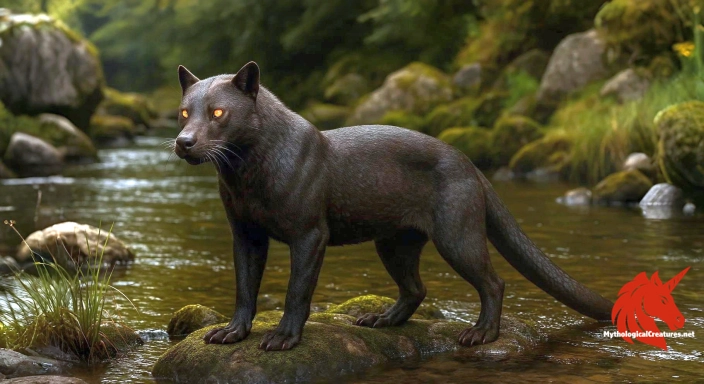
Dobhar-chú: The Dobhar-chú, or King Otter, is a mythological creature from Irish and Scottish folklore known for its hybrid form that combines features of a dog, otter, and sometimes a fish.
Dobhar-chú
Dobhar-chú - Embodies the mysterious blend of land and water elements and holds a unique place in Celtic oral tradition.
the legend in five swipes.
the legend in five swipes.
Dobhar-chú: How the Story Began
The Dobhar-chú emerges from the mists of Celtic tradition as a creature both mysterious and formidable, woven deeply into the fabric of Irish and Scottish folklore. Its name, meaning 'water dog' or 'water hound', immediately hints at its dual nature as both canine and aquatic. Born in the ancient oral traditions of a people closely tied to their wild, watery landscapes, the creature's first attestation is found not on parchment but in the spoken word of generations. Its presence in rural lore evokes the untamed spirit of lochs, rivers, and estuaries, where nature’s power is both revered and feared. The creature’s dual identity as both protector and ominous portent reflects the complex relationship between human communities and the natural world. In the absence of extensive written records, the legend has been passed down through song and story, preserving an aura of mystery that continues to captivate. Over time, artists, storytellers, and local custodians have embellished its myth, ensuring that its enigmatic legacy endures. Its narrative is closely entwined with an ancient cultural reverence for water, embodying both the nurturing and destructive forces of nature. Overall, the Dobhar-chú stands as a symbol of the ineffable qualities of wild places, its very existence a reminder of the delicate balance between beauty and danger in the natural world.
The Source Texts Behind the Dobhar-chú
Despite the scarcity of written documents detailing its existence, the Dobhar-chú has been robustly sustained in the realms of oral history and local tradition. Early mentions are found in community recitations and folk narratives rather than classical manuscripts, leading to a multiplicity of story variants. Various storytellers have passed the legend through generations, each adding their own embellishments to the creature’s mythos. In some accounts, the creature is portrayed as a benign guardian of freshwater sources, while in others it is a formidable omen of impending misfortune. Travellers’ tales and regional ballads from rural Ireland and Scotland have further enriched its complexity, contributing disparate details that sometimes conflict but always intrigue. Occasional references in 19th-century folklore compilations hint at a wider cultural fascination during periods of Celtic revival. This rich tapestry of narrative variants has allowed the creature to evolve in tandem with the shifting values and concerns of local communities. Even where texts remain sparse, the numerous oral accounts serve as a living archive, each retelling reinforcing the creature’s enigmatic allure. The persistent nature of these stories underscores the power of oral tradition in preserving cultural identity. Ultimately, the diverse and sometimes contradictory narratives offer a multifaceted insight into how communities have historically grappled with the mysteries of the natural world.
How did the old accounts describe the Dobhar-chú?
The physical depiction of the Dobhar-chú is a study in enchanting duality, blending canine and aquatic characteristics in a seamless yet uncanny form. Descriptions often highlight a sleek, streamlined body reminiscent of an otter, crafted for swift movement through water. The creature’s fur is reputedly dense and water-resistant, providing it with a natural armour against the elements while also adding a regal sheen to its appearance. Some traditions suggest that its body may also display subtle fish-like elements, such as a tapered shape and a slightly scaled texture along its lower limbs. Its head is usually portrayed with the alert eyes and pointed ears characteristic of a hound, yet there is often an indefinable quality that hints at a more mystical origin. Tales recount that its eyes sometimes gleam with an eerie luminescence, a feature that seems to capture the moonlight on stormy nights. The extremities, including webbed claws, are emphasised as adaptations that enhance its swimming prowess and assert its dominion over watery domains. Variations in size are noted across different accounts, with some describing a creature of modest dimensions and others portraying a more imposing, almost monstrous figure. This duality in physical description reinforces its nature as a hybrid, straddling the boundary between the everyday and the supernatural. Altogether, these detailed portrayals have contributed to an image that is as visually arresting as it is steeped in symbolic meaning.
Which regions tell stories of the Dobhar-chú?
Across the varied landscapes of Ireland and Scotland, the Dobhar-chú takes on distinct regional flavours that mirror local beliefs and natural settings. In Ireland, the creature is often intertwined with the mysticism of secluded lakes and winding rivercourses, where it is sometimes seen as a guardian spirit of vital water sources. Scottish tellings, on the other hand, frequently bestow upon it the title of King Otter, a nod to a more noble or even regal interpretation of its character. Local adaptations sometimes transform the creature from a mere water-bound anomaly into a symbol of the unpredictable power of nature, reflecting the rugged and often harsh environment of the highlands. Regional narratives may also imbue it with varied moral attributes, ranging from benevolent protector to sinister harbinger of doom, depending on the prevailing fortunes of local lore. Coastal and inland communities alike have modified the tale, blending elements of ancient pagan belief with emerging Christian motifs. In some parts, the Dobhar-chú is mythologised as a shape-shifter, capable of assuming multiple forms that align with the mood of the natural setting. These adaptations underline the ways in which the creature’s myth has been reinterpreted to serve diverse communal and spiritual needs. The regional diversity adds a vibrancy to its legend, turning it into a mirror of the local human experience with nature. Overall, these variations highlight the rich interplay between geography, cultural identity, and the power of myth.
How does the Dobhar-chú compare to figures in other traditions?
The myth of the Dobhar-chú resonates with a number of cross-cultural tropes and serves as a bridge between disparate legendary archetypes found throughout European folklore. Its hybrid nature, merging elements of both terrestrial and aquatic life, invites comparisons with creatures such as the Scottish each uisge or even the spectral black dogs that roam the British countryside. Like many creatures of liminality, it embodies the tension between the familiar and the otherworldly, thus evoking broader themes of transformation and ambiguity. Parallels can also be drawn with other water-bound entities in world mythologies, where water not only nourishes life but also conceals danger beneath its surface. The creature’s dual attributes echo those of hybrid figures in Mediterranean and Northern European legends, reaffirming the universality of myths that explore the boundaries between land and sea. Similar to the way in which folklore often utilises animal hybrids to symbolise transitional states, the Dobhar-chú reflects human attempts to categorise and understand the natural world's enigmatic facets. Its recurring depiction as both protector and predator finds equivalence in legends where nature is revered and feared in equal measure. These cultural connections underscore the shared human fascination with beings that defy simple classification. In comparative terms, the Dobhar-chú serves as an emblem of the enduring interplay between myth and the mysteries of the natural environment. Overall, this cross-cultural analysis highlights how such legends can traverse geographical and temporal boundaries while retaining their essential symbolic power.
What does the Dobhar-chú mean to people today?
The evolution of the Dobhar-chú in myth has been a long and nuanced process, shifting from a shadowy figure of oral lore to an icon reimagined by modern storytellers and artists alike. In earlier traditions, the creature was depicted in a way that underscored the raw, untamed power of nature, its image sharpened by the absence of formal documentation and the mutable nature of oral storytelling. Later, during periods of cultural revival and national reawakening, the Dobhar-chú was embraced as a symbol of Celtic heritage and the mysterious beauty of the natural world. Contemporary reinterpretations have placed it in a modern context, where it frequently appears in literature, art, and even digital media as a figure of environmental significance. Its portrayal has grown increasingly complex, blending historical depictions with modern concerns such as ecological conservation and the preservation of cultural identity. Festivals, exhibitions, and regional folklore societies have all played a role in reintroducing the creature to a new generation. Modern depictions often highlight its hybrid beauty and the allure of its mysterious, liminal existence amidst waterlogged landscapes. Today, the Dobhar-chú continues to enthral both enthusiasts of ancient myth and those with an interest in cryptozoology. The creature’s legacy thus endures not only as a remnant of Celtic tradition but also as a living symbol that adapts to the evolving narratives of modern culture. Its re-emergence in casual ghost stories, graphic novels, and cultural festivals underlines an enduring appeal that transcends time.
Interesting Fact
Its unique hybrid characteristics and the legendary protective fur make the Dobhar-chú a fascinating emblem of the blend between natural and mystical elements in Celtic lore.
Mythological Treasures
Chinese Beasts: A field guide to the dragons and demon kings of Chinese myth
From river dragons to demon kings, with the legends that shaped five thousand years of storytelling.
Japanese Yokai: A field guide to the spirits and demons of Japanese folklore
Fifteen spirits, with the signs to watch for and what the old tales say to do if you meet one.
Greek Myths: A field guide to the monsters of ancient Greece
Every monster here earned its place in legend, and each gets a full page of artwork and the story behind it.
the legend in five swipes.
Advertising opportunity
Showcase your mythology project
We offer limited sponsor placements for books, courses, games, and creators aligned with our audience.
View partnership optionsQuick Creature Info
Features:
Associations:
Our Mythic Legendary Rating:

Also Sometimes Known As:
Habitat:
Physical Attributes:
Abilities:
Behavior:
Lore:
Related Creatures, Tales or Lore
- CCu Sith
- BBlack Shuck
- BBarghest
References
Discover Another Mythical Legend You May Not Have Heard Of?
Uncover the mysteries of ancient folklore and expand your knowledge of legendary beings from cultures around the world.
Dare to Meet the Aisha Qandicha....
The Mythological Creatures Book Series
Yokai, Greek, Norse, Egyptian & Chinese. Five illustrated field guides to the creatures the old stories either warned or told you about.
Curated by the Mythological Creatures Team
Series editor: Mythological Creatures Directory
Primary desk: Northern & European Folklore Desk
(rev. November 2025)