
Gloucester sea serpent: The Gloucester Sea Serpent is a massive, legendary sea creature reportedly sighted off the coast of Gloucester, Massachusetts and Cape Ann.
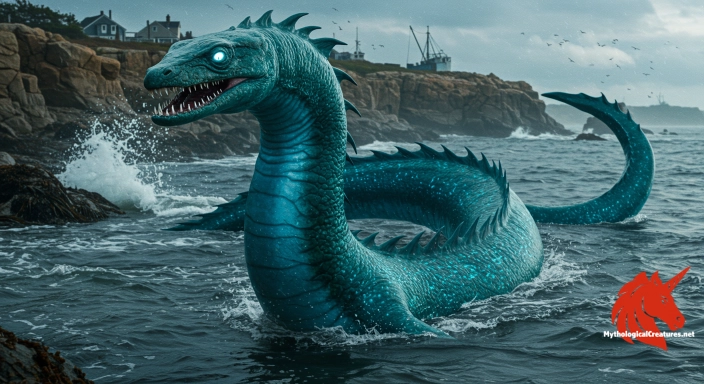
Gloucester sea serpent
Gloucester sea serpent - A longstanding subject of maritime lore, the Gloucester Sea Serpent embodies the mystery of the deep and continues to intrigue both locals and cryptid enthusiasts.
Origins & First Encounters
The Gloucester sea serpent is a storied creature that has long haunted the maritime horizons of Massachusetts, particularly in the vicinity of Gloucester and Cape Ann. Its legend, steeped in centuries of local lore, has captivated the imaginations of seafarers and residents alike. Early mentions, dating back to 1638 with an account by John Josselyn, laid the groundwork for the myth that would later be embellished by myriad firsthand reports. The creature's reputation received a significant boost during the early 19th century, when a series of dramatic sightings between 1817 and 1819 stirred both awe and debate. Local testimonies describe an immense, sinewy being marked by undulating humps and a mysterious presence that defies easy explanation. As these narratives were passed down through generations, the sea serpent came to embody the enigmatic character of the deep ocean. Its enduring fame reflects the delicate interplay between historical record and the imaginative retellings of coastal communities. The legend has grown to symbolise not only the power and mystery of the natural world but also the rich cultural narratives of New England. The sea serpent’s myth continues to inspire curiosity and artistic interpretation, serving as a reminder of the enduring allure of the unexplained. Its evolution in local memory underscores the human penchant for embracing mystery in the face of nature’s vast unknowns.
Source Texts & Tale Variants
Historical documentation of the Gloucester sea serpent is a mosaic of early colonial records, vivid eyewitness accounts, and persistent oral tradition. The first recorded mention, attributed to John Josselyn in 1638, provided a tantalising glimpse of a creature that would later dominate local folklore. In the wake of this early note, the early 1800s saw a surge in detailed reports emerging from Gloucester’s fishing community, each replete with colourful descriptions and personal testimonies. Varied newspaper articles and maritime diaries from that period recount encounters that oscillate between factual reportage and imaginative embellishment. Some accounts depict the creature with an almost supernaturally detailed anatomy, while other retellings focus on its elusive and spectral nature. The diversity of these reports has resulted in multiple story variants that, while differing in detail, all contribute to the creature’s mythic status. This corpus of sources is enriched by local folklore where tales of the serpent are passed down in storytelling sessions among sailors and fishermen. A number of these narratives were later compiled into regional manuscripts and local histories, each adding layers of both wonder and ambiguity. Even into the modern era, sporadic sightings and anecdotal evidence have reinforced the serpent’s presence in the collective memory. The aggregation of these various sources highlights a tradition where fact and fancy merge into an enduring legend.
Form & Powers
The Gloucester sea serpent is typically imagined as a long and sinuous creature accented by a series of pronounced, undulating humps that ripple along its body. Observers have often noted an elongated, somewhat reptilian head with eyes that, under certain conditions, seem to glow with an eerie luminescence. Its body appears to be covered in scales or, at times, a smooth, almost wet skin that blends with the dark blues and murky greens of its oceanic habitat. Detailed descriptions frequently remark on the contrast between its sinuous form and the stately movement it exudes in the water. Additional features, such as fin-like appendages or a tapering, powerful tail, further underscore its aquatic capabilities and contribute to the mystery of its appearance. Variations in its reported size and colour add to the creature’s elusiveness, with some accounts suggesting mythically exaggerated dimensions. Artistic renderings over the years have captured these shifting details, often highlighting both the creature’s raw, prehistoric form and its surreal adaptation to modern seascapes. The interplay of light and water in eyewitness accounts sometimes results in descriptions that seem almost painterly or impressionistic. Such physical portrayals evoke a blend of natural beauty and latent menace, inviting onlookers to both admire and fear its presence. Ultimately, the vivid and diverse depictions of its anatomy sustain the legacy of the Gloucester sea serpent as one of the most enigmatic figures in maritime lore.
Regional Faces
In the coastal communities of New England, the Gloucester sea serpent occupies a multifaceted role that shifts in character depending on local belief and tradition. Fishermen along the Cape Ann shoreline often recount encounters with the creature as if it were a native guardian or a mysterious harbinger of the sea. In some villages, the serpent is portrayed as a benevolent presence that ensures safe passage and bountiful catches, while elsewhere it is cited as an ominous portent of turbulent weather or misfortune. The local adaptations of its story often reflect the unique environmental conditions of each coastal area, with sightings influenced by the interplay of light, sea state, and regional maritime activity. Variations in its described colours, size, and behaviour underscore a fluid narrative that adapts to the specific cultural landscape of each community. These regional differences not only provide a rich tapestry of interpretations but also tie the legend closely to the lived experiences of those who depend on the sea. Artistic and oral traditions in the area have embraced the creature’s mutable characteristics, reinforcing its status as a cultural icon. As the tale is retold from port to port, nuances arise that align the serpent’s myth with local customs and collective memories. This regional diversity transforms the Gloucester sea serpent into more than just a singular creature—it becomes a dynamic symbol that resonates differently with each coastal settlement. In this way, the folklore surrounding the creature remains as shifting and unpredictable as the ocean itself.
Cultural Parallels
The Gloucester sea serpent occupies an intriguing space within the broader spectrum of global mythological creatures, drawing compelling parallels with other legendary aquatic entities. It shares a kinship with tales like Scotland’s Loch Ness Monster and the formidable sea serpents of Norse lore, each embodying the mystique of the unfathomable deep. The motif of a sinuous, elusive creature found in watery realms is a theme that echoes across cultures, often representing both nature’s beauty and its inherent dangers. Comparisons extend even to mythic dragons from diverse traditions, where serpentine forms often serve as metaphors for chaos and elemental power. What distinguishes the Gloucester legend is its intimate connection to the specific maritime environment of New England, entwining the creature’s narrative with the sea’s unpredictable temperament. Across the world, similar legends function as reflections of local uncertainties and the timeless allure of undiscovered realms. While the details and cultural interpretations may vary, the universal appeal of enigmatic sea beings continues to inspire storytellers and curious minds alike. The interplay between fear and fascination in these legends links communities around the globe in their shared pursuit of the unknown. Such cross-cultural analysis not only highlights the common threads of myth-making but also underscores the adaptability of these stories in different social and natural settings. In essence, the Gloucester sea serpent stands as a unique yet universally resonant emblem of the mysterious depths.
Legacy & Modern Evolution
The evolution of the Gloucester sea serpent from a whispered maritime myth to a celebrated emblem of local heritage illustrates the enduring power of folklore. Once confined to the realms of sailor’s tales and early colonial records, its story has continually adapted to suit the needs and imaginations of successive generations. The extraordinary wave of sightings reported in the early 19th century transformed it from a mere curiosity into a phenomenon that both terrified and enthralled the local populace. In modern times, sporadic claims of encounters and digital-age reinterpretations have breathed new life into this ancient narrative. Contemporary depictions in art, literature, and media have begun to fuse scientific scepticism with an appreciation for the myth’s historical allure. The sea serpent now serves as a cultural touchstone in coastal tourism, inspiring festivals, local exhibits, and community lore that celebrate maritime mystery. Its portrayal has shifted from a feared omen to a celebrated, if enigmatic, symbol of the region’s rich nautical tradition. Advances in technology and social media have allowed both believers and casual enthusiasts to document and discuss their experiences, perpetuating its legend in an increasingly globalised context. Over time, the Gloucester sea serpent has come to encapsulate the timeless dialogue between human curiosity and the unknowable forces of nature. As a result, its legacy endures, continuously reshaped by modern interpretations while remaining a poignant link to a storied past.
Interesting Fact
An interesting observation about the Gloucester Sea Serpent is that, despite advancements in marine exploration, reports of its sightings persist, highlighting the enduring allure and mystery of maritime legends.
For serious myth projects
Feature your work alongside the legends
From academic works to story-rich games, we highlight projects that respect world mythologies. Talk to us about a measured, long-term placement.
Start a conversationQuick Creature Info
Origin:
Features:
Associations:
Our Mythic Legendary Rating:

Habitat:
Supernatural Powers:
Physical Attributes:
Abilities:
Behavior:
Lore:
References
Discover Another Mythical Legend You May Not Have Heard Of?
Uncover the mysteries of ancient folklore and expand your knowledge of legendary beings from cultures around the world.
Dare to Meet the Pronoe....
Curated by the Mythological Creatures Team
Series editor: Mythological Creatures Directory
Primary desk: Americas & Indigenous Traditions Desk
(rev. November 2025)