
Gná and Hófvarpnir: Gnà is a Norse goddess renowned for executing divine errands across multiple worlds.
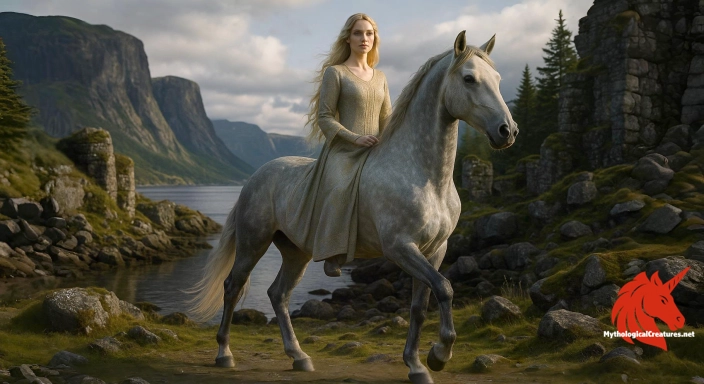
Gná and Hófvarpnir
Gná and Hófvarpnir - They exemplify the vital connection between the gods and the multiple realms of Norse cosmology, with Gnà executing divine errands and Höfvarpnir serving as her supernatural mount.
Origins & First Encounters
Gná emerges from the intricate tapestry of Norse mythology as a figure embodying both divine purpose and agile movement. She is tasked with the important role of conveying messages within and beyond the earthly realms for the goddess Frigg, which lends her an air of mystique and authority. Her origins are rooted in a tradition where duty and transcendence intertwine, echoing the broader themes of fate and cosmic balance. Early attestations of her character appear in medieval texts, most notably in the Prose Edda composed in the 13th century by Snorri Sturluson. Her presence in these narratives underscores a vibrant cultural context where the divine interacts directly with the mortal world. Throughout the mythological record, her swift traversal between worlds symbolises a bridge between the tangible and intangible. The subtle hints regarding her connection to fullness and abundance further enrich her enigmatic role. In a landscape where divine figures often encapsulate deep-seated human ideals, Gná is portrayed as both an intermediary and an embodiment of a higher order. Her myth continues to intrigue through the layers of symbolism that invite a multifaceted interpretation of her legacy.
Source Texts & Tale Variants
The account of Gná and her distinctive steed, Höfvarpnir, is primarily found in the canonical texts of Norse literature. The Prose Edda, composed by Snorri Sturluson during the 13th century, provides the principal narrative framework within which these figures operate. Although the texts themselves are succinct, they have spurred a wealth of alternative readings and story variants in later literary traditions. Some interpretations of the scant details have led to the suggestion that Gná may share attributes with other deities associated with fullness and communication. In addition, the intriguing epithet for Höfvarpnir has invited comparisons to other transcendent horses within the Norse corpus, such as Sleipnir. The sparse descriptions have been fertile ground for oral embellishments and regional retellings, each adding subtle nuances to their mythic roles. The muted direct references in the medieval texts have encouraged modern scholars to piece together a broader narrative from contextual clues. Over time, various folklore traditions have reimagined these characters, cementing their status as integral components of the mythological landscape. The enduring interest in these figures reflects both the layers of interpretative complexity in the original sources and the imaginative expansions that have followed.
Form & Powers
In artistic and literary portrayals, Gná is often envisioned as a graceful and limber deity whose presence is marked by a quiet yet compelling dynamism. Although explicit physical descriptions are limited, her portrayal suggests an ethereal beauty and the agility characteristic of a divine courier. The subtle elegance attributed to her form hints at a figure unbound by the constraints of mortal appearance. In juxtaposition, Höfvarpnir is described in terms that evoke an extraordinary, almost otherworldly physique. Known as the one whose hoofs are thrown about, his very essence implies a vigorous and unorthodox mode of movement. His ability to fly and tread the sea suggests that he possesses a unique amalgamation of strength, speed, and magical dexterity. Traditional imagery often calls to mind a sleek, shimmering coat paired with a dynamic presence that challenges the ordinary nature of horses. Both figures, though not exhaustively detailed in early texts, leave a lasting impression of fluidity and supernatural prowess in their physical manifestations. The interplay between Gná’s understated grace and Höfvarpnir’s kinetic energy creates a compelling visual contrast that continues to inspire creative interpretation.
Regional Faces
Across the Scandinavian cultural landscape, the portrayals of Gná and Höfvarpnir vary in intriguing ways that reflect local traditions and interpretative nuances. In certain regions, particularly within Icelandic lore, Gná is celebrated as much more than a mere messenger; she is an emblem of interdimensional connectivity and the embodiment of divine fullness. Local narratives have often accentuated her role as an agile intermediary amid the stark, varied landscapes of the north. Similarly, the qualities of Höfvarpnir have been locally reimagined to align with regional values that honour both the mysterious and the elemental forces of nature. Maritime communities, for instance, have found symbolic resonance in a steed capable of conquering both air and sea. These regional adaptations highlight a flexibility in mythic interpretation, with local storytellers infusing additional layers of meaning into the characters. The interplay between the consistent core elements of their stories and the diverse regional embellishments has allowed both figures to remain relevant throughout the ages. Such variations underscore the dynamic nature of Norse mythology, reflecting a tradition where the myth adapts to the environment and the societal ethos of its audience.
Cultural Parallels
The narrative functions and attributes of Gná invite interesting comparisons with messenger deities and mythic figures from other cultural traditions. Her role bears a resemblance to that of swift divine couriers found in various pantheons, where intermediaries bridge the gap between the celestial and the mortal realms. In classical mythology, parallels might be drawn with figures that symbolise divine communication, adding depth to her interpretative potential. Similarly, Höfvarpnir’s depiction as a transcendent steed has echoes in legendary equine figures such as the eight-legged Sleipnir, as well as in other mythological contexts where the horse represents both freedom and otherworldly might. Some scholars have posited that Gná may share conceptual ties with the Roman goddess Fama, thereby linking Norse myth with broader Mediterranean traditions. This cross-cultural correlation highlights the universal archetype of the divine messenger, where attributes like speed and mobility are celebrated. The intertextual comparisons enhance our understanding of these figures by situating them within a wider framework of mythological symbolism. By comparing such traits with those in other cultural narratives, one can observe a recurring motif that champions the roles of communicative and transcendent entities in ancient lore.
Legacy & Modern Evolution
The legacy of Gná and Höfvarpnir has evolved significantly over the centuries, weaving together strands of medieval myth with modern reinterpretations. Initially confined to the pages of the Prose Edda and oral traditions, their characters have grown to represent broader symbolic concepts such as connectivity, movement, and the transcendent nature of the divine. Their portrayals have been reinvented over time, finding new expression in literature, art, and even digital media, where the mystical qualities of Norse cosmology continue to captivate contemporary audiences. Artists and storytellers frequently draw on the fluidity and dynamism of Gná’s image as a messenger who traverses various realms, while Höfvarpnir’s distinctive traits have inspired modern depictions of otherworldly steeds in fantasy genres. This progressive evolution mirrors the enduring appeal of Norse mythology, as both figures are adapted to reflect modern sensibilities and artistic innovations. Their journey from ancient texts to contemporary iconography underscores a deep, persistent link between mythic tradition and cultural identity. Modern scholarship and popular culture have both found fertile ground in reimagining their narratives, confirming that these mythic figures still resonate powerfully today. The interplay between ancient symbolism and modern reinterpretation ensures that Gná and her remarkable steed remain vibrant icons in the ever-evolving tapestry of myth.
Interesting Fact
An intriguing aspect of this mythological pair is the theorized cognate relationship between Gnà and the Roman goddess Fama, underscoring a broader, cross-cultural archetype of the divine messenger.
For publishers and studios
Your next readers are already here
Many of our visitors are looking for books, campaigns, and resources that deepen their journey into myth. Position your title or setting here.
Discuss a placementQuick Creature Info
Origin:
Features:
Our Mythic Legendary Rating:

Habitat:
Supernatural Powers:
Physical Attributes:
Abilities:
Behavior:
Lore:
Related Creatures, Tales or Lore
- IIris (Greek messenger goddess)
- FFama (Roman cognate deity)
- SSleipnir (Norse transcendent steed)
References
Discover Another Mythical Legend You May Not Have Heard Of?
Uncover the mysteries of ancient folklore and expand your knowledge of legendary beings from cultures around the world.
Dare to Meet the Amadioha....
Curated by the Mythological Creatures Team
Series editor: Mythological Creatures Directory
Primary desk: Northern & European Folklore Desk
(rev. November 2025)