
Gwragedd Annwn: Gwragedd Annwn, also known as the Dames of the Lower Region, are beautiful female fairies from Welsh folklore who dwell beneath lakes and rivers.
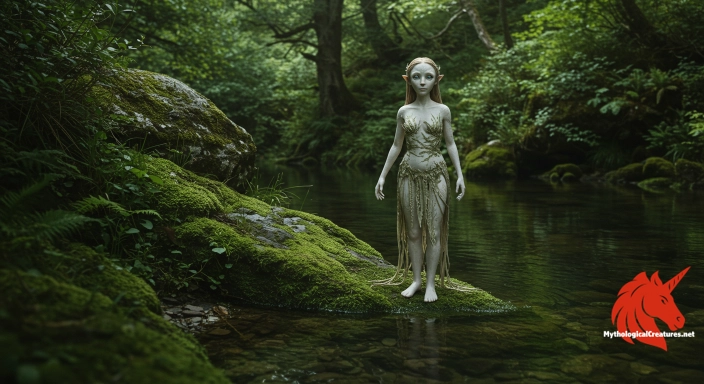
Gwragedd Annwn
Gwragedd Annwn - They serve as a bridge between the natural and supernatural realms in Welsh myth, embodying both enchantment and mystery.
Origins & First Encounters
Gwragedd Annwn are extraordinary figures in Welsh folklore, celebrated as ethereal beings whose origins are enshrouded in the mists of ancient myth. They emerge from a time when the natural world and the supernatural intertwined seamlessly, and are revered as integral members of the Tylwyth Teg, the Welsh fairy host. Their legend is intricately connected to the watery realms of lakes and rivers, where their presence is said to lend both enchantment and mystery to the landscape. Over the centuries, these fairy women have been portrayed as both benign and inscrutable, linking them with natural phenomena and the cycles of life. Their narrative is further enriched by associations with local legends, including ties to the origin of the Welsh black cattle. Myths of their occasional ascent into the human world underscore their role as mediators between the tangible and the unseen. The cultural context of their story reflects a world where nature was revered and the line between the physical and the spiritual blurred. As enduring symbols of beauty and magic, the Gwragedd Annwn continue to captivate imaginations and inspire retellings that bridge ancient lore with contemporary myth. Their tale remains a vital thread in the rich tapestry of Welsh myth, echoing through generations and across the watery landscapes they call home.
Source Texts & Tale Variants
Traditional narratives of the Gwragedd Annwn find their roots in a broad array of Celtic and medieval sources, preserved by a vibrant oral tradition. Early storytellers passed down their legends through generations, ensuring that the essence of these water-bound faeries was never lost. Some manuscripts, though modest in number, hint at the involvement of renowned figures such as Saint Patrick in the shaping of their mythos. Bardic poems and local folklore compilations further enrich the tapestry of their story, offering variants that reflect differing local colours and nuances. In several accounts, their appearance is interwoven with seasonal changes and transformative twilight moments, revealing a dual nature that is both benevolent and ambiguous. The narratives often present them as enigmatic guides whose interactions with mortals could bring blessings or portents of change. Variations abound, with some records focusing on their seductive charm while others emphasise a more cautionary aspect. Written sources and collected folktales alike contribute to a multi-layered understanding of their character, highlighting the dynamic evolution of their myth. These layers of tradition demonstrate how a blend of oral and written sources has continuously moulded the lore surrounding these enigmatic beings.
Form & Powers
The physical portrayal of the Gwragedd Annwn is as captivating as it is nuanced, marked by an ethereal beauty that seems to defy mortal description. They are typically depicted with slender, graceful forms that mirror the gentle curves of the lakes and rivers they inhabit. Their skin is often thought to possess a soft, shimmering quality reminiscent of moonlit water, and their eyes glisten with an inner luminescence that hints at a deep, arcane knowledge. Flowing tresses, ranging in hue from silken gold to the deep blues of dusk, cascade around delicate features that combine both allure and a quiet melancholy. Their attire is usually rendered as flowing robes or garments that seem to be woven from the very essence of mist and water vapor, enhancing their supernatural presence. In some traditions, subtle hints of their aquatic nature appear, such as faint traces of webbing between their fingers or an iridescent glow along their limbs. Every description captures the elusive quality of their beauty—constantly shifting like the reflections on a rippling surface. Despite the variations in detail, each account conveys a visual image that celebrates a delicate balance of charm and otherworldliness. Artistic depictions over the centuries have immortalised their beauty in a manner that continues to inspire wonder and reverence.
Regional Faces
Across Wales, the Gwragedd Annwn are depicted with regional variations that lend distinct local flavours to their myth. In certain locales, these fairies are portrayed as benevolent guardians of specific lakes and rivers, each body of water carrying its own unique legend. Coastal regions sometimes blend maritime elements into their stories, with the fairies taking on characteristics reminiscent of sea nymphs as well as freshwater sprites. In more secluded rural areas, local adaptations frequently emphasise their role as harbingers of fertility, with their appearances often coinciding with the rhythm of nature’s cycles. At times, communities describe them with a luminous aura that is uniquely tied to particular geographical sites, reflecting the intimate bond between local identity and the natural landscape. Some regional tales also caution that a chance encounter with one of these beings might foretell either good fortune or an enigmatic warning. Variations in narrative often arise from the interplay of Celtic traditions with neighbouring cultural influences, enriching their portrayal with distinctive talismans and regalia. The local lexicon, too, adapts to colour these legends, with descriptive terms evolving to capture the spirit of the region. In every retelling, the fairies serve as a mirror to the diverse and ever-changing backdrops of Welsh countryside mythology, underscoring an enduring connection between lore and land.
Cultural Parallels
The Gwragedd Annwn share intriguing similarities with water-bound faerie figures found throughout Europe, forming part of a widespread cultural dialogue on the supernatural. Their enigmatic beauty and elusive nature draw comparisons with Greek Naiads, whose refreshing presence is as transient as the ripples on a stream. Echoes of their mystique can also be found in the Irish sidhe, with both embodying the delicate balance between the human and the otherworldly realms. In the realms of maritime folklore, similarities emerge with mermaids and sirens, whose charm and mystery mesmerise those who venture too close to their domain. Yet, the Gwragedd Annwn stand apart through their unique integration with terrestrial elements, such as their association with the origin of the Welsh black cattle and local agrarian cycles. Their dual existence—thriving beneath the water and occasionally gracing the upper world—underscores an inherent connection to both domains. Like other European faerie beings, they embody themes of seduction, transformation, and the capricious nature of fate. Comparative studies reveal that although many water spirits share universal traits, each cultural variant is imbued with distinctive attributes reflective of its local environment and historical context. Ultimately, the Gwragedd Annwn contribute to a rich, interconnected web of myth where similarities and differences coalesce to form a broader narrative of the mystical and the miraculous.
Legacy & Modern Evolution
Throughout the ages, the myth of the Gwragedd Annwn has evolved, reflecting changes in both societal perceptions and artistic sensibilities. In medieval times, their stories were transmitted orally and modestly recorded in manuscript forms, where they embodied the mystique and inherent dangers of the natural world. Their representation grew increasingly romanticised during the Renaissance, when art and literature began celebrating a more lyrical, melancholic beauty that resonated with broader cultural shifts. In contemporary culture, these fairy women have experienced a resurgence as symbols of nature’s enigmatic allure, inspiring modern poets, novelists, and visual artists alike. Today, their legacy is often intertwined with ecological themes, as modern interpretations frequently cast them as guardians of our natural environments. Cultural festivals and heritage events in Wales regularly invoke their image, celebrating a rich past that continues to inform present identities. Modern adaptations in film, literature, and art have reimagined the Gwragedd Annwn as both cautionary figures and icons of transformation, bridging the gap between ancient myth and current cultural narratives. Their enduring appeal lies in their capacity to evolve while retaining the essential qualities that make them mysterious and compelling. As symbols of the delicate boundary between the seen and unseen, they invite continuous reinterpretation in response to contemporary concerns. The ongoing legacy of the Gwragedd Annwn is a testament to the timeless power of myth and its ability to mirror the human experience across generations.
Interesting Fact
One intriguing aspect of their lore is the association with Welsh black cattle, highlighting an unexpected connection between the fairy realm and earthly life.
For publishers and studios
Your next readers are already here
Many of our visitors are looking for books, campaigns, and resources that deepen their journey into myth. Position your title or setting here.
Discuss a placementQuick Creature Info
Features:
Associations:
Our Mythic Legendary Rating:

Also Sometimes Known As:
Habitat:
Supernatural Powers:
Physical Attributes:
Abilities:
Behavior:
Weaknesses:
Lore:
Related Creatures, Tales or Lore
- TTylwyth Teg
- AAos Sí
- PPeri
References
Discover Another Mythical Legend You May Not Have Heard Of?
Uncover the mysteries of ancient folklore and expand your knowledge of legendary beings from cultures around the world.
Dare to Meet the Idyia....
Curated by the Mythological Creatures Team
Series editor: Mythological Creatures Directory
Primary desk: Northern & European Folklore Desk
(rev. November 2025)