
Hecatoncheires: The Hecatoncheires, known as the Hundred-Handers, are gigantic, multi-headed giants from Greek mythology renowned for their immense strength and crucial role in the Titanomachy.
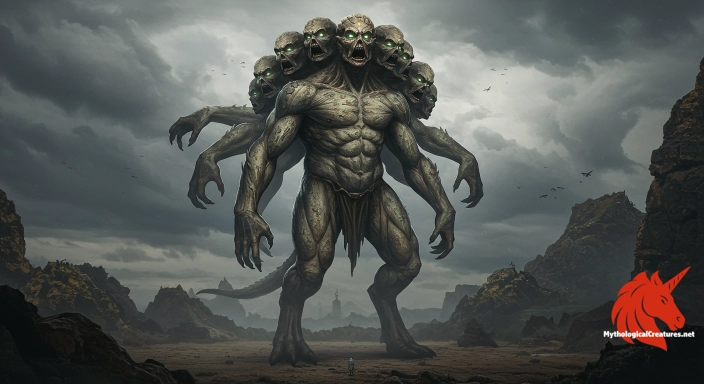
Hecatoncheires
Hecatoncheires - They embody the overwhelming force of primordial chaos harnessed by the gods to establish cosmic order.
the legend in five swipes.
the legend in five swipes.
When were the Hecatoncheires first written about?
The Hecatoncheires stand as some of the most formidable figures in ancient Greek mythology, their very existence embodying the raw power of the cosmos. Born of the union between Uranus and Gaia, they emerged into a world shaped by primordial forces and divine conflicts. Their earliest attestation is found in the epic narratives that recount the Titanomachy, where their sublime strength contributed decisively to the overthrow of the Titans. These colossal beings, each bearing the staggering count of fifty heads and one hundred arms, struck fear and awe into the hearts of gods and mortals alike. They were not mere brutes but symbols of nature’s chaotic potential and the inherent power lurking behind cosmic creation. Within the framework of myth, their role surpassed that of simple antagonists by becoming instrumental allies to the Olympian order. Their story reflects an essential aspect of Greek cultural identity, where the interplay between order and chaos forms the mythic substrate of human existence. In many ways, the Hecatoncheires served as a bridge between the chaotic energies of the early universe and the structured reign of Zeus, adding layers of complexity to the mythic tradition. Their legendary feats and overwhelming presence have kept them alive in the cultural imagination over centuries. The legacy of these giants continues to invite reinterpretation and analysis, reflecting the enduring nature of myth in human society.
Which books and scrolls describe the Hecatoncheires?
Ancient texts serve as the primary sources for the account of the Hecatoncheires, with Hesiod’s Theogony offering one of the earliest and most comprehensive descriptions. These texts detail not only their fearsome appearance but also their pivotal involvement in the cosmic battle against the Titans. Variants of their story appear in later mythographical works and poetic retellings that introduce subtle differences in their narrative roles. Some accounts attribute to them additional names and distinct characteristics, further enriching their mythological profile. In some literary traditions, they are alternatively referred to by names that stress their colossal strength and tumultuous nature. Later compilations by authors like Apollodorus have refined and sometimes reinterpreted the legends, ensuring that each retelling captures the essence of their mythical might. Folklore and artistic representations over time have sometimes blended classical descriptions with local motifs, evidence of the broad narrative impact they had across generations. The diverse versions circulating among ancient communities underline the flexible and evolving nature of myth, as storytellers adapted their stories to suit local tastes and spiritual needs. Their narrative has stood as a testament to the power of myth to evolve with society’s changing perceptions of the divine and the monstrous.
What do the Hecatoncheires look like?
The physical form of the Hecatoncheires is as extraordinary as it is daunting, comprising fifty heads and one hundred arms in a single body that defies natural proportion. Each head is often depicted with a unique expression, embodying emotion, anger, or determination, which adds a sense of individuality among the seemingly uniform parts. Their sprawling arms radiate in every direction, suggesting an inescapable force that can both protect and devastate. Ancient depictions portray them as titanic beings whose very presence eclipses that of more conventional deities. The bodily structure is imbued with raw, almost elemental power, as if every limb carries the weight of both creation and destruction. Variations in artistic representations hint at differences in their build, with some traditions emphasising a more rugged, mountainous physique while others celebrate a sinewy, agile form. This amalgamation of multiple sensory organs and limbs creates an imposing image of an entity who transcends the usual biological limits of a mortal being. The sculptural details in vase paintings and friezes capture the dynamic energy and chaotic symmetry of their form. Every artistic interpretation serves as a reminder of the vast forces at play in the ancient cosmic battles, where even the body of a creature could symbolise the amplitude of nature’s fury and beauty.
Hecatoncheires: Regional Versions and Local Names
Despite originating in the Hellenic world, the myth of the Hecatoncheires has experienced various regional adaptations over time. In mainland Greece, early artistic depictions focused primarily on their role in the Titanomachy, reinforcing their association with divine retribution and cosmic order. As the myth spread through the Mediterranean, Roman interpretations gave them the alternative name Centimani while often emphasizing their monstrous aspect as a symbol of overwhelming power. In the Byzantine era, artistic renditions evolved, sometimes merging their iconography with that of other formidable mythic figures in the context of imperial symbolism. Local adaptations in regions influenced by Greek culture have occasionally altered the numbers or angry demeanour to better mirror regional aesthetics or moral lessons. Some Eastern Mediterranean communities adapted their narrative to align with spiritual themes, incorporating the giants as metaphors for natural chaos subdued by human ingenuity. These variations underscore the fluid nature of myth, where local culture and artistic innovation transform enduring stories. Their portrayal has been interwoven with regional histories, sometimes taking on allegorical meanings that resonate with local struggles and triumphs. Each regional version contributes to a broader mosaic that reflects both local colour and universal themes found in mythic literature.
Legends Comparable to That of the Hecatoncheires
The Hecatoncheires share thematic similarities with other mythological giants found in various cultural traditions, offering a fascinating perspective for comparative mythologists. In Norse mythology, for instance, the Jotunn possess a ferocious connection with nature and chaos, paralleling the Hecatoncheires’ role in the cosmic conflict between order and disorder. Similarly, some South Asian legends feature multi-armed asuras whose many limbs symbolize boundless power, a motif that finds resonance in the Greek narrative. The layered symbolism of the Hecatoncheires, mixing elements of divine fury and creative chaos, is echoed in East Asian depictions of deities and spirits with multiple arms and faces. These creatures, irrespective of cultural origin, often serve as representations of forces beyond the control of mortals, challenging the established order. Such cross-cultural connections highlight the universal human fascination with the idea of compounded power and the blending of beauty with monstrosity. Their multifaceted portrayal often invites drawing parallels between the physical overload of their form and the conceptual overload of cosmic energy. This comparative view enriches the overall understanding of how different societies conceptualise the sublime and the monstrous. By examining these parallels, one can appreciate a shared mythic language that transcends geographical and temporal boundaries.
Hecatoncheires in Books, Film and Games
Over the centuries, the image of the Hecatoncheires has undergone significant transformation, evolving alongside cultural shifts and artistic innovations. Their early depiction as helpers of Zeus in the Titanomachy gradually gave way to a broader representation as symbols of chaotic power and cosmic unpredictability. Renaissance artists, inspired by classical antiquity, often re-envisioned these giants in grand canvases and sculptures, reflecting both drama and allegory in their portrayals. In modern times, the Hecatoncheires have found their way into various forms of literature and entertainment, from fantasy novels to graphic novels, where they are reinterpreted for contemporary audiences. The enduring fascination with their hyperbolic physical form and mythic power renders them as enduring icons of ancient mythology, bridging past and present. Their depiction as embodiments of cosmic disarray continues to resonate with modern storytellers who seek to explore themes of power, destruction, and renewal. Educational contexts also revisit their narrative, engaging students with the rich tapestry of Greek myth and its impact on Western culture. The modern legacy of the Hecatoncheires underlines a dynamic reinterpretation, where classical myth inspires diverse artistic expressions and philosophical reflections. Today, their myth remains a potent symbol not only of ancient divine battles but also of the timeless struggle between order and chaos.
Interesting Fact
A striking feature of the Hecatoncheires is their extreme anatomical design—with each possessing fifty heads and one hundred arms—underscoring not only their immense power but also the profound symbolism of chaos and strength in Greek myth.
Mythological Treasures
Greek Myths: A field guide to the monsters of ancient Greece
Every monster here earned its place in legend, and each gets a full page of artwork and the story behind it.
Japanese Yokai: A field guide to the spirits and demons of Japanese folklore
Fifteen spirits, with the signs to watch for and what the old tales say to do if you meet one.
Norse Sagas: A field guide to the beasts of the Viking world
Drawn from the saga accounts themselves, with the powers, weaknesses and doom of each being set out.
the legend in five swipes.
For serious mythcraft
Your project belongs among the legends
If your work deepens how people understand, play with, or teach mythology, a sponsor placement here keeps it in front of the right readers all year.
Submit a sponsorship enquiryQuick Creature Info
Origin:
Our Mythic Legendary Rating:

Also Sometimes Known As:
Habitat:
Supernatural Powers:
Physical Attributes:
Abilities:
Behavior:
Lore:
References
Discover Another Mythical Legend You May Not Have Heard Of?
Uncover the mysteries of ancient folklore and expand your knowledge of legendary beings from cultures around the world.
Dare to Meet the Tamfana....
The Mythological Creatures Book Series
Yokai, Greek, Norse, Egyptian & Chinese. Five illustrated field guides to the creatures the old stories either warned or told you about.
Curated by the Mythological Creatures Team
Series editor: Mythological Creatures Directory
Primary desk: Hellenic & Ancient Mediterranean Desk
(rev. November 2025)