
Heramba: Heramba is a five-headed form of the Hindu god Ganesha, revered for his wisdom and ability to remove obstacles.
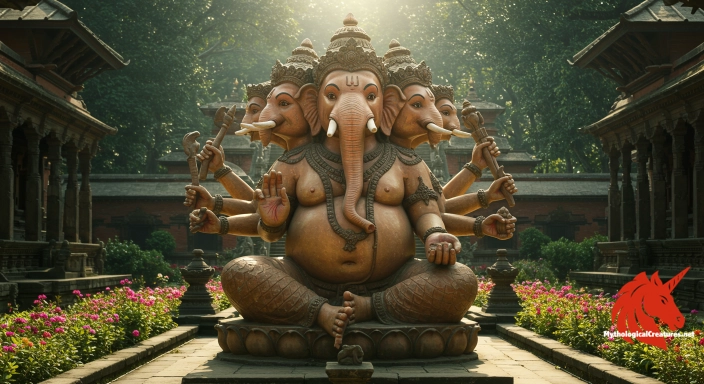
Heramba
Heramba - One of the most celebrated of the thirty-two forms of Ganesha, especially important in Tantric practices
Origins & First Encounters
Heramba manifests as a striking and multifaceted version of Ganesha, embodying a rich synthesis of cultural symbolism and spiritual strength. His five-headed representation emerged from deeply rooted Tantric traditions that blend mysticism with intricate iconography. The evolution of Heramba can be traced back to periods when artistic expression and devotional practices converged to reveal a deity capable of bridging earthly challenges and cosmic insight. His presence is particularly potent in Nepal, where the merging of indigenous beliefs and broader Hindu traditions enriched his depiction. The deity’s multiple faces symbolise a comprehensive understanding of diverse energies and human conditions. In his early attestations, the form of Heramba was celebrated not only for protection but also as a beacon of auspicious beginnings. The integration of protective and benevolent attributes in his form reflects a deliberate artistic strategy to encapsulate complex philosophical ideas. His legacy continues to be a source of inspiration, inviting devotees to explore the multifarious dimensions of divine power and wisdom. This vibrant synthesis of traditional motifs and innovative interpretations underscores the enduring appeal of Heramba in both religious and cultural contexts.
Source Texts & Tale Variants
Ancient temples and inscriptions provide glimpses into the early worship of Heramba, with artistic records highlighting his five distinctive faces. Textual traditions in Tantric lore and specialised manuscripts have offered detailed descriptions of his attributes, affirming his stature among the thirty-two recognized forms of Ganesha. Diverse narrative strands have played a role in shaping the lore surrounding Heramba, sometimes emphasising his role as a cosmic protector and at other times his capacity to unlock spiritual mysteries. The rich iconography found in Nepal serves as an enduring testament to his ancient origins, where both sculpture and ritual continue to celebrate his persona. Variations in his myth are evident in regional texts and folktales that bolster his reputation as a guardian against chaos. The survival of these texts across centuries reflects the dynamic and adaptive nature of Heramba's worship. Oral traditions and folk narratives have further enriched these textual sources by introducing adaptive elements that resonate with local cultural experiences. This multifaceted repository of sources has allowed the legend of Heramba to evolve, ensuring that both orthodox and folk practices continue to find meaning in his image. The enduring convergence of literary and artistic traditions highlights the compelling narrative and symbolic dimension of his character.
Form & Powers
Heramba is typically portrayed with five distinct heads, each contributing its own layer of meaning to his overall presence. The central, elephant-headed visage reverberates with the familiar benevolence and wisdom attributed to Ganesha, while the additional four faces are rendered with meticulous attention to detail. Each head is subtly differentiated, sometimes with unique expressions that range from calm reassurance to intense vigour. His eyes are rendered as profound windows to the divine, offering viewers a sense of otherworldly insight and contemplation. The intricate detailing on his skin, often adorned with elaborate patterns and celestial symbols, speaks to a craftsmanship that is both devotional and artistic in nature. Rich ornamentation, including finely wrought jewellery and vibrant textiles, encircles his form, reinforcing his exalted status. The spatial arrangement of the heads, typically in a harmonious circular pattern, symbolises the integration of multiple perspectives and energies. Every aspect of his depiction, from the gently curved trunk to the graceful posture, is designed to evoke both strength and compassion. This comprehensive physical portrayal uniquely positions Heramba as an embodiment of cosmic balance and spiritual depth.
Regional Faces
Heramba’s depiction has adapted to reflect the nuanced artistic and cultural traditions of the regions that revere him, with Nepal offering perhaps the most illustrative example. In Nepal, his five-headed form is intricately carved and vividly painted in temples and statues that echo local Newar artistic sensibilities. The aesthetic choices in his portrayal—ranging from the curvature of his trunk to the stylisation of his eyes—often bear the imprint of regional artisans who blend classical iconographic principles with indigenous motifs. In northern India, subtle stylistic variations can be observed, where local legends infuse his image with distinctive narratives of protection and prosperity. These regional adaptations sometimes place greater emphasis on specific heads, imbuing them with attributes that resonate with local spiritual needs. The interplay of regional myth with broader Tantric influences ensures that each representation of Heramba carries a unique contextual significance. Artists and devotees alike embrace these variations, which allow the deity to function as both a universal protector and a locally imbued guardian spirit. The dynamic nature of his regional portrayals highlights the continuing dialogue between tradition and local innovation. As a result, Heramba remains a deeply situated figure whose iconography mirrors the rich tapestry of regional culture and belief.
Cultural Parallels
The multi-headed form of Heramba invites comparisons with a range of deities from different cultural backgrounds who similarly embody multiplicity and cosmic complexity. His portrayal resonates with the iconography of Brahma and other polycephalic deities, where several faces symbolise diverse aspects of omniscience and creative power. Similar to motifs found in certain Buddhist traditions, the additional heads in his depiction serve as metaphors for an expansive array of insights and abilities. The cross-cultural presence of multi-headed deities often signifies the desire to capture the full spectrum of divine attributes, a theme vividly reflected in Heramba’s form. This convergence of symbolism is not only evident in visual art but also in the narratives that portray these deities as mediators between different realms of existence. The notion of multiple faces as a vehicle for encompassing the entirety of divine wisdom is a recurring motif that transcends geographical and cultural boundaries. Such comparative insights underline the universal appeal of these complex representations in exploring themes of unity and fragmentation. When viewed alongside other mythological figures, Heramba’s form stands as a compelling testament to both the diversity and the interconnectedness of global spiritual traditions. Through these parallels, his icon becomes a focal point for understanding broader questions of divine multiplicity and cultural symbolism.
Legacy & Modern Evolution
The evolution of Heramba’s portrayal from an arcane Tantric symbol to a prominent figure in modern devotional art highlights a rich historical journey. Early representations emphasised his formidable and protective aspects, which were vividly captured in stone carvings and ritual iconography. Over time the narrative surrounding his form evolved, gradually encompassing themes of wisdom, benevolence, and artistic expression. In contemporary times, his image has found new life in a variety of media ranging from traditional sculptures to modern digital reinterpretations. Artists today continue to experiment with his five-headed motif, merging classical traditions with innovative design techniques. Festivals, exhibitions, and religious commemorations keep his legacy alive among communities that value both heritage and creative evolution. His modern legacy has also become a subject of academic and artistic inquiry, with scholars exploring how his imagery reflects broader societal transformations. This dynamic adaptation across centuries underscores the inherent versatility of his form, allowing Heramba to persist as a symbol of both ancient wisdom and modern dynamism. The enduring impact of his iconography ensures that he remains a vibrant figure in the continuous interplay between tradition and contemporary culture.
Interesting Fact
An intriguing aspect of Heramba is that his five-headed form, while less known outside certain Tantric circles, continues to influence modern interpretations of Ganesha in art and temple architecture.
Partner with us
Sponsor this space
Reach thousands of mythology enthusiasts with a curated placement on our creature pages.
Learn about sponsorshipQuick Creature Info
Features:
Associations:
Our Mythic Legendary Rating:

Also Sometimes Known As:
Habitat:
Supernatural Powers:
Physical Attributes:
Abilities:
Behavior:
Lore:
Related Creatures, Tales or Lore
- GGanesha
- VVakratunda
- LLambodara
References
Discover Another Mythical Legend You May Not Have Heard Of?
Uncover the mysteries of ancient folklore and expand your knowledge of legendary beings from cultures around the world.
Dare to Meet the Ngareima....
Curated by the Mythological Creatures Team
Series editor: Mythological Creatures Directory
Primary desk: Asian & Pacific Myth Cycles Desk
(rev. November 2025)