
Luison: Luison is a legendary cursed beast from Paraguayan folklore, born as the seventh and last son of Tau and Kerana.
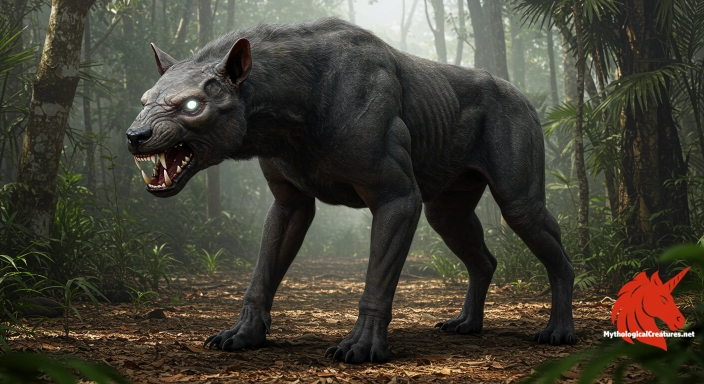
Luison
Luison - Luison embodies the curse of the seventh son, playing a crucial role in Guaraní folklore as a harbinger of fate and misfortune.
Origins & First Encounters
In Paraguayan mythology, the Luison is a figure shrouded in both mystery and destiny, known as one of the seven legendary beasts and the final offspring of Tau and Kerana. Born as the seventh male child, his fate is intertwined with a prophetic curse that transforms him into a fearsome creature. Emerging from the rich tapestry of Guaraní lore, his story has been woven into the collective cultural identity of Paraguay. His transformation is not merely a monstrous metamorphosis but a symbolic representation of the conflict between predestination and human frailty. Early retellings of his myth can be traced back to indigenous oral traditions, where each generation recounted his tale with renewed vibrancy. The Luison holds a dual role, serving as both a cautionary tale and an emblem of mystic power that defies conventional order. His existence challenges the boundaries between the natural and the supernatural, carving a unique niche in local folklore. Community narratives frequently evoke his tragic genesis to underscore the unpredictable nature of fate. Ultimately, his story continues to inspire both reverence and trepidation, inviting listeners to ponder the interplay of destiny and personal choice.
Source Texts & Tale Variants
Stories about the Luison have been passed down through centuries via rich oral traditions and early colonial accounts. Local storytellers preserved his legend meticulously, ensuring that every retelling captured the nuances of his cursed transformation. Written records from early Spanish chroniclers mention this enigmatic figure, linking him firmly to indigenous beliefs and the rhythms of the natural world. Various manuscripts and archival documents reveal that his myth has undergone considerable evolution over time. Several sources underscore his connection with familial destiny, emphasising that the seventh male offspring is fated to become this formidable creature. Folklorists have since compiled a range of diverse accounts, each adding layers that reflect subtle regional differences. In some variants, his nature is painted with elements of profound tragedy, while other narratives portray him as an uncontrollable force of nature. Contemporary interpretations have enriched his lore further by blending traditional themes with modern cultural symbolism. Rare historical texts uncovered in local libraries provide glimpses into even earlier iterations of his tale. Collectively, these sources illustrate a layered narrative that remains influential in the cultural consciousness of Paraguay.
Form & Powers
Visual descriptions of the Luison are as varied as they are haunting, capturing a blend of human and supernatural traits that leave a lasting impression. He is frequently depicted with a formidable physical presence, his build both muscular and agile, hinting at the latent power inherited from his divine lineage. Distinctive lupine characteristics dominate his appearance, evoking imagery reminiscent of the classic werewolf yet imbued with a unique local mystique. His eyes are often described as luminescent and piercing, mirroring the inner torment of a soul caught between human vulnerability and beastly fury. The creature’s face is a complex tapestry of human expression intermingled with fierce animalistic features, including pronounced canine teeth and a perpetual snarl. In several depictions, unkempt hair and a wild, spectral silhouette further enhance his eerie persona when the moon rises. Some accounts even suggest that he towers over ordinary men, while alternative portrayals lean towards a lithe and almost ethereal form under moonlight. Intricate markings along his fur are said to symbolise ancestral bonds and the divine imprint of his origins. Every detail of his anatomy is crafted to evoke both an unsettling sense of dread and an inexplicable sympathy, cementing his image as an icon of cursed destiny.
Regional Faces
Across different regions of Paraguay and its neighbouring areas, the lore surrounding the Luison has been adapted to reflect local cultural nuances and geographical identities. In rural communities, he is frequently referred to by alternate names such as Lobizón, with each term carrying its own subtle connotations. Local narratives often describe him as a nocturnal wanderer who strides along the border between civilisation and the wild expanse of nature. In some villages, his curse is interlaced with themes of protection, with folklore suggesting he guards the secrets of the untamed wilderness. Variations found in border areas of Argentina and southern Brazil incorporate elements drawn from both indigenous beliefs and European mythological traditions. Certain retellings cast him as a solitary, tormented figure doomed to wander, while others embed him within broader ensembles of legendary creatures. Community rituals and protective amulets that reference his legend have also evolved in line with regional practices. The transformation of his tale adapts seamlessly to local histories and environments, serving as both a warning and a source of cultural identity. Through these diverse regional portrayals, the Luison’s myth remains both enduring and ever-evolving across the cultural landscape.
Cultural Parallels
When placed alongside other mythological figures, the Luison stands as a striking exemplar of themes that encompass transformation and fated destiny. His narrative bears notable resemblances to the European werewolf legend, particularly in its motif of a human being transformed by an inescapable curse. Like many cursed beings in folklore, his story encapsulates the dangers of transgressing natural limits and the inevitable consequences that follow. Comparisons have also been drawn with other Latin American mythic entities, where the blend of human and beastly qualities underscores the tension between the natural and supernatural realms. In both his portrayal and that of figures like the famed Chupacabra, the complex interplay of vulnerability and monstrous power is made evident. Observers often find echoes of ancient myth, such as the Norse Fenrir, in the tragic contours of his character. These parallels highlight a shared exploration across cultures of what it means to be cursed by destiny. His dual nature—at once human and inhuman—serves as a canvas upon which universal fears and hopes are projected. The comparative study of such legends reveals how myths address the perennial human struggle with identity, control, and the unknown.
Legacy & Modern Evolution
The evolution of the Luisón myth mirrors the dynamic interplay between age-old tradition and modern reinterpretation, reflecting shifting societal attitudes toward the supernatural. Early depictions firmly rooted him in the mystical heritage of indigenous Paraguayan culture, where his tale resonated with ancient spiritual beliefs. The influence of colonial encounters gradually introduced European elements that enriched his character with features akin to werewolf lore while preserving his regional uniqueness. Over time, the Luison has emerged not purely as a monster, but as a nuanced symbol of the tension between predetermined fate and the struggle for self-determination. Contemporary narratives often reimagine him as a tragic antihero, a figure burdened by his cursed destiny yet capable of evoking empathy. Modern artistic expressions—ranging from literature to visual arts—use his story to explore themes of identity, alienation, and the duality of existence. Film and theatre adaptations occasionally draw on his legend to delve into these layered meanings, presenting him as both a warning and a mirror to modern societal conflicts. Community festivals and folk performances continue to celebrate and reinterpret his myth, ensuring its relevance in contemporary culture. The sustained legacy of the Luisón speaks to the universal allure of legends that transcend time, evolving with each retelling. Through each generation, his story remains a potent reminder of the enduring power of myth to capture the imaginations and fears of humanity.
Interesting Fact
An interesting aspect of Luison is that his fate as a cursed being is intrinsically tied to his birth order, emphasising the power of numerology and destiny in Guaraní mythology.
Partner with Mythological Creatures
Bring your myth-based world into ours
From game settings to narrative worlds, we work with partners who treat myths with care. Share your project for a potential sponsor slot.
Partner with usQuick Creature Info
Origin:
Features:
Our Mythic Legendary Rating:

Also Sometimes Known As:
Habitat:
Supernatural Powers:
Physical Attributes:
Abilities:
Behavior:
Weaknesses:
Lore:
Related Creatures, Tales or Lore
- LLoup-garou
- LLobisomem
- WWerewolf
References
Discover Another Mythical Legend You May Not Have Heard Of?
Uncover the mysteries of ancient folklore and expand your knowledge of legendary beings from cultures around the world.
Dare to Meet the Maruda....
-b766f6be-a879-4754-896e-7044de5e0ece_small.webp "Depiction of Maruda")
Curated by the Mythological Creatures Team
Series editor: Mythological Creatures Directory
Primary desk: Americas & Indigenous Traditions Desk
(rev. November 2025)