
Mahishasura: Mahishasura is a formidable bovine asura from Hindu mythology known for his deceptive, shape-shifting abilities.
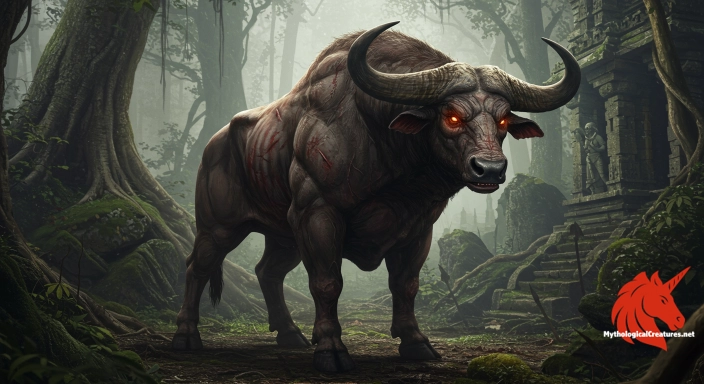
Mahishasura
Mahishasura - Mahishasura's defeat by Durga epitomizes the victory of good over evil and is central to Shaktism.
Origins & First Encounters
Mahishasura is a compelling figure in Hindu mythology, embodying both the terrifying force of chaos and the transformative power of divine retribution. Born from a lineage of asuras and marked by a unique bovine essence, his character has long captured the imaginations of believers and scholars alike. His tale first emerged in ancient Sanskrit literature, where narratives detail his cunning shape-shifting and audacious defiance against cosmic order. The demon’s origins, intertwined with the bloodlines of significant mythic figures, serve as a rich backdrop for his eventual confrontation with the goddess Durga. His defiant actions and the subsequent divine retribution underscore a timeless theme of the struggle between good and evil. The festival of Navaratri, culminating on Vijayadashami, has enshrined his story as a celebration of righteousness overcoming malevolence. Over time, his myth has been woven into the fabric of cultural rituals and religious observances, reinforcing communal ideals of justice and balance. The enduring legend of Mahishasura continues to be a source of inspiration, symbolically representing the eternal conflict between order and chaos. His narrative, replete with both grandeur and warning, has secured his place as an influential figure in the mythological landscape.
Source Texts & Tale Variants
The primary narrative of Mahishasura is rooted in the ancient texts of Hindu tradition, where his story is prominently featured in the Devi Mahatmya. The hymn composed by Adi Shankara, known as the Mahishasura Mardini Stotra, further cements his role in the mythos of divine triumph. Various versions of his tale exist, each highlighting diverse attributes—from his deceptive nature to his overwhelming physical strength. Oral traditions and regional folklores enrich the canonical texts, ensuring that multiple perspectives bring out nuances of his character. Dramatic recitations, ritual performances, and temple enactments have all contributed to the layered portrayals of his myth. In many regions, the recitation of his story during festive periods lends an immediacy to his legend, making it a living tradition. The evolution of his narrative through centuries reveals a mosaic of adaptations, each reflecting the cultural contexts in which they were retold. These varied textual and oral sources collectively offer a multifaceted view of Mahishasura, confirming his status as a complex and dynamic antagonist. His enduring presence in both literature and ritual underscores the adaptability of mythic narratives across time and space. Through these diverse sources, his legacy has been shaped and sustained as an iconic symbol of the eternal battle between divine forces and demonic chaos.
Form & Powers
Mahishasura is typically depicted with a striking amalgam of human and bovine features, a synthesis that renders his appearance both imposing and otherworldly. His most recognisable trait is his buffalo head, crowned with prominent, curved horns that accentuate his formidable presence. In numerous artistic renditions, his form transitions fluidly between a human-like figure and that of a wild, powerful beast. His eyes are often illustrated as glowing with a fierce intensity, symbolising a deep, untamed ferocity. Attributes such as a broad, muscular torso and robust limbs are common, emphasising the physical might that complements his cunning nature. The demon’s skin tone is frequently rendered in earthy, shadowy hues that evoke the rugged resilience of nature herself. Detailed temple carvings and classical paintings highlight his sinewy build and dynamic posture, capturing the tension between his bestial and intelligent aspects. Such depictions are not merely literal but imbued with symbolic meaning, representative of the dual forces within his character. The variability in his portrayal allows artists and storytellers alike to project diverse narratives onto his form, from raw brutality to tragic grandeur. The complex visual imagery associated with Mahishasura continues to inspire a rich tradition of iconography in both ancient and modern art.
Regional Faces
The legend of Mahishasura transforms subtly as it permeates various regions of the Indian subcontinent, each imbuing his story with local colour and distinctive emphasis. In the northern realms, he is most often portrayed as an embodiment of sheer malevolence, whose defeat heralds the restoration of cosmic order. Southern traditions, however, frequently highlight the cunning and strategic aspects of his character, emphasising the dramatic tension in his struggle against divine forces. Temple rituals and classical dance dramas across regions infuse the narrative with vivid interpretative elements, making his myth a living part of communal celebrations. Some rural traditions present him with a sombre, almost tragic dimension, intimating that his downfall was as much a product of hubris as of divine intervention. Southeast Asian adaptations incorporate indigenous artistic motifs, with local sculptural traditions offering nuanced visual renditions of his form. The variations in storytelling not only reflect divergent cultural priorities but also the dynamic manner in which oral traditions mould myth to meet contemporary sensibilities. These regional adaptations have kept his legend flexible and accessible, ensuring that Mahishasura’s narrative resonates with a wide audience. Each community's portrayal contributes uniquely to the overarching myth, anchoring his legacy firmly within the diverse cultural and religious tapestry of the region. Through these interpretations, Mahishasura continues to engage devotees in a dialogue that spans both time and geography.
Cultural Parallels
Mahishasura’s myth finds intriguing echoes in myriad cultural narratives, where hybrid creatures often embody the intersection of human cunning and animal strength. Similar to the Greek Minotaur, whose formidable presence and labyrinthine lore intrigue modern audiences, Mahishasura encapsulates the universal conflict between order and chaos. In Japanese folklore, oni exhibit parallel traits of both guile and brute force, drawing comparisons to the shape-shifting and deceptive qualities attributed to him. Across various cultures, demonic or semi-divine entities serve as allegories for the human struggle against inner and outer evils, a role that Mahishasura fulfils with striking intensity. Such comparative figures illustrate the recurring motif of the creature who negates established norms to force a renewal of cosmic order. These interconnections offer insight into the universality of myth, revealing shared narrative structures that bridge Eastern and Western traditions. The portrayal of hybrid beings in global folklore underscores the enduring appeal of characters that simultaneously invoke fear and fascination. By examining these cultural parallels, one unearths the common human preoccupation with the duality inherent in existence. Such cross-cultural comparisons enrich our understanding of Mahishasura’s role, situating his myth within a larger framework of universal archetypes. This dialogue between traditions enhances the symbolic power of his narrative, affirming its relevance across different historical and social contexts.
Legacy & Modern Evolution
Throughout the centuries, the narrative of Mahishasura has undergone a dynamic evolution, adapting to the shifting contours of religious thought and cultural practice. Originally depicted as a fearsome and unyielding force of chaos, his story gradually acquired layers of moral and philosophical significance. Modern interpretations have re-examined his character through new lenses, sometimes casting him as a tragic figure whose downfall is precipitated by ambition and pride. The vibrant celebrations of Navaratri and Vijayadashami continue to bring his legend to life, with performances and ritual re-enactments that underscore his impact on collective memory. Contemporary art and literature have explored his myth with a renewed sensitivity, sometimes even questioning the rigid binaries of good and evil. His enduring presence in popular culture is a testament to the timeless nature of his story and its adaptability to modern sensibilities. Museums, temples, and cultural festivals across the globe exhibit a rich tapestry of iconography that immortalises his narrative in both traditional and innovative formats. Each reinterpretation invites a re-examination of the eternal struggle between divine justice and demonic transgression. As societal values evolve, so too does the retelling of his myth, ensuring that Mahishasura’s legacy remains both a cautionary tale and an emblem of profound metaphysical truths. The continuing dialogue surrounding his character affirms his status as a lasting symbol in the global mythological canon.
Interesting Fact
An intriguing aspect of Mahishasura's legend is his mastery of shape-shifting, which highlights the theme that appearances can be deceiving—a lesson that resonates deeply in the cultural celebrations of his defeat.
For publishers and studios
Your next readers are already here
Many of our visitors are looking for books, campaigns, and resources that deepen their journey into myth. Position your title or setting here.
Discuss a placementQuick Creature Info
Features:
Our Mythic Legendary Rating:

Also Sometimes Known As:
Supernatural Powers:
Physical Attributes:
Abilities:
Behavior:
Weaknesses:
Lore:
Related Creatures, Tales or Lore
- RRaktabija
- SShumbha
- NNishumbha
References
Discover Another Mythical Legend You May Not Have Heard Of?
Uncover the mysteries of ancient folklore and expand your knowledge of legendary beings from cultures around the world.
Dare to Meet the Chalcis....
-199037cb-6af9-48b9-8448-73b98ee9fb3c_small.webp "Depiction of Chalcis")
Curated by the Mythological Creatures Team
Series editor: Mythological Creatures Directory
Primary desk: Asian & Pacific Myth Cycles Desk
(rev. November 2025)