
Mande Barung: The Mande Barung is a legendary ape‐like cryptid from the remote subtropical forests of Meghalaya in Northeast India.
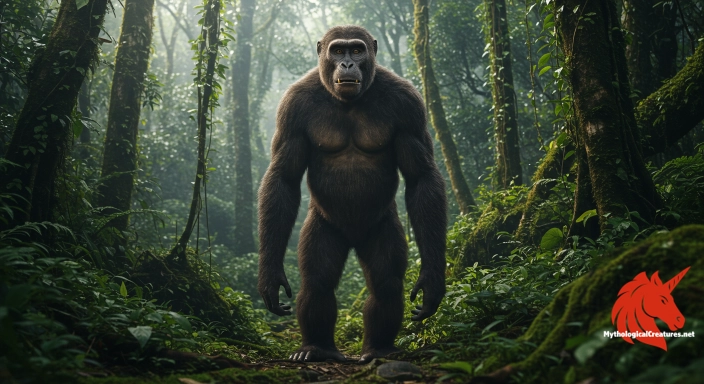
Mande Barung
Mande Barung - A symbol of mystery and natural enigma that connects regional lore with global legends such as Bigfoot and Yeti.
Origins & First Encounters
The Mande Barung is a captivating cryptid emerging from the lush, subtropical expanses of Meghalaya in Northeast India, where local lore paints it as an elusive ape‐like being cloaked in mystery. It has its origins in the time‐worn oral traditions of indigenous communities who have preserved its story over countless generations. The creature is reputed to dwell in the remote Garo Hills, a region where nature’s raw beauty and enigmatic hazards intertwine. Its reputation as a large, hairy, bipedal hominoid has woven it into the fabric of regional belief, symbolising both the wonder and fear of the wilderness.
Earliest attestations, although primarily transmitted by word of mouth, hint at a creature that has sparked imaginative recollections and cautious reverence. Local narratives have gradually incorporated elements of both spiritual guardianship and ominous portent, reflecting deep cultural ties to the natural world. Its myth has grown to bridge ancient mythmaking with contemporary fascination, drawing curious minds to the mysteries of the forest. As a figure deeply embedded in traditional lore, the Mande Barung also hints at the interplay between humanity and untamed nature. Its story continues to be shaped and reshaped by those who seek to make sense of the wild and inexplicable. Over time, the creature has evolved into an enduring symbol, inviting both wonder and scepticism among successive generations.
Source Texts & Tale Variants
The primary evidence for the legend of the Mande Barung arises from the rich oral traditions of the communities inhabiting the Garo Hills. Storytellers and elders have passed down detailed narratives that describe uncanny encounters and mysterious movements amid the dense forest. Fleeting mentions in early colonial documents add a layer of historical curiosity, despite their ambiguous and cautious tone. These traditional accounts offer a tapestry of myth shaped more by community memory than by written records.
Additional sources include regional compilations and artistic depictions that capture the creature’s elusive presence, each variant contributing unique nuances to its character. Ethnographic snapshots found in local lore provide descriptive detail about its appearance, behaviour, and the atmospheric conditions of its habitat. Variations among accounts suggest that while some view the creature as a misinterpreted natural occurrence, others gift it with an almost supernatural quality. The divergent narratives from neighbouring villages further enrich the myth, each adapting the legend to local sensibilities. Striking auditory and visual details have been highlighted by eyewitnesses in some retellings, deepening its enigmatic appeal. These multifaceted sources, though anecdotal, continue to fuel both local belief and modern debate over the precise nature of the Mande Barung.
Form & Powers
Eyewitness descriptions consistently portray the Mande Barung as a substantial, bipedal primate enveloped in a thick coat of coarse hair. Reports suggest that its height may range from seven to ten feet, presenting a figure that is both imposing and mysterious. The creature’s robust frame, including broad shoulders and powerful limbs, speaks to a formidable strength that would be well suited to the rugged terrain of the Meghalaya forests. Detailed accounts frequently note a heavy, muscular build combined with an agile, almost graceful stride that belies its size.
Further observations reveal features such as elongated arms and a pronounced brow, which lend an air of primitive intelligence to its appearance. Variations in fur colour—ranging from deep brown to a more ashen tone—enhance its ability to vanish into the forest’s dappled shadows. Some narratives mention an occasional glimmer in its eyes, a detail that contributes to its almost otherworldly persona under the fading light of dusk. The creature’s facial features, often described as somber and intense, reinforce the overall impression of a being both ancient and enigmatic. Eyewitnesses have remarked on how seamlessly its robust silhouette blends with its natural surroundings, rendering it a ghostly inhabitant of the wild. Together, these detailed observations coalesce into an image of a powerful, elusive guardian of the forest realm.
Regional Faces
Regional interpretations of the Mande Barung reflect the diverse cultural milieu of Northeast India, where the creature is entwined with both reverence and trepidation. In Meghalaya, local narratives cast it as a mysterious sentinel of the forest, a being whose sporadic appearances underscore nature’s unpredictability. The myth is deeply intertwined with the region’s animistic traditions, with the creature serving as a potent symbol of the untamed wilderness. Folk accounts vary, sometimes portraying it as a solitary, menacing force and at other times as a benign guardian of natural order.
Beyond Meghalaya, similar legends appear under different names, such as the Ban-manush in Bangladesh, each adapted to reflect local cultural and ecological contexts. Despite minor variations in description—whether in size, temperament or symbolic role—the essential characteristics remain consistent across the region. Local adaptations often infuse the creature with attributes influenced by the surrounding landscape, from mist-laden hills to dense, shadowed forests. These regional nuances have allowed the myth to evolve dynamically, resonating with community identity and environmental awareness. The flexibility of its depiction underscores a collective need to narrate the mystery of nature in ways that reflect local experience. In this manner, the Mande Barung has become a multifaceted emblem, continuously reinvented by the cultural tapestry of its native region.
Cultural Parallels
The legend of the Mande Barung stands shoulder to shoulder with other celebrated cryptids, such as the Himalayan Yeti, the North American Bigfoot, and the Chinese Yeren. Each of these enigmatic figures, though born of distinct cultural soils, shares common traits including impressive size, hair-covered bodies, and a mysterious, elusive nature. These similarities suggest a shared template in myth-making, reflecting universal human fascinations with the hidden aspects of the natural world. Interwoven through these tales is a mutual yearning to give form to the unknown and to validate encounters with the wild that defy simple explanation.
Comparative analysis reveals that while each legendary creature adapts to its local landscape and cultural context, the underlying motif remains unmistakably aligned with nature’s untamed power. The Mande Barung, in particular, resonates with regional lore while simultaneously drawing parallels to its global counterparts. Such cross-cultural comparisons highlight both the distinctive nuances and the shared human propensity for myth-making in the face of nature’s mysteries. These interconnections serve to broaden the discussion around cryptids, inviting diverse interpretations that blend natural history with the supernatural. Each account, regardless of its origin, contributes a verse to the global ballad of hidden creatures. In this way, the comparative study of these legends underscores a universal narrative that celebrates mystery, resilience, and the perennial allure of the unexplained.
Legacy & Modern Evolution
The historical evolution of the Mande Barung captures its transition from a shadowy figure confined to local myth to an emblem of global cryptozoological intrigue. In earlier times, it was woven into the fabric of superstition, serving as a cautionary tale and a reminder of the untameable forces that inhabit the wilderness. As centuries passed, oral traditions gradually gave way to written and visual renditions that reimagined the creature in light of changing cultural and environmental paradigms. Its portrayal began to shift as modernity introduced scientific enquiry and a new appreciation for the conservation of remote, wild landscapes.
In contemporary culture, the Mande Barung features prominently in documentaries, cryptid expeditions and even local festivals that celebrate regional identity. The digital era has further amplified its mystique, with online communities and media productions continuously reinterpreting its story. Modern enthusiasts, blending respect for traditional narratives with scepticism, probe the boundaries between myth and potential zoological reality. This evolving legacy has spurred initiatives in eco-tourism and wildlife preservation, where the creature symbolises both mystery and the call to protect natural habitats. Debates over its existence have not only enriched academic discussions but have also ignited broader conversations about the interplay between nature, myth, and modern identity. The Mande Barung now embodies a multilayered symbol—honouring the past while engaging with the contemporary quest to understand the wild, uncharted territories of our planet.
Interesting Fact
The widespread similarities between the Mande Barung and other legendary ape‐like cryptids hint at a universal archetype in human myth-making, transcending cultures and continents.
Reach myth fans
Connect your myth-driven brand with this audience
Our readers are writers, educators, gamers, and collectors who care about mythology. Enquire about a limited sponsor placement on creature pages.
Enquire about sponsorshipQuick Creature Info
Features:
Our Mythic Legendary Rating:

Also Sometimes Known As:
Habitat:
Supernatural Powers:
Physical Attributes:
Abilities:
Behavior:
Lore:
References
Discover Another Mythical Legend You May Not Have Heard Of?
Uncover the mysteries of ancient folklore and expand your knowledge of legendary beings from cultures around the world.
Dare to Meet the Hati Hróðvitnisson....
Curated by the Mythological Creatures Team
Series editor: Mythological Creatures Directory
Primary desk: Asian & Pacific Myth Cycles Desk
(rev. November 2025)