
Onihitokuchi: Onihitokuchi is a legendary demon from Japanese setsuwa, depicted with the terrifying ability to eat a human in a single mouthful.
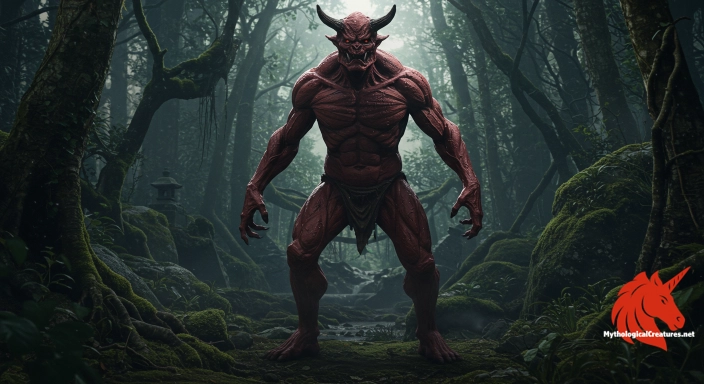
Onihitokuchi
Onihitokuchi - Symbolises extreme danger and the metaphorical notion of tackling challenges swiftly.
Origins & First Encounters
The legend of Onihitokuchi emerges as a vivid testament to the dual power of myth and metaphor in Japan’s cultural history. The narrative portrays an oni so formidable that it can consume a human in a single, decisive mouthful, symbolising the shock of overwhelming force. Rooted in the setsuwa tradition, the tale first took shape in an era when oral storytelling intertwined with written texts to forge moral lessons. The account is as much a reflection of literal fear as it is an allegory for sudden, life-altering challenges. Over time, the motif has evolved to represent obstacles that are both daunting and, at times, surprisingly effortless to overcome through swift action. Its origins are intertwined with the ritualistic and symbolic narratives that were prevalent during Japan’s medieval periods. The tale has captivated audiences for centuries by encapsulating the terror of the unknown alongside the resonance of everyday struggles. With each retelling, Onihitokuchi has maintained its status as an emblem of the extraordinary capabilities of destructive power.
Source Texts & Tale Variants
The tale of Onihitokuchi finds its earliest traces within the diverse collection of setsuwa, where myth and morality blend seamlessly. Various ancient texts recount the episode with subtle variations, some detailing the literal act of instant human consumption, while others imbue the narrative with metaphorical significance. In historical compilations, such as temple manuscripts and regional folktales, the oni is portrayed as possessing an almost supernatural ability to obliterate its target in one swift gulp. Multiple story variants have emerged over time, each offering its own nuance and emphasising different elements of fear and unexpectedness. Some versions accentuate the creature’s unbridled ferocity, while others use the motif to symbolise rapid and decisive transformation. The existence of contrasting accounts reveals a rich tradition of retelling, where oral and written sources alike contributed to a layered understanding of the legend. Local narrations, passed down through the generations, often altered details to reflect contemporary social anxieties. Together, these sources weave a complex tapestry that not only documents an ancient myth but also mirrors the evolving cultural landscape of Japan.
Form & Powers
In imaginative depictions, Onihitokuchi is embodied as a colossal and menacing figure whose physical attributes are as dramatic as the legend itself. The creature is often illustrated with a gargantuan mouth, wide enough to engulf a human in a single, shocking bite. His eyes are said to burn with an inner fire, evoking both fury and an otherworldly determination. Thick, wild hair and prominent, curved horns further accentuate his monstrous silhouette, contributing to the eerie blend of beauty and terror. His skin, depicted in hues ranging from deep crimson to dark, ominous tones, reinforces the notion of a being born from chaos. While some artistic interpretations focus on a robust, muscular form suggestive of brute strength, others offer a leaner, almost skeletal outline that hints at spectral malevolence. Every exaggerated feature, from bulging muscles to a fearsomely contorted visage, is intentionally crafted to evoke a sense of primal dread. In this way, the physical characterisation of Onihitokuchi serves not only as a cautionary image but as an enduring symbol of unstoppable, fearsome power.
Regional Faces
The interpretation of Onihitokuchi varies significantly across different regions of Japan, each adding unique local flavours to the ancient tale. In rural communities, the legend is often retold with an emphasis on nature’s untamed and sudden violence, serving as a compelling warning against straying into dangerous wilds. In the Kansai region, artistic renditions tend to highlight additional grotesque attributes, such as extra sets of eyes or unusually twisted horns, which serve to heighten the local mythic imagination. Eastern regions, by contrast, sometimes depict the creature as a more spectral presence, merging fear with an ethereal quality that blurs the line between myth and spirit. This regional diversity extends to the metaphorical use of Onihitokuchi in colloquial expressions, where the phrase ‘one mouthful’ is applied to describe tasks or incidents that occur rapidly and decisively. Local festivals and ritual performances occasionally incorporate elements of the legend, transforming the fearsome figure into a symbolic agent of cleansing and renewal. These varied regional portrayals provide a fascinating lens through which to view the dynamic adaptability of folklore across Japan. Collectively, they underscore how a single mythic motif can be reinvented to resonate with the distinctive values and experiences of diverse communities.
Cultural Parallels
Across the global mythological landscape, the image of a monstrous being that consumes its victims whole finds intriguing parallels. European folklore, for example, offers tales of ogres whose singular, horrifying appetite mirrors the swift act of devouring embodied by Onihitokuchi. In these diverse narratives, the instant annihilation of a victim serves as a potent metaphor for the suddenness of catastrophe and the unforeseen nature of misfortune. Similar allegorical themes can be seen in various cultural legends, where the act of consumption is not merely physical but emblematic of overwhelming, transformative forces. East Asian mythologies also contribute close counterparts, with spirits and demons occasionally depicted in ways that echo the one-mouthful motif. Despite differences in cultural context and artistic style, there is a shared symbolism in the immediate eradication of life, suggesting a universal human fascination with the concept of unstoppable power. These cross-cultural comparisons reveal that the fear and awe inspired by such legends transcend geographical borders. Ultimately, the narrative of Onihitokuchi stands in a rich dialogue with international mythic traditions, highlighting common concerns about vulnerability and the sudden impact of chaos.
Legacy & Modern Evolution
Over the centuries, the depiction of Onihitokuchi has evolved from a stark emblem of terror into a multifaceted cultural icon. Initially, early narratives served as a literal warning of the dangers posed by the unknown, but with time the tale began to operate more as a metaphor for overwhelming and rapid challenges. As literary and artistic interpretations broadened, the figure of the oni merged its grotesque physicality with allegorical meanings, reflecting the complexities of human adversity. During the Edo period, visual media such as prints and scrolls reimagined the demon with a blend of horror, satire, and social commentary. In contemporary Japanese culture, the image of the oni, including aspects reminiscent of Onihitokuchi, frequently appears in anime, manga, and modern literature, resonating with a new generation. These modern embodiments often reinterpret the ancient warning in a playful yet potent manner, underlining the timeless nature of the myth. The contemporary use of the term in everyday language further illustrates how deeply the legend has permeated cultural consciousness. As a symbol that bridges the mystical past with modern life, Onihitokuchi continues to inform discussions on fate, resilience, and the dual nature of human challenges, ensuring its place in the evolving tapestry of myth and meaning.
Interesting Fact
Interestingly, the term 'Onihitokuchi' has transcended its mythological origins to become a common idiom in modern Japanese, reflecting the cultural memory of its swift, decisive nature.
Curated sponsor space
One subtle banner. Thousands of myth lovers.
We offer a small number of curated sponsor spots for relevant books, courses, games, and art. No clutter, just well-matched partners.
Partner with usQuick Creature Info
Features:
Associations:
Our Mythic Legendary Rating:

Habitat:
Supernatural Powers:
Physical Attributes:
Abilities:
Behavior:
Lore:
Related Creatures, Tales or Lore
- SShuten-dōji
- IIbaraki-dōji
- GGeneral Oni
References
Discover Another Mythical Legend You May Not Have Heard Of?
Uncover the mysteries of ancient folklore and expand your knowledge of legendary beings from cultures around the world.
Dare to Meet the Alakshmi....
Curated by the Mythological Creatures Team
Series editor: Mythological Creatures Directory
Primary desk: Asian & Pacific Myth Cycles Desk
(rev. November 2025)