
Orek: The Orek is an undead, reanimated corpse from Turkic mythology.
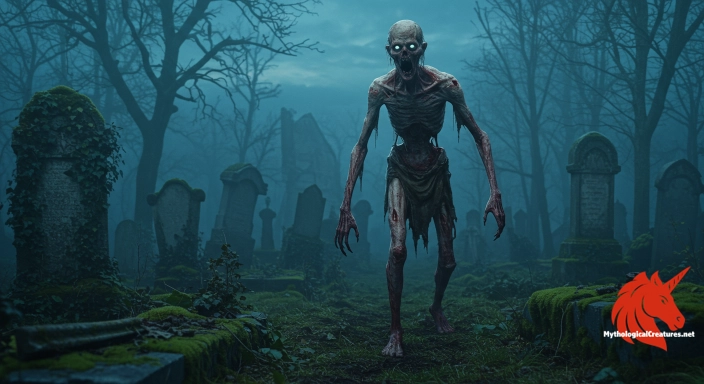
Orek
Orek - Represents the fear of the dead returning and serves as a cautionary symbol of the consequences of dark magic in Turkic folklore.
Origins & First Encounters
The Orek embodies a chilling embodiment of life stripped of its natural order, a phenomenon deeply woven into Turkic mythological tradition. Its origin is steeped in the mysterious rituals and ancient beliefs of Turkic cultures, where reanimation through mystical means provided answers to the boundaries between life and death. Emerging from traditions that have been passed down through generations, the Orek was first attested in oral narratives that reflected fears and awe towards the unknown. Over time, its legend was enriched by various cultural practices and metaphysical interpretations, turning it into a focal point of supernatural lore. The creature is often depicted as a corpse brought back to life through methods such as witchcraft, challenging natural laws with its animated state. Its existence is not merely a physical anomaly but a deep-seated symbol of unresolved spiritual turmoil. In many traditions, the Orek’s reanimation is triggered by a mysterious figure, often a girl dressed in white, who performs the act in secretive rituals under moonlit skies. With a name that in some languages translates to ‘soul’ or ‘ghost’, it blurs the line between the corporeal and the spectral, underscoring the multifaceted cultural context that birthed it.
Source Texts & Tale Variants
The narrative surrounding the Orek is derived from a blend of ancient oral traditions and later written compilations that capture Turkic folklore. Folktales and regional legends, especially from Turkish, Azerbaijani, Tatar, and Bashkir sources, have provided numerous variants of its story. Ancient manuscripts and later ethnographic records document the creature’s appearances and attribute its reanimation to mystical practices. Stories often diverge on details such as the method of its revival, with some accounts citing the involvement of a girl adorned in white while others hint at darker sorcery. These narrative variants have evolved over time, reflecting local customs and supernatural interpretations unique to each community. Historical records, though fragmented, suggest that the belief in the Orek has roots in shamanistic and animistic practices prevailing in early Turkic societies. As storytellers adapted the myth to suit their cultural milieu, literary and oral retellings diversified, ensuring that the tale of the Orek remained both mutable and enduring. The evolution of these sources has enriched the myth, offering a tapestry of variations that reinforce its enduring presence in the folkloric canon.
Form & Powers
The physical depiction of the Orek is as unsettling as it is iconic, marked by the stark contrast between its once-human features and its current decayed form. Chronicled in various narratives, the creature is typically portrayed as a reanimated corpse with discoloured, pallid skin that hints at its unholy revival. Its eyes are often described as vacant or glowing with an otherworldly luminescence, reflecting a void where a soul might have resided. The creature’s anatomy, though recognizable, is marred by the ravages of decay, with sagging flesh and exposed bones that underscore its unnatural state. In some descriptions, the Orek maintains remnants of its former attire, now tattered and stained, which evoke a mournful reminder of its past life. The physical presence of the Orek is further enhanced by an eerie stillness, as if the very air around it recoils in fear. Variations in size and stature appear in regional accounts, with some portrayals assigning it a towering, spectral form while others depict it as more human-sized and grotesquely contorted. Each detail, from the chilling grip of its withered hands to the slow, shuffling gait, reinforces its status as an entity that defies natural order.
Regional Faces
Across the vast panorama of Turkic lands, regional interpretations enhance the tapestry of the Orek myth. In Turkish and Azerbaijani traditions, the creature is seen as a symbol of cursed existence, a dire consequence of meddling with forbidden arts. In contrast, Tatar and Bashkort communities sometimes use the term to denote a wandering soul or ghost, adding layers of ambiguity to its nature. Some areas emphasise the role of a mystical female figure in transforming the dead into an Orek, a narrative element that remains unique to specific locales. Variations in physical descriptions and behavioural traits further illustrate how local environmental and cultural influences shape its legend. The Orek’s manifestation can differ subtly, with some regions portraying it as a slow-moving revenant cloaked in decay, while others envision it with an almost animalistic ferocity fueled by a hunger for human flesh. As folk narratives filtered through local dialects and customs, the creature's aura of dread was tailored to both rural and urban settings. These local adaptations not only preserved the myth but also allowed the tale of the Orek to reflect the diverse fears and superstitions inherent in different communities.
Cultural Parallels
An exploration of cultural parallels reveals that the Orek shares thematic and physical similarities with other undead entities found in worldwide mythologies. Comparable to the European revenant, the Orek embodies the terror of a defiled corpse that wanders the world, animated by forces beyond mortal comprehension. The motif of a reanimated corpse is similarly echoed in modern depictions of zombies, far removed from their contemporary interpretations but rooted in ancient beliefs. Comparisons can also be drawn with East Asian myths, such as the Jiangshi, where the manipulation of life and death results in unnerving creatures that defy nature. Like many folkloric entities, the Orek serves as a vessel for cultural anxieties surrounding mortality and the unknown. Both the Orek and its counterparts encapsulate the dread of what lies beyond the grave, blurring the boundaries between the human and the supernatural. The shared elements among these myths underscore a universal human fascination with and fear of life after death, while also highlighting unique regional nuances. Such comparative analyses reveal that the Orek is not an isolated myth but part of a broader tapestry of undead legends that reflect the collective cultural psyche across continents.
Legacy & Modern Evolution
Over the centuries, the perception of the Orek has undergone a significant transformation, evolving from ancient oral lore to a subject of modern reinterpretation in literature and film. Early depictions drew heavily on the visceral imagery of decay and terror, reflecting societies confronted with death and the mysteries surrounding it. As cultural narratives shifted, the Orek became a metaphor for unresolved grief and the persistence of memory beyond the grave. Contemporary reinterpretations often blend traditional motifs with modern horror aesthetics, yielding portrayals that resonate with current societal fears. In art and cinema, the creature has been reimagined with a psychological edge, symbolising the inescapable nature of past transgressions and the spectre of spiritual disquiet. Its enduring legacy is also evident in academic and cultural studies that examine the intersection of myth and identity in Turkic societies. Museums and cultural exhibitions sometimes highlight the Orek as a prime example of how myth can shape and reflect community values through the ages. Ultimately, the evolution of the Orek myth illustrates a dynamic interplay between tradition and modernity, ensuring that this eerie figure continues to captivate and unsettle audiences in new and unexpected ways.
Interesting Fact
The name 'Orek' translates to 'soul' or 'ghost' in Tatar and Bashkort, underscoring its dual identity as both a tangible reanimated corpse and a spectral presence in myth.
Support the directory
Promote your myth project and fund more research
Sponsor placements help keep this directory growing and free to use while giving your work a focused, relevant audience.
Learn how sponsorship worksQuick Creature Info
Origin:
Features:
Our Mythic Legendary Rating:

Also Sometimes Known As:
Habitat:
Supernatural Powers:
Physical Attributes:
Abilities:
Behavior:
Weaknesses:
Lore:
References
Discover Another Mythical Legend You May Not Have Heard Of?
Uncover the mysteries of ancient folklore and expand your knowledge of legendary beings from cultures around the world.
Dare to Meet the Sharabha....
Curated by the Mythological Creatures Team
Series editor: Mythological Creatures Directory
Primary desk: Asian & Pacific Myth Cycles Desk
(rev. November 2025)