
Petermännchen: Petermännchen is a small, good-natured household spirit from Schwerin Palace in Germany, renowned for his key-bearing and protective nature.
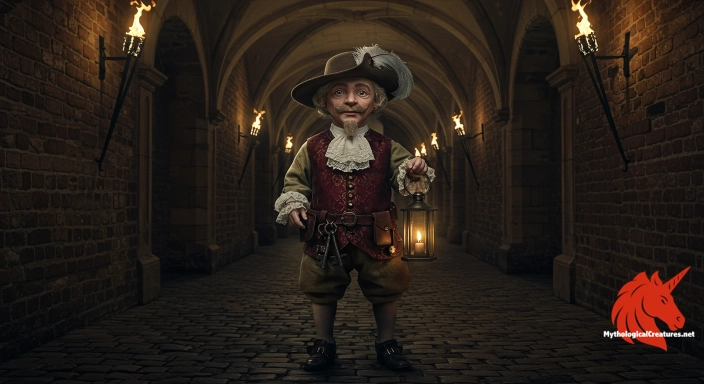
Petermännchen
Petermännchen - Protector of the castle who rewards the honest and punishes intruders, embodying both a guardian and trickster figure in local legend.
Origins & First Encounters
Petermännchen is a uniquely endearing household spirit whose legend has been woven into the historical fabric of Schwerin in northern Germany. Born from the old lore of Mecklenburg, he has been acknowledged as a benevolent guardian of the Schwerin Palace, where myths and history converge. His origins are intertwined with the ancient transition from pagan ritual to Christian ethos, making him a symbol of both continuity and adaptation. Over time, tales of his nightly rounds in the castle’s labyrinthine vaults have elevated him to a status of a vigilant protector. He is said to reward honest souls while meting out peculiar chaos to miscreants. His narrative has been passed down through local oral traditions and historic accounts, each adding layers to his multifaceted persona. The spirit’s enduring presence mirrors the deep cultural impressions left by centuries of local myth-making. His story continues to captivate audiences with its blend of mystery, moral undertones, and a subtle humour that has resonated for generations.
The charm of Petermännchen lies in his ability to bridge the ancient with the modern, reinforcing regional identity and the timeless human fascination with the unseen protectors of our dwellings.
Source Texts & Tale Variants
The tales of Petermännchen have been maintained through a rich tapestry of local folklore and historical narration, passed from generation to generation. Numerous narratives, often collected in regional manuscripts and oral histories, describe his nightly vigils and his role as a keeper of keys. In some accounts, he is depicted carrying not only keys but also a lantern and even a weapon, each element underscoring his dual nature as both caretaker and enforcer. Alternate versions of the story even recount his days as a blacksmith within the secret tunnels beneath Schwerin Palace. The spirit’s character is further embellished by narratives that recount his intervention during the night-watch of soldiers, thereby cementing his role as a saviour of disciplined duty. Some local chronicles hint at his ancient roots linked to a pagan deity whose retinue, save for him, dispersed with the advent of Christianity. These diverse portrayals are a testament to the vibrant and mutable traditions that keep his story alive. Over time, these sources have collectively enriched the legend, providing a multifarious perspective that continues to inspire curiosity.
The varied narrative strands not only affirm his status in local myth but also highlight the community’s enduring investment in the legend of this modest yet influential spirit.
Form & Powers
In visual accounts, Petermännchen is often portrayed as a diminutive spirit, standing only a few feet tall, yet his presence is anything but diminutive. Descriptions vary widely, with some depictions showing him as an elderly figure, complete with a long, flowing white beard that cascades down to his waist, suggesting wisdom and a life spent in ancient service. In other interpretations, his appearance is more dapper, with a stylish moustache and a finely tailored waistcoat that hints at a cavalier elegance. He is sometimes shown wearing riding boots with spurs, a detail that amplifies the sense of readiness in his nightly patrols of shadowy corridors. A feathered hat and lantern often accompany him, symbolising both his historical roots and his ongoing vigilance in the dark recesses of the palace. The keys he carries are rendered with particular care, each one a metaphor for the unlocking of secrets hidden within the castle walls. Variations in his attire, from the rugged look of a blacksmith to the refined image of a guardian, reflect the narrative diversity of his legend. These detailed physical portrayals create a vivid composite image that has evolved with each retelling, capturing the imagination of all who hear his tale.
The multifaceted physical descriptions of Petermännchen ensure that his image remains both iconic and adaptable to the passing ages.
Regional Faces
Petermännchen is primarily celebrated in the Schwerin region, yet his legend echoes in the broader cultural landscape of northern Germany. Various local lore adaptations have seen him incorporate elements common to regional household spirits, integrating features that resonate with the local populace. In some nearby communities, similar spirits are revered for their roles in protecting homes, illustrating a convergence of themes across the region. These local iterations may introduce subtle variations in his appearance, sometimes blending traditional German aesthetics with influences from neighbouring folklore. The spirit’s customary duties, such as rewarding good conduct and punishing wrongdoers, are familiar motifs that have been adapted to local social values. In areas adjacent to Schwerin, legends have expanded his realm to include more overt manifestations of supernatural mischief. Regional storytellers have also tailored his character to mirror local architectural and cultural landmarks, thereby reinforcing his connection to place. These variations serve to both enrich and personalise his myth, ensuring that every retelling resonates with the specific customs and traditions of its area.
The diverse regional adaptations of Petermännchen underscore the fluidity of folklore and its capacity to evolve within distinct cultural milieus.
Cultural Parallels
Across the diverse tapestry of European folklore, Petermännchen finds his counterparts in many local household spirits who embody the dual roles of protector and punisher. His function as a benevolent yet mischievous guardian has notable parallels with the Brownies of British lore, who similarly watch over the homestead while ensuring moral rectitude. Comparable entities, such as the German kobolds and the Scandinavian tomte, share the common trait of assisting with domestic chores and preserving household order. These spirits, much like Petermännchen, are celebrated for their ability to infuse everyday life with a sense of mystery and moral consequence. The interwoven narratives across various cultures highlight a universal human need to explain and mediate the unseen forces that guard our living spaces. Petermännchen’s unique blend of humour, vigilance, and moral oversight aligns him closely with these cross-cultural legends, reinforcing a shared mythological archetype. His tale, therefore, is not only a regional emblem but also part of a broader European narrative of protective supernatural beings. Such comparative insights illuminate the myriad ways in which similar mythological motifs manifest and inspire the cultural imagination.
This cross-cultural reflection enriches our understanding of Petermännchen, situating him within a wider context of domestic spirits and guardian entities.
Legacy & Modern Evolution
The evolution of Petermännchen’s legend from ancient myth to modern folklore encapsulates the dynamic nature of cultural memory. Historical depictions have shifted over the centuries, initially rooted in pagan traditions and later reinterpreted through the lens of Christian morality. As local culture transformed, so too did the image of this benevolent spirit, gradually becoming a symbol of both heritage and local pride. In contemporary times, his visage is frequently celebrated in festivals, local tours, and artistic portrayals that seek to revive the magic of Schwerin’s past. Modern stories tend to emphasise his protective presence and moral symbolism, presenting him as a benevolent overseer who bridges the gap between history and modern life. The spirit’s iconography has been reimagined to include modern sensibilities, blending tradition with creativity in art and media. His enduring resonance is further evident in the way he continues to inspire local storytellers and cultural custodians. Petermännchen now stands as a captivating figure who embodies the spirit of resilience and the transformative power of myth in a rapidly changing world.
In this way, the legacy of Petermännchen remains an inspiring reminder of the enduring influence of folklore on both community identity and cultural creativity.
Interesting Fact
An intriguing aspect of Petermännchen is his ability to transform his appearance, reflecting evolving cultural perceptions of household spirits over the centuries.
Partner with Mythological Creatures
Bring your myth-based world into ours
From game settings to narrative worlds, we work with partners who treat myths with care. Share your project for a potential sponsor slot.
Partner with usQuick Creature Info
Origin:
Associations:
Our Mythic Legendary Rating:

Also Sometimes Known As:
Habitat:
Supernatural Powers:
Physical Attributes:
Abilities:
Behavior:
Lore:
References
Discover Another Mythical Legend You May Not Have Heard Of?
Uncover the mysteries of ancient folklore and expand your knowledge of legendary beings from cultures around the world.
Dare to Meet the Cipitio....

Curated by the Mythological Creatures Team
Series editor: Mythological Creatures Directory
Primary desk: Northern & European Folklore Desk
(rev. November 2025)