
Ponmagyi: Ponmagyi is a Burmese rice and fertility nat revered by farmers in Upper Myanmar.
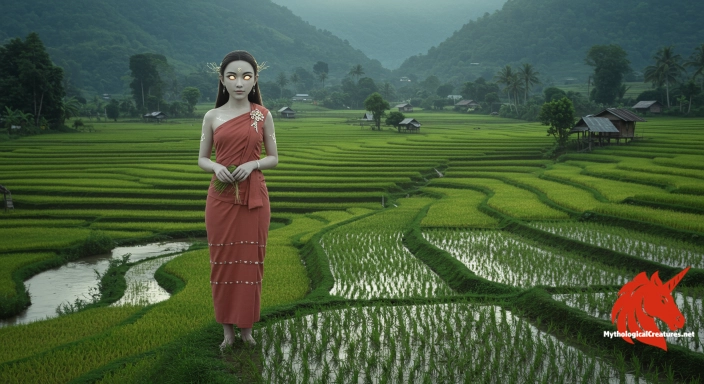
Ponmagyi
Ponmagyi - Ponmagyi is revered by farmers for her ability to bless them with bountiful rice harvests and overall agricultural prosperity.
Origins & First Encounters
Ponmagyi emerges as a distinctive figure within the Burmese pantheon of nats, revered chiefly for her association with rice and fertility. Her origins appear deeply intertwined with agricultural life, symbolising both the bountiful harvest and the nurturing aspects of nature. She is traditionally celebrated by the farming communities of Upper Myanmar, where the cycle of rice cultivation holds cultural and economic significance. Historical records and oral traditions suggest that Ponmagyi has been an emblem of prosperity since ancient times, with her veneration predating many of the later Buddhist influences in the region. Local lore recounts her as a spirit who bridges the gap between the earthly and the divine, her interventions believed to safeguard crops and ensure fertility. The earliest attestations of Ponmagyi are found in local ritual practices and iconographic depictions that have evolved over centuries. She is also known as Ponmagyi Shinma, a name that further reinforces her maternal and nurturing qualities seen as essential for community survival. Over time, her narrative has amalgamated elements of myth, ritual, and agrarian magic, rendering her an integral part of Myanmar’s cultural heritage.
Source Texts & Tale Variants
The sources that recount the legend of Ponmagyi derive from a rich mixture of oral narratives, traditional performances, and sporadic inscriptions. Various folklore collections preserve multiple versions of her story, each emphasising her role in ensuring a successful rice harvest and fertility of the land. Alongside these oral testimonies, temple rituals and local festivals have historically offered a stage for recounting her deeds and displaying symbolic artefacts. In some regional manuscripts, subtle variations hint at a complex evolution of her myth, where local deities merge with the figure of Ponmagyi through centuries of renarration. Artisans and storytellers in rural villages have maintained her legacy by enacting seasonal dramas that highlight her benevolent power. Though not as extensively chronicled in formal writings as some other nats, her influence is palpable in the everyday rites and festivals of Upper Myanmar. Certain colonial-era documents also mention her as a symbol of agrarian hope, woven into the fabric of local religious practices. These layered and sometimes contradictory sources jointly enrich the tapestry of traditions that celebrate Ponmagyi.
Form & Powers
Iconographically, Ponmagyi is often depicted as an ethereal embodiment of fertility and abundance, her presence marked by an elegant yet spirited bearing. Traditional representations show her adorned in flowing garments that mirror the colour of ripened rice, with subtle hints of gold and green that speak to her connection with the harvest. Her visage is portrayed with gentle features and warm, compassionate eyes, reflecting both maternal care and the vitality of nature. In some depictions, she carries symbols of agriculture such as rice stalks or bowls filled with grains that underscore her role as a harbinger of fertility. Artists sometimes embellish her form with intricate patterns inspired by traditional Burmese textiles, while others focus on the natural motifs that symbolise growth. Variations in size and proportion across different regions point to local artistic interpretations, yet a consistent elegance and nurturing quality characterises her depictions universally. Delicate ornaments and floral motifs often accompany her, signifying the blossoming of life and the cyclical nature of the seasons. This visual iconography reinforces her status as a powerful yet benevolent force in the agrarian realm.
Regional Faces
While Ponmagyi is rooted in the cultural landscape of Upper Myanmar, her portrayal adapts to the regional nuances of various local communities. In rural hinterlands, her image tends to be more intimately connected with the immediate cycles of planting and harvest, often portrayed in simpler, earthy terms that echo the environment. Resourceful local artists may incorporate indigenous materials and local flora into depictions of her, thereby creating versions that resonate with their own cultural context. Conversely, in more urban or central ceremonial settings, her presentation can be more elaborate, with refined details that reflect a synthesis of traditional and contemporary Burmese aesthetics. Some regional festivals dedicate entire ceremonies to Ponmagyi, where the local dialect and ritual songs introduce unique variations in her story, highlighting her multifaceted role as both a nurturer and protector. The blending of indigenous and external influences in these regions has led to a dynamic range of iconographic interpretations. Rural narratives sometimes imbue her with attributes from neighbouring Southeast Asian agrarian deities, thereby enriching her myth with a transnational character. Such regional adaptations underscore the versatility of her symbolism, making her a truly local yet widely resonant figure.
Cultural Parallels
In a broader cultural context, Ponmagyi shares thematic parallels with various fertility deities found across Southeast Asia and beyond, each embodying nature’s capacity for renewal and growth. Similar to the Thai and Lao agricultural spirits, she is frequently celebrated as a guardian of the harvest and a symbol of the community’s reliance on the land. Comparative studies reveal that like many other agrarian deities, her narrative intertwines benevolence with the transformative power of nature, which is a recurring motif in mythologies worldwide. Her attributes have echoes in the Indian goddess of wealth and fertility, though her emphasis on rice situates her uniquely within Burmese and Southeast Asian traditions. The cross-cultural similarities extend to iconographic elements such as the display of natural motifs and the use of symbolic items like rice and grains. Despite these common threads, Ponmagyi retains a distinctive identity that reflects the particular agricultural and spiritual ethos of Myanmar. Her mythology resonates with universal themes of life, death, and rebirth, while also maintaining localized expressions of belief that set her apart from other fertility figures. These connections serve as a testament to the shared human impulse to invoke divine assistance in matters of sustenance and growth.
Legacy & Modern Evolution
The enduring legacy of Ponmagyi is evident in the way her image has transformed and adapted across generations. Traditionally venerated by farmers, she now symbolizes not only agrarian fertility but also the resilience and continuity of cultural identity in Myanmar. Over time, her portrayal has expanded to incorporate elements of modern artistry and cultural revival, finding a place in festivals, local theatre, and even in contemporary visual arts. The synthesis of age-old folklore with modern interpretations has allowed her narrative to evolve beyond mere agricultural rites, touching on themes of female empowerment and environmental stewardship. Communities continue to honour her through ceremonial practices that have been updated to resonate with today’s social and economic landscapes. In recent years, scholars and cultural custodians have sought to preserve her stories as an integral part of Myanmar's intangible heritage. Modern reinterpretations sometimes cast her as a symbol of hope and renewal, reflecting the challenges and aspirations of present-day rural life. As such, Ponmagyi remains a vibrant and dynamic figure whose myth continues to influence both tradition and innovation in the cultural expressions of the region.
Interesting Fact
An intriguing aspect of Ponmagyi is her dual identity as both a fertility deity and a protective spirit, symbolizing the profound relationship between nature and culture in Myanmar.
Curated sponsor space
One subtle banner. Thousands of myth lovers.
We offer a small number of curated sponsor spots for relevant books, courses, games, and art. No clutter, just well-matched partners.
Partner with usQuick Creature Info
Origin:
Features:
Associations:
Our Mythic Legendary Rating:

Also Sometimes Known As:
Habitat:
Supernatural Powers:
Physical Attributes:
Abilities:
Behavior:
Lore:
Related Creatures, Tales or Lore
- IInari
- DDemeter
- PPachamama
References
Discover Another Mythical Legend You May Not Have Heard Of?
Uncover the mysteries of ancient folklore and expand your knowledge of legendary beings from cultures around the world.
Dare to Meet the Mazapégul....

Curated by the Mythological Creatures Team
Series editor: Mythological Creatures Directory
Primary desk: Asian & Pacific Myth Cycles Desk
(rev. November 2025)