
Sandraudiga: Sandraudiga is an ancient Germanic goddess known from a Latin-inscribed stone in North Brabant, the Netherlands.
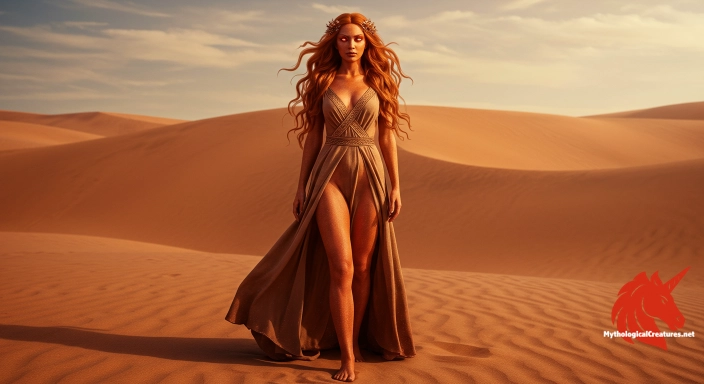
Sandraudiga
Sandraudiga - Sandraudiga is significant as one of the few attested indigenous deities from the southern Netherlands, reflecting syncretism between Roman and Germanic cultural influences.
Origins & First Encounters
Sandraudiga emerges from the mists of ancient Germanic lore as an enigmatic goddess whose origins are as debated as they are intriguing. Her earliest and most tangible attestation is carved on a stone bearing a Latin inscription found in North Brabant, which provides a rare yet precious glimpse into the spiritual world of the region. The inscription itself is brief, yet it hints at a potent identity by suggesting a role that might be interpreted as 'she who dyes the sand red', inviting explorations of both symbolic colour and elemental power. Rooted in the cultural milieu of southern Netherlands, her presence reflects the synthesis of indigenous tradition with Roman influence, creating a dynamic religious landscape. The fragmentary nature of her historical record has encouraged modern scholars to piece together her narrative from scattered epigraphic evidence and regional comparisons with other deities. Embedded within the same artistic and cultic context as figures like Nehalennia and Vagdavercustis, Sandraudiga holds a place among a pantheon signalling the diverse spiritual practices of the time. Her mysterious appellation and sparse attestation fuel ongoing debates regarding her functions, which may have spanned fertility, transformation, and the very marking of boundaries in nature. The continuing scholarly interest in her character underscores both her cultural significance and the enduring allure of mythic fragments that challenge modern understanding.
Source Texts & Tale Variants
The primary evidence for Sandraudiga is the inscribed stone from North Brabant, a tangible relic that anchors the goddess in the annals of history. This stone, now preserved in the National Museum of Antiquities in Leiden, carries a Latin inscription that serves as the sole written account of her existence. Although the inscription is laconic, it has been pivotal in sparking interpretative debates among historians and archaeologists alike. No comprehensive mythological texts or elaborate literary cycles preserve her tales, leaving artisans and scholars to extrapolate meaning from the scant clues provided. Diverse readings of her name have led to alternative narratives, each attempting to situate her within the broader context of regional divinities. Alongside other indigenous Dutch deities mentioned in similar inscriptions, Sandraudiga shares ties with a local pantheon rich in symbolism and ritual significance. Some modern interpretations have sought to expand upon these brief inscriptions by invoking comparative studies with related deities of nearby cultures. This fragmentary epigraphic evidence continues to be a springboard for vibrant scholarly discourse and speculative reconstructions of her mythic persona.
Form & Powers
In the absence of surviving iconographic depictions, the physical attributes of Sandraudiga remain largely a matter of informed conjecture and artistic interpretation. It is conceivable that if visual representations once existed, they might have portrayed a figure that harmoniously blended human elegance with the formidable aspects of nature. Artistic reconstructions often envision her in flowing robes, perhaps marked by a distinctive red hue that symbolically aligns with her name. Such imagery would suggest an embodiment of both transformation and the regenerative power inherent in natural cycles. In later depictions inspired by comparative mythologies, she is sometimes rendered with a serene and enigmatic expression, hinting at wisdom and otherworldly insight. The motif of red, potentially linked to the dyeing of sand, has prompted artists to incorporate elements of earth and fire into her portrayal. Variations in imagined size and form can be discerned in modern artistic experiments, symbolising the fluidity of her myth rather than any fixed anthropomorphic standard. This speculative reconstruction not only bridges the gap left by the ancient record but also provides a canvas upon which the nuanced interplay between identity and nature can be celebrated.
Regional Faces
Sandraudiga’s narrative is particularly resonant within the local context of the southern Netherlands, where indigenous religious practices mingled with Roman influences to shape distinct regional cults. The stone inscription in North Brabant points to a deity who was deeply embedded in the local spiritual landscape, offering a glimpse of a goddess who might have presided over natural phenomena specific to that area. Her enigmatic name, tentatively translated as 'she who dyes the sand red', suggests an intimate connection with the local environment and its unique physical characteristics. Regional variations in the interpretation of her name and functions highlight a flexible iconography, adapted to meet the spiritual and cultural needs of different communities. Local ritual practices and seasonal rites may have celebrated her as a guardian of transformation and renewal, reflecting the cyclical patterns of agrarian life. As part of a broader compendium of southern Dutch deities, her character was likely shaped by overlapping traditions and the syncretism inherent in borderland cults. Variability in her representation across nearby settlements points to a mosaic of local practices rather than a unified doctrine. This regional specificity underscores how Sandraudiga’s myth evolved in tandem with the cultural and environmental dynamics of her homeland.
Cultural Parallels
Within the wider realm of comparative mythology, Sandraudiga can be juxtaposed with other deities who embody the themes of transformation and elemental power. She shares intriguing similarities with figures such as Nehalennia and even aspects of the Roman goddesses who symbolised nature and fertility, where colour and natural materials play a significant role in their iconography. The interpretation of her name as evoking a red dye brings to mind cross-cultural references where red signifies both vitality and the transformative force of natural cycles. Such parallels extend to other Germanic and Celtic deities, whose mythic narratives often celebrate the interplay between human endeavour and nature’s inexorable processes. In each case, the blending of indigenous and external influences results in a richly layered tapestry of symbols and meanings. Comparative studies reveal that while the specifics of iconography and narrative vary, the motif of rebirth through the modulation of natural elements is a common ethnographic thread. This interrelationship between disparate mythological systems reinforces the notion that Sandraudiga was part of a broader, pan-European dialogue on themes of renewal and transformation. The cross-cultural examination of similar deities enhances our understanding of how local legends echo universal concerns about nature, power, and change.
Legacy & Modern Evolution
Over the centuries, Sandraudiga has transitioned from an obscure inscription on an ancient stone to a symbol that continues to inspire modern reinterpretation. Her elusive narrative, pieced together from fleeting epigraphic evidence, has given rise to myriad scholarly debates and creative reconstructions. Contemporary cultural discourse has embraced the ambiguity of her myth, allowing artists, writers, and even neopagan communities to reinvigorate her image as a deity of transformation. Museums, such as the National Museum of Antiquities in Leiden, use her story as a compelling entry point into the complex interplay of local and imperial influences in early Germanic society. Modern exhibitions and academic conferences frequently highlight the enigmatic nature of her inscription, underscoring the enduring appeal of deities who straddle myth and history. Her evolving portrayal—from a local cult figure to a broader emblem of nature’s cyclical power—reflects shifting cultural priorities and interpretations over time. The poetic resonance of her name continues to motivate artistic endeavours that celebrate both the mystery and the vitality of ancient traditions. Ultimately, Sandraudiga’s legacy is not defined by a single narrative, but by the collective imagination of those who seek to understand the enigmatic past and its influence on modern cultural identity.
Interesting Fact
The inscription of Sandraudiga provides one of the rare direct evidences of pre-Christian Germanic worship in the southern Netherlands, highlighting a unique blend of Roman and indigenous influences.
For serious mythcraft
Your project belongs among the legends
If your work deepens how people understand, play with, or teach mythology, a sponsor placement here keeps it in front of the right readers all year.
Submit a sponsorship enquiryQuick Creature Info
Origin:
Features:
Associations:
Our Mythic Legendary Rating:

Habitat:
Supernatural Powers:
Physical Attributes:
Abilities:
Lore:
Related Creatures, Tales or Lore
- NNehalennia
- VVagdavercustis
- HHludana
References
Discover Another Mythical Legend You May Not Have Heard Of?
Uncover the mysteries of ancient folklore and expand your knowledge of legendary beings from cultures around the world.
Dare to Meet the Xipe-Totec....
Curated by the Mythological Creatures Team
Series editor: Mythological Creatures Directory
Primary desk: Northern & European Folklore Desk
(rev. November 2025)