
Starkad: Starkad is a legendary Norse figure portrayed either as an eight‐armed giant or the human grandson of a giant, renowned for his valor and ambiguous morality.
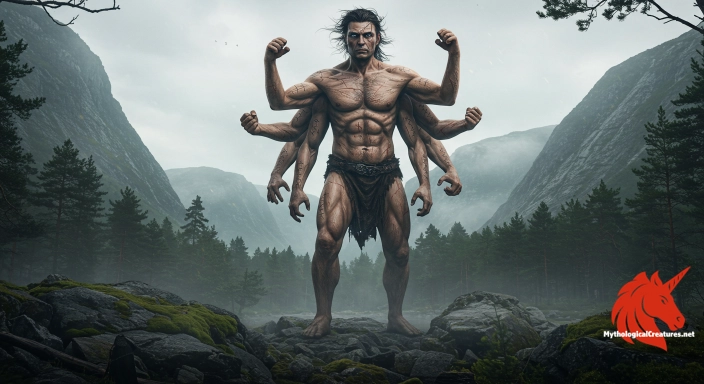
Starkad
Starkad - A pivotal figure in Scandinavian legends whose exploits underscore the interplay between heroic greatness and tragic moral ambiguity.
the legend in five swipes.
the legend in five swipes.
Who first told stories about Starkad?
Starkad emerges as one of Norse mythology’s most complex figures, whose legend is intricately woven with themes of both heroic grandeur and moral ambiguity. He is portrayed in one tradition as an eight-armed giant, while another tradition venerates him as the human descendant of a mighty giant. His origins resonate with an era when myth and history blurred, imbuing his character with an enigmatic air borne from ancient genealogical mysteries. Early medieval texts and oral traditions present his exploits in vivid detail, marking the intersection of supernatural might and human endeavour. His narrative is steeped in a cultural context where valor and transgression coexisted, reflecting the turbulent ethos of his times. The multifaceted nature of his character highlights the struggle between destiny and self-determination. His exploits, both laudable and condemned, are interlaced with the societal values and existential dilemmas of early Scandinavian societies. Over time, his story has captivated audiences by embodying the paradoxes inherent in heroic legends. Starkad’s enduring presence in myth underscores a legacy that is as much about cautionary lessons as it is about celebrated feats.
Starkad: Variants Across the Sources
The accounts of Starkad have been preserved through a tapestry of medieval literature, with the Gesta Danorum offering one of the most extensive narratives of his deeds. Diverse texts from Icelandic sources further elaborate on his adventures, presenting variations that emphasise different facets of his character. Each source contributes a unique perspective, with some emphasising his supernatural attributes while others focus on his human flaws. The written records are enriched by oral traditions that have passed his story down through generations in the Nordic lands. Remarkably, his legend even finds a cognate in the Anglo-Saxon epic Beowulf, where echoes of his dual nature can be discerned. These diverse story variants illustrate a myth that is both adaptable and deeply resonant with its audience. The amalgamation of sources offers a multi-layered understanding that enriches the portrayal of his heroic and criminal dimensions. As textual traditions evolved, they allowed for regional embellishments and reinterpretations that are as enlightening as they are varied. The surviving narratives collectively capture a figure who has been both revered and vilified, celebrating the intricate fabric of Norse myth.
Starkad: Powers, Strengths and Vulnerabilities
Starkad’s physical depiction is as varied as the legends that recount his exploits, showcasing an extraordinary blend of human and supernatural traits. In some portrayals, his figure is marked by the striking presence of eight arms, symbolising superhuman strength and an almost insurmountable prowess in battle. This iconic detail sets him apart, allowing him to engage enemies on multiple fronts simultaneously. Other descriptions focus on his towering stature and rugged features, portraying him as a battle-hardened warrior whose weathered visage tells a story of numerous conflicts. His eyes are often described as fierce and penetrating, reflecting both wisdom and the scars of countless battles. The variance in his depiction—sometimes as a giant, other times as a mortal hero—adds a compelling layer of ambiguity to his character. Detailed illustrations in ancient manuscripts frequently highlight his imposing presence and the symbolism imbued in his physical attributes. His armour and weaponry, often depicted as adorned with mythic motifs, further accentuate the legendary aura that surrounds him. These vivid descriptions reinforce an image that has evolved through a multitude of interpretations over the centuries.
Starkad: Local Variations in the Story
The myth of Starkad has been refracted through the unique lenses of different Scandinavian cultures, leading to distinct regional variations in his portrayal. In Danish traditions, his narrative is often intertwined with themes of regal heroism and a storied martial legacy, lending his exploits an air of noble destiny. In contrast, Icelandic sources tend to accentuate his human lineage, painting him as a conflicted yet formidable warrior whose deeds are as much about personal struggle as legendary conquests. These regional adaptations have allowed local storytellers to embellish his adventures with culturally resonant details, making his character both universal and uniquely local. Variations in his physical description and the emphasis on his supernatural traits reflect the distinct aesthetic and moral values of each community. Some local versions cast him as a figure burdened by fate, while others celebrate his defiant ingenuity in the face of inevitable doom. This multiplicity of views illustrates how his myth has been tailored to reflect the societal challenges and aspirations of different Nordic regions. The evolving regional narratives provide rich insights into how folklore adapts to diverse historical and cultural milieus. Through these varied lenses, Starkad remains a dynamic symbol of both collective heritage and individual interpretation.
What makes Starkad different from similar figures?
Starkad’s multifaceted legend resonates with mythological figures found in diverse cultural traditions, forging intriguing parallels across the ancient world. His ambiguous nature—being portrayed at times as a giant and at others as a valiant human—mirrors the dualistic heroes found in other mythologies, where strength and frailty coexist in a single character. The Anglo-Saxon epic Beowulf, for instance, offers a counterpoint, presenting warriors who share the blend of heroic virtue and tragic imperfection. Analogous to the complex heroes of Greek and Irish lore, Starkad’s narrative encapsulates the tension between divine favour and mortal flaw. His story, replete with both glorious triumphs and serious transgressions, reflects a broader archetype of the tragic hero who is as celebrated as he is cautioned against. The interplay between his supernatural endowment and human fallibility invites comparisons with other legendary figures whose lives were marked by extraordinary attributes and profound moral conflicts. Across these shared motifs, his myth serves as a bridge linking a wide array of cultural and literary traditions. The cross-cultural analysis of his tale highlights universal themes such as the burden of destiny, the interplay of destiny and free will, and the inherent contradictions in the human condition. Such comparative reflections underscore the timeless appeal and rich symbolic depth of his character.
Starkad: Modern Retellings and Reinventions
Over time, Starkad has evolved from a figure central to ancient Scandinavian epics into a symbol that continues to intrigue modern audiences. Medieval chronicles first painted him as an awe-inspiring warrior whose life was punctuated by both heroic triumphs and notorious misdeeds. As centuries passed, reinterpretations of his tale began to reflect shifting cultural attitudes towards heroism, honour, and the consequences of ambition. Modern adaptations have reimagined him through various artistic media, ranging from literature to film, often underscoring the dual nature of his legacy. In contemporary popular culture, Starkad is frequently portrayed as a morally complex antihero, embodying the perpetual conflict between noble aspirations and human failings. His enduring myth serves as a metaphor for the ambiguous nature of power and the perpetual tension between valor and vice. Scholars and enthusiasts alike find his story a rich canvas upon which to explore the evolution of myth in the face of modern values. The continuing allure of his legend is a testament to the transformative power of storytelling, which adapts ancient narratives to speak to each new generation. As a result, Starkad remains a potent symbol of resilience, complexity, and the timeless struggle between light and shadow in the human spirit.
Interesting Fact
Remarkably, despite his ambiguous nature oscillating between monstrous and human traits, Starkad’s legend has influenced both Norse and Anglo-Saxon literary traditions, highlighting the timeless allure of characters defined by duality.
Mythological Treasures
Norse Sagas: A field guide to the beasts of the Viking world
Drawn from the saga accounts themselves, with the powers, weaknesses and doom of each being set out.
Chinese Beasts: A field guide to the dragons and demon kings of Chinese myth
From river dragons to demon kings, with the legends that shaped five thousand years of storytelling.
Japanese Yokai: A field guide to the spirits and demons of Japanese folklore
Fifteen spirits, with the signs to watch for and what the old tales say to do if you meet one.
the legend in five swipes.
Curated sponsor space
One subtle banner. Thousands of myth lovers.
We offer a small number of curated sponsor spots for relevant books, courses, games, and art. No clutter, just well-matched partners.
Partner with usQuick Creature Info
Origin:
Features:
Our Mythic Legendary Rating:

Also Sometimes Known As:
Habitat:
Supernatural Powers:
Physical Attributes:
Abilities:
Behavior:
Lore:
Related Creatures, Tales or Lore
- BBeowulf
- SSigurd
- HHrólf Kraki
References
Discover Another Mythical Legend You May Not Have Heard Of?
Uncover the mysteries of ancient folklore and expand your knowledge of legendary beings from cultures around the world.
Dare to Meet the Chaneque....
The Mythological Creatures Book Series
Yokai, Greek, Norse, Egyptian & Chinese. Five illustrated field guides to the creatures the old stories either warned or told you about.
Curated by the Mythological Creatures Team
Series editor: Mythological Creatures Directory
Primary desk: Northern & European Folklore Desk
(rev. November 2025)