
Stoor worm: The Stoor worm was a gigantic and malevolent sea serpent from Orcadian folklore.
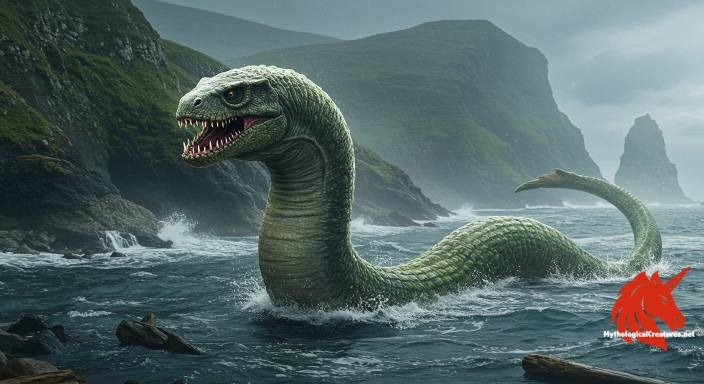
Stoor worm
Stoor worm - The Stoor worm's legend explains the formation of several northern islands and reflects cultural shifts away from human sacrifices.
Origins & First Encounters
The stoor worm emerges from the rich tapestry of Orcadian folklore as a gargantuan sea serpent whose malevolence was the subject of both awe and dread. Its origins are steeped in local myth yet bear a striking resemblance to the Norse world serpent, hinting at a cross-cultural exchange of mythic ideas. The earliest attested versions of the legend are found within oral traditions, where seafarers and rural communities alike wove its dreadful exploits into cautionary narratives. Over time, the creature became emblematic of nature’s untamed fury, representing both physical and moral corruption. The myth evolved in a cultural milieu where dramatic natural phenomena were often explained by supernatural forces. Local storytellers imbued the beast with a primal power that both fascinated and terrified their audiences. As communities grappled with the unpredictable forces of the sea, the stoor worm served as a metaphor for both ecological tumult and existential threat. Its legend has continued to captivate imaginations, reflecting enduring themes of chaos, retribution, and transformation.
Source Texts & Tale Variants
Most of our knowledge about the stoor worm comes from a blend of oral tradition and later literary adaptations in medieval manuscripts and ballads. Varied recitations across the Orkney Islands have preserved differing accounts of its nature and deeds, each adding layers to its mythic persona. Some narratives portray the beast as a sea dragon with apocalyptic symbolism, while others emphasise its ability to wreck the natural order with its corrupting presence. In certain tellings, its demand for human sacrifices is highlighted, suggesting an underlying commentary on the sacrifice of life in the face of natural calamity. Alternate versions, however, focus more on heroic defiance, particularly in the tale of Assipattle, the unlikely slayer of the monster. There exist textual links between the stoor worm legend and other Scandinavian myths, notably those of Jörmungandr. Over time, scribes and folk historians have reinterpreted these stories to reflect evolving societal values and religious beliefs. Despite the patchy record of early attestations, the persistence of the narrative in various forms speaks to its powerful impact on regional cultural identity.
Form & Powers
The stoor worm is depicted as a creature of immense proportions, its monstrous form dwarfing any natural beast found in the folklore of the region. Its serpentine body is said to be covered in rugged, brine-worn scales that glisten like cold, utilitarian armour beneath the subdued light of northern skies. The head of the creature is frequently described as formidable, often adorned with sharp protrusions and a menacing array of teeth. These teeth, legendary in their own right, ultimately transform into physical features of the landscape, a mythic explanation for the formation of nearby islands. Its putrid breath, both toxic and corrosive, is recounted as having the power to contaminate the land and wither plant life. Remarkable accounts sometimes attribute glowing eyes to the worm, suggesting an uncanny, almost sentient awareness of its surroundings. The creature’s overall appearance blends raw natural power with a spectral quality that speaks to its mythic origins. Variations in the narrative depict slight differences in size and proportions, yet all agree upon its overwhelming scale and formidable presence. This vividly detailed portrayal serves not only to instil fear but also to symbolise the untameable forces of the natural world.
Regional Faces
Within the Orkney archipelago, the stoor worm is most famously known as the Mester Stoor Worm, a title that underscores its dominion over both the sea and the land. Regional variants of the story adapt the creature’s narrative to reflect local environmental concerns and cultural dynamics, often linking its demise to the creation of geographical landmarks. In the Shetland Isles and the Faroes, for instance, the myth is interwoven with local legends that credit the creature’s dismembered body with shaping the very contours of the islands. Some versions emphasise its role as a harbinger of ecological disaster, while others present it as an almost redeemable force, whose defeat heralds renewal and order. The regional adaptations tend to focus on the interplay between human agency and the brute force of nature, especially in heroic confrontations. Minor variations in the portrayal of its physical features can be found across the islands, each tailored to the environmental backdrop of its narration. Despite these differences, the central theme of a monstrous sea serpent remains invariant, uniting the various cultural renditions. The stoor worm thus serves as a nexus for regional identity, anchoring communal memory and local mythologies in a shared narrative of cosmic struggle.
Cultural Parallels
The stoor worm shares striking similarities with the Norse Jörmungandr, both of which occupy pivotal roles in their respective mythological frameworks. In cross-cultural contexts, sea serpents often symbolise the chaotic and unpredictable aspects of nature, a motif that is vividly present in the stoor worm legend. Comparable narratives can be found in classical antiquity, where heroes triumph over monsters that embody natural forces beyond human control. The tale of Assipattle bears a thematic resemblence to other dragon-slayer myths, where a seemingly insurmountable evil is brought low by the courage of a mortal hero. Like many mythic dragons and serpents across various traditions, the stoor worm represents the liminal space between life and nature’s raw forces, frequently serving as an allegory for the eternal struggle between order and chaos. Similar creatures appear in Mediterranean and Middle Eastern mythologies, adding to the interconnected tapestry of legendary sea beasts. Such comparative studies reveal that while the names and specific attributes may differ, the underlying symbolic structure is remarkably consistent. These shared motifs reinforce the concept that myth, in its many forms, serves to elucidate humanity’s perennial conflicts and aspirations.
Legacy & Modern Evolution
Over the centuries, the depiction of the stoor worm has undergone significant transformation, shifting from a figure of primal terror to one rich in metaphorical significance. Early portrayals of the creature were utilitarian in their purpose, serving as cautionary tales that warned of nature’s untamable and destructive power. With the advent of modern literary and artistic reinterpretation, the legend has been reframed to explore themes of environmental degradation and the complex interplay between humanity and the natural world. Contemporary narratives often cast the stoor worm as a symbol of the threats posed by unchecked ecological imbalance, resonating in an era deeply concerned with conservation and sustainability. Modern adaptations in film, literature and visual arts have breathed new life into the legend, transforming it into a multifaceted icon that reflects both ancient fears and modern dilemmas. This evolution reflects a broader trend in myth-making, where traditional stories are continually reimagined to align with current cultural and moral sensibilities. The creature’s narrative has also been embraced in regional tourism and cultural festivals, where it is celebrated as an integral part of local heritage. In this way, the stoor worm lives on as a potent emblem of resilience, transformation and the enduring power of myth to bridge past and present.
Interesting Fact
An intriguing aspect of the myth is that the creature's death not only marked the end of a terror but also a creative act, with its teeth forming the very islands that define the northern seascape.
Advertising opportunity
Showcase your mythology project
We offer limited sponsor placements for books, courses, games, and creators aligned with our audience.
View partnership optionsQuick Creature Info
Origin:
Features:
Associations:
Our Mythic Legendary Rating:

Also Sometimes Known As:
Habitat:
Supernatural Powers:
Physical Attributes:
Abilities:
Behavior:
Lore:
Related Creatures, Tales or Lore
References
Discover Another Mythical Legend You May Not Have Heard Of?
Uncover the mysteries of ancient folklore and expand your knowledge of legendary beings from cultures around the world.
Dare to Meet the Yamawaro....
Curated by the Mythological Creatures Team
Series editor: Mythological Creatures Directory
Primary desk: Northern & European Folklore Desk
(rev. November 2025)