
Ta-Bitjet: Ta-Bitjet is an ancient Egyptian scorpion goddess known for her divine healing blood, which serves as a panacea for poisons.
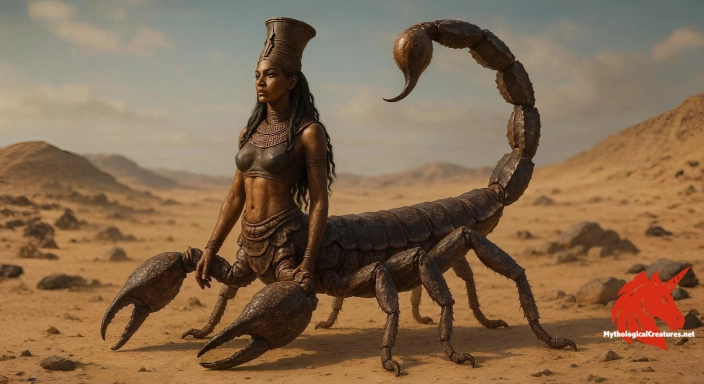
Ta-Bitjet
Ta-Bitjet - Her healing blood is central to her mythos, underscoring themes of sacrifice, regeneration, and divine intervention in averting poison.
Origins & First Encounters
Ta-Bitjet emerges from the rich tapestry of Egyptian mythology as a captivating deity whose origins hint at a complex interplay of healing and danger. Her narrative is interwoven with the divine exploits of Horus, with whom she shares a compelling and intimate association. Emerging in some of the oldest mythic traditions of Egypt, she is portrayed as both a consort and a potent symbol of life’s regenerative powers. Her legend reveals an unusual and striking motif: the mystical power of her blood, which is believed to neutralise poisons, thereby conferring a measure of protection and renewal. Within the broader cultural context, Ta-Bitjet represents the delicate balance between harm and healing, a theme common across many ancient belief systems. Stories of her often suggest that even within chaos lies the potential for cure and rebirth, symbolised by her unique attributes. Her myth is reflective of the ancient Egyptians’ reverence for both the peril and the miracles of nature, particularly in a land where the desert and the Nile coexisted as sources of life and death. The vivid imagery of her association with serpentine danger and venom underscores her role in rituals that aimed to protect and purify. As a goddess, Ta-Bitjet underscores the intertwined fates of love, betrayal, and healing, making her one of the more enigmatic figures in ancient Egyptian lore.
Source Texts & Tale Variants
The primary narratives surrounding Ta-Bitjet can be traced to several ancient texts and funerary inscriptions, where her association with Horus is mentioned with both reverence and mystery. In various temple reliefs and hieroglyphic inscriptions, she appears as a significant figure whose attributes connect her to scorpion iconography and potent healing powers. While extant texts provide only fragmented glimpses into her myth, later interpretations and folk traditions have enriched her story significantly. Multiple versions of her tale circulate in the ancient Egyptian corpus, each emphasising her dual role as both life-giver and agent of purification. Some texts recount the dramatic episode of her ruptured hymen, from which the life-affirming blood flows, a detail that has both symbolic and ritualistic importance. The intermingling of her story with that of Serket offers further layers of interpretative complexity, indicating that her identity might have been part of a broader tradition of scorpion deities. Continuity in her narrative is seen in ritual contexts where the curative powers of her blood symbolised hope and protection against venomous danger. In later periods, scribes and religious practitioners revisited her legend, sometimes merging her identity with other protective deities. Oral traditions passed down through generations further cemented her status, intertwining her myth with the everyday concerns of health and survival in an often unpredictable natural world. The composite nature of these sources allows modern readers to appreciate the adaptability and endurance of her myth throughout Egypt’s long history.
Form & Powers
Visually, Ta-Bitjet is often depicted with a striking blend of anthropomorphic and scorpion elements that emphasise her dual essence. In ancient iconography, she appears with the graceful form of a woman, yet her figure is accentuated by distinctive scorpion features such as a segmented tail and subtle hints of pincers. This synthesis of human and animal traits highlights her role as both a nurturer and a formidable guardian against toxins. Artwork from various dynastic periods sheds light on her elegant yet enigmatic appearance, combining the softness of human form with the edgy symbolism of a scorpion. Her eyes are frequently rendered with an intense, almost otherworldly gleam, which serves to remind viewers of her connection with the potent forces of nature. Adornments in her depictions include intricate regalia that incorporate symbols of regeneration, like the lotus, and protective elements reminiscent of the uraeus. Variations in her portrayal suggest that while the core elements remain consistent, local artisans sometimes adapted her features to reflect regional aesthetic preferences. Some depictions emphasise a broader, more voluptuous form to underline her connection to fertility, while others focus on her dangerous, venomous aspects. The careful balance of beauty and menace in her physical portrayal reflects the ancient Egyptians’ view of divinity as a force that could nurture life even as it harboured elements of peril. Overall, Ta-Bitjet’s iconography is a testament to the sophisticated symbolic language that defined Egyptian art and religious thought.
Regional Faces
Regional interpretations of Ta-Bitjet reveal a fascinating spectrum of local adaptations that underscore her variable character across Egypt. In Lower Egypt, her identity is sometimes conflated with other scorpion goddesses, leading to portrayals that emphasise her curative blood and protective nature. In contrast, depictions in Upper Egypt may portray her with a more explicit focus on her dangerous attributes, linking her more directly to the realm of venom and purification. Local cults in areas where scorpions were a significant hazard might have especially revered her, integrating her myth into daily practices related to healing and detoxification. Some temple reliefs incorporate regional iconographic details, such as distinct dress patterns and specific symbols that resonate with local religious sensibilities. This regional divergence highlights the flexible and participatory nature of Egyptian religious practice, where deities could embody different aspects in different communities. In Nubian regions, adaptations of her myth sometimes merged her characteristics with indigenous healing deities, further diversifying her image. These regional variations illustrate that Ta-Bitjet was not a static figure but a dynamic symbol central to the cultural imagination across ancient Egypt. Her evolving image in various locales reflects the interplay between local environmental realities, such as the prevalence of venomous creatures, and the mythic need for protection and healing. Ultimately, these adaptations serve as a testament to her multifaceted role within the broader Egyptian pantheon.
Cultural Parallels
Ta-Bitjet’s mythological profile finds intriguing parallels in the broader spectrum of world mythology, where deities dwell on the threshold of danger and healing. Similar to other scorpion or venom-associated goddesses found in Mesopotamian legends, her narrative embodies both the threat of poison and the promise of cure. In comparative mythology, parallels can be drawn with deities such as the Indian goddess Kali, who similarly typifies the destructive and transformative forces of nature. The complex interplay of life and death in Ta-Bitjet’s tale also finds echoes in Greek myth, where aspects of divine blood sometimes hold restorative properties. Like many figures in global mythologies, she embodies the dichotomy of creation and destruction, a recurring theme that speaks to the human experience of life’s precarious balance. This duality is further highlighted by her association with other Egyptian deities, such as Serket, whose overlapping attributes suggest a shared cultural consciousness about the potency of venom and antidote. Comparative narratives indicate that cultures often personify nature’s dangers in the form of deities whose blessings are as essential as their curses. Such thematic similarities demonstrate an underlying commonality in the way diverse societies symbolise healing, transformation, and protection. By comparing Ta-Bitjet’s myth with similar figures across different cultures, one uncovers a rich tapestry of interrelated ideas that transcend geographical boundaries. These analogies reinforce the notion that the power to both harm and heal is a universal and enduring motif in human storytelling.
Legacy & Modern Evolution
The historical evolution of Ta-Bitjet’s myth reflects a gradual transformation from an obscure divine figure into a symbol of enduring resilience and healing. Early depictions primarily accentuated her healing abilities and her fierce protection against venom, aligning with the pragmatic needs of ancient Egyptian society. Over time, as the pantheon evolved and myths intermingled, her identity became increasingly intertwined with that of other protective deities, resulting in a more layered and nuanced portrayal. In later periods, interpretations of her myth began to emphasise the metaphorical significance of her regenerative blood, as a symbol of the eternal cycle of life and rebirth. Modern scholarly interpretations have reassessed her role, highlighting her contribution to the ancient understanding of medicine and the transformative power of nature. Contemporary artistic and literary works sometimes reimagine her as a figure representative of the enduring struggle against toxicity in both a literal and metaphorical sense. Modern spiritual movements, too, have occasionally invoked her image, drawing on her myth as a reminder of the dual nature of healing and harm. The evolution of her depiction underscores the adaptability of myth and its ongoing resonance in modern culture. Her legacy resonates well beyond ancient hieroglyphs and temple walls, influencing modern narratives that explore themes of vulnerability, power, and redemption. Today, Ta-Bitjet stands not only as a relic of ancient myth but as an enduring symbol of how ancient ideas continue to inspire contemporary paths to healing and transformation.
Interesting Fact
It is uniquely remarkable that Ta-Bitjet's blood is believed to be a cure for poisons, setting her apart from other deities and highlighting the intertwined themes of sacrifice and healing in Egyptian mythology.
Curated sponsor space
One subtle banner. Thousands of myth lovers.
We offer a small number of curated sponsor spots for relevant books, courses, games, and art. No clutter, just well-matched partners.
Partner with usQuick Creature Info
Origin:
Associations:
Our Mythic Legendary Rating:

Habitat:
Supernatural Powers:
Physical Attributes:
Abilities:
Behavior:
Lore:
References
Discover Another Mythical Legend You May Not Have Heard Of?
Uncover the mysteries of ancient folklore and expand your knowledge of legendary beings from cultures around the world.
Dare to Meet the Uriaș....

Curated by the Mythological Creatures Team
Series editor: Mythological Creatures Directory
Primary desk: Hellenic & Ancient Mediterranean Desk
(rev. November 2025)