
Teka-her: Teka-her is a monstrous serpent from Egyptian mythology, known as 'He with the enlightened face'.
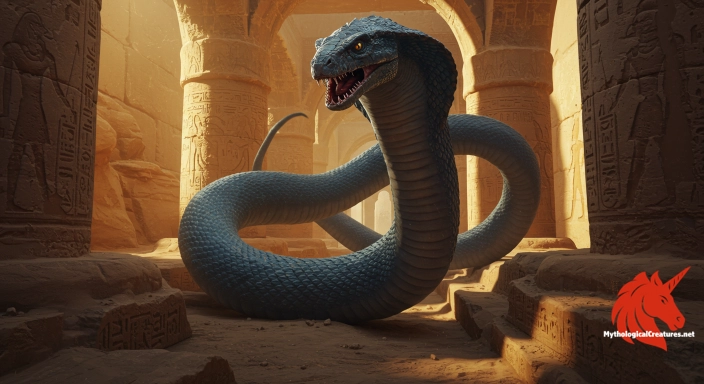
Teka-her
Teka-her - Represents divine order in the Duat by safeguarding the passage during the night.
Origins & First Encounters
Teka-her is a striking and enigmatic figure in the realm of ancient Egyptian mythology, renowned for his illuminating presence and formidable role as a guardian of the underworld. His very name, meaning 'He with the enlightened face', suggests a paradoxical blend of divine radiance and monstrous form. Emerging prominently in the New Kingdom period, his first attestation in the Book of Gates highlights a culture imbued with complex ideas of the afterlife and cosmic order. As a guardian deity, he stands at the threshold of the Duat, ensuring that the passage between life and death is vigilantly protected. His association with the underworld underscores the Egyptians’ deep-seated belief in maintaining the balance between chaos and order. Teka-her's role is further accentuated by his companionship with other significant deities who similarly oversee the nocturnal voyage of the sun god Ra. The interplay between his fearsome appearance and his divine luminosity encapsulates the inherent dualities at the heart of Egyptian religious thought. Over generations, this guardian's legacy has remained intertwined with the rituals surrounding death and rebirth, symbolising both protection and renewal. The enduring fascination with his myth reflects the rich tapestry of narratives that characterised ancient Egyptian spirituality.
Source Texts & Tale Variants
The textual evidence for Teka-her most notably appears within the revered passages of the Book of Gates, a work inscribed on the tombs of New Kingdom pharaohs. This authoritative source provides valuable insights into his function as a guardian at the critical doorway of the underworld's Fourth Hour of the Night. In these sacred texts, he is portrayed alongside figures like Tekmy and Amun, whose own images imbue the myth with layers of protective symbolism. Various temple reliefs and tomb inscriptions have maintained a consistent narrative about his duty to fortify the path that Ra must traverse each night. In addition to formal hieroglyphic compositions, subtle variations in the inscriptions suggest that his myth was susceptible to regional reinterpretation. Artistic renderings, across different archaeological sites, have sometimes highlighted specific aspects of his character, such as his glowing mien and formidable serpentine form. These narrative accounts paint a picture of a deity whose presence is both awe-inspiring and functional in the cosmic scheme. The multiplicity of versions and story variants surrounding Teka-her underscores the dynamic nature of Egyptian myth, where each retelling added further depth to his cosmic role. His continued mention within these primary sources lends credence to the enduring importance of his myth in the Egyptian religious tradition.
Form & Powers
Teka-her is typically depicted as a colossal, serpentine entity whose body undulates with a compelling blend of menace and majesty. Central to his iconic image is an 'enlightened face' that seems to radiate an otherworldly luminescence, marking him as both formidable and sacred. His elongated form is adorned with intricate markings and patterns that echo the hieroglyphs and symbols of the ancient Egyptian pantheon. The textured scales along his body not only add to the sense of awe but also serve to visually communicate the complex symbolism of protection and divine power. In many depictions, artists have emphasised the contrast between the sleek, sinuous curves of his body and the stark brilliance of his facial features. There is an almost otherworldly quality to his countenance, which is rendered with sharp, penetrating eyes that suggest both wisdom and vigilance. His enormous size, often depicted in relation to the gateways and cosmic maps of the underworld, reinforces his role as a sentinel against chaos. Every brushstroke detailing his form is steeped in ritual significance, with each element meticulously crafted to convey narratives of death, protection, and regeneration. The overall depiction of Teka-her is one that blends physical ferocity with an ethereal glow, encapsulating the multifaceted nature of ancient Egyptian divinity.
Regional Faces
While Teka-her’s origins are deeply entrenched in the canonical texts of ancient Egypt, his artistic depictions reveal subtle regional variations that speak to local interpretative traditions. In areas such as Thebes, where religious practices thrived, his illuminated face is rendered with an exceptional delicacy, often interwoven with additional solar motifs and symbols of rebirth. In contrast, inscriptions from other regions sometimes present him with a more robust and elaborately scaled form that underscores his defensive capabilities. Regional artists often adapted his image to align with local theological nuances, incorporating distinctive elements that enhanced his protective aura. Some depictions merge his formidable qualities with the facial features of other guardian deities, reflecting a local blend of mythic narratives. Variations in his portrayal also occur in relation to the artistic conventions of different periods, illustrating the evolution of Egyptian visual language over time. These local adaptations underscore the interplay between standardised myth and regional artistic innovation. Even subtle differences in the curvature of his body or the intricacy of his adornments point to diverse regional influences. Overall, these variations highlight the adaptability of his myth and its capacity to reflect the diverse cultural landscape of ancient Egypt.
Cultural Parallels
The figure of Teka-her invites intriguing comparisons with similar mythological guardians found throughout the ancient world. Much like the dragons and serpentine deities of other cultures, his dual nature as both protector and formidable force resonates with a universal archetype. In Greek mythology, for instance, the concept of a guardian who stands vigil over the thresholds between life and death bears some similarity to the roles attributed to Cerberus and the python. In Near Eastern traditions, serpentine figures also embody the delicate balance between cosmic chaos and order, a theme that is vividly present in Teka-her’s character. His illuminated visage, which seems to blend mysticism with martial severity, finds echoes in the iconography of divine serpents across Asia and Mesoamerica. This intermingling of protective and transformative qualities in serpentine figures speaks to a broader, cross-cultural fascination with symbols of both destruction and regeneration. The comparative analysis reveals that while each culture adapts these motifs to its unique spiritual framework, the overarching themes remain strikingly consistent. Teka-her thus occupies a place within a global tapestry of myth, where his distinctive attributes contribute to a shared human narrative of fear, reverence, and the inexorable passage between worlds.
Legacy & Modern Evolution
The historical evolution of Teka-her’s image underscores a continuous dialogue between ancient traditions and modern reinterpretations. Initially immortalised in the finely inscribed tombs and temples of the New Kingdom, his depiction as a luminous guardian laid the groundwork for a legacy that would persist through the ages. Over time, shifts in artistic style and cultural perspective have softened some of his more monstrous elements while further accentuating his divine radiance and authority. Modern artists and writers, inspired by his complex iconography, have reimagined him as a symbol of enlightenment, transformation, and the perpetual struggle between light and darkness. Contemporary reinterpretations often cast Teka-her as an emblem for the resilience of ancient myth in the face of modernity, where the interplay of chaos and order continues to captivate. His enduring presence in literature, digital art, and even popular media reflects a revitalised interest in the rich mosaic of Egyptian mythology. Scholars and enthusiasts alike revisit his narrative, drawing parallels between ancient rituals and the symbolic challenges of the modern era. Each new portrayal contributes to a living dialogue, where Teka-her’s myth is not only preserved but also re-envisioned for future generations. The legacy of Teka-her, therefore, is one of continual reinvention and timeless resonance, embodying the enduring power of myth as a guide through both history and the human condition.
Interesting Fact
One intriguing aspect of Teka-her is his dual role as both a fearsome guardian and a divine entity, reflecting the complex nature of Egyptian afterlife beliefs.
Advertising opportunity
Showcase your mythology project
We offer limited sponsor placements for books, courses, games, and creators aligned with our audience.
View partnership optionsQuick Creature Info
Origin:
Features:
Associations:
Our Mythic Legendary Rating:

Habitat:
Supernatural Powers:
Physical Attributes:
Abilities:
Behavior:
Lore:
References
Discover Another Mythical Legend You May Not Have Heard Of?
Uncover the mysteries of ancient folklore and expand your knowledge of legendary beings from cultures around the world.
Dare to Meet the Cuegle....

Curated by the Mythological Creatures Team
Series editor: Mythological Creatures Directory
Primary desk: Hellenic & Ancient Mediterranean Desk
(rev. November 2025)