
Vucub Caquix: Vucub Caquix is a mythological bird demon from K'iche'-Maya mythology, featured in the Popol Vuh.
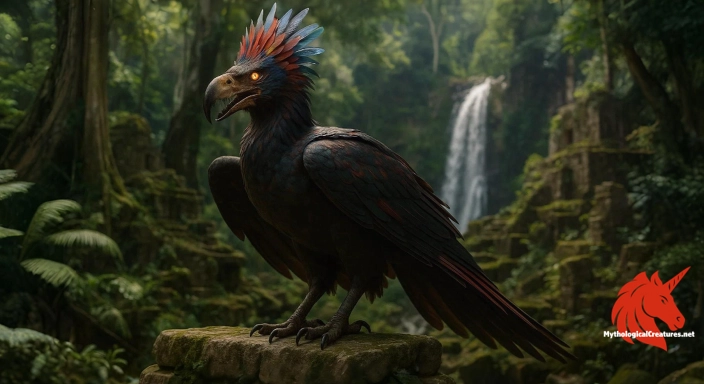
Vucub Caquix
Vucub Caquix - Represents the hubris of false deities and serves as an origin for other powerful mythological beings.
Origins & First Encounters
Vucub-Caquix emerges as one of the more enigmatic figures in the vast tapestry of Maya mythology, recognised primarily as a fearsome bird demon whose name hints at a splendor akin to the vivid macaw.
His advent in myth is deeply intertwined with the K’iche’-Maya, whose cultural heritage and oral traditions imbued such creatures with cosmic significance.
His earliest narratives appear in the famed text Popol Vuh, a document compiled in the 18th century, yet the essence of his myth dates back to the Late Preclassic period before 200 AD.
In these ancient accounts, he is depicted as a force of arrogance and chaos, whose defiance leads to a climactic confrontation with the celebrated Hero Twins.
This confrontation symbolises the eternal struggle between disorder and the restorative energies of the cosmos.
His myth also weaves in familial ties by naming him as the father of other formidable deities, including the underworld demon Zipacna and Cabrakan, the Earthquake God, thus enriching his narrative layers.
The legend encapsulates the dynamic interplay between celestial order and terrestrial disorder, making him a pivotal character in the mythic hierarchy.
Vucub-Caquix, therefore, stands not just as a singular menace, but as a reflection of a wider metaphysical debate prevalent in ancient Maya society.
Source Texts & Tale Variants
The principal account of Vucub-Caquix is preserved within the Popol Vuh, a narrative cornerstone for the K’iche’-Maya that interlaces myth with ritual and cosmology.
This document, while compiled in the 18th century, serves as a repository of ancient oral traditions that stretch back into deep antiquity.
The story of his defeat by the Hero Twins is a recurring theme found in multiple recensions of the myth, ensuring that his legacy is explored through varied narrative threads.
Alongside the Popol Vuh, archaeological findings suggest that iconographic depictions of the demon date to the Late Preclassic period, providing material evidence of his early worship and symbolic importance.
Variations of the tale have emerged as the myth travelled across generations, each iteration accentuating different facets of his character and divine misdeeds.
Some narrative fragments and local oral traditions reposition his role, sometimes casting him as a cautionary figure whose downfall illustrates the perils of hubris.
The textual discrepancies across sources have contributed to a layered understanding, inviting scholars and enthusiasts alike to re-examine his multifaceted persona.
This rich tapestry of sources underscores a shared heritage where myth, history, and art converge to depict a being both formidable and emblematic of cosmic dualities.
Form & Powers
Vucub-Caquix is traditionally envisioned as a bird demon, with his very name hinting at a majestic yet monstrous appearance reminiscent of a macaw.
His form is often depicted with an extravagant array of colourful plumage that connotes both beauty and menace, setting him apart from ordinary avian creatures.
Artistic renditions frequently illustrate him with a large, curved beak and piercing eyes that radiate a wild, untamed intelligence.
His wings are portrayed as expansive and imposing, capable of evoking both the grace of natural flight and the overwhelming power of a tempest.
In some interpretations, his body seems to merge the elegance of a tropical bird with the mythic characteristics of a demonic entity.
The scale of his presence often varies, sometimes rendered as a colossal figure whose physicality symbolises cosmic might and, at other times, as a nuanced blend of elegance and menace.
This duality in his depiction is reflective of broader Maya iconography, where beauty and terror are intertwined to convey deeper moral and cosmological messages.
Subtle variations in his physical description across different depictions may also indicate regional artistic interpretations and the evolving symbolism over the centuries.
Regional Faces
The myth of Vucub-Caquix is deeply rooted in the highland regions of Guatemala, where the K’iche’-Maya nurtured a rich tradition of storytelling and symbolic representation.
In these local contexts, his epithet, often translated as 'seven-Macaw', carries layers of allegory, possibly alluding to the multiple strata of the celestial hierarchy.
Regional traditions sometimes reframe his character from a mere antagonist into a complex embodiment of cosmic imbalance and arrogance.
As his myth spread among neighbouring Maya groups, slight narrative shifts introduced variations that emphasised different aspects of his nature, from his physical ferocity to his symbolic significance.
Local adaptations often highlight the moral lesson embedded within his tale, warning against excessive pride and the disruption of universal order.
Iconographical depictions in regional art, including murals and carvings, vary markedly, sometimes merging his bird-like features with local fauna symbolism.
Rural oral traditions have preserved unique interpretations, imbuing his character with a blend of fear and reverence that reflects the distinct cultural outlook of each community.
These diverse portrayals underline the adaptive and evolving nature of myth within Maya culture, ensuring that Vucub-Caquix remains an integral figure in local identities and ritual practices.
Cultural Parallels
The figure of Vucub-Caquix resonates with similar entities found throughout diverse mythological landscapes, presenting intriguing parallels with other bird-associated deities.
One notable comparison is with Quetzalcoatl, the feathered serpent of Mesoamerican lore, whose synthesis of avian and serpentine features creates a complex symbol of both wisdom and power.
While Vucub-Caquix is portrayed as a demonic and defiant figure, his narrative arc shares common themes with global mythic archetypes that explore the downfall induced by hubris.
This motif finds echoes in various Greco-Roman and Near Eastern legends, where supernatural beings embody the fine line between divine grace and chaotic disruption.
The duality inherent in his character, embodying both the majesty of a revered creature and the terror of a demonic presence, is mirrored in other mythologies that warn against the pride of gods and mortals alike.
His role as a progenitor of subsequent monstrous beings amplifies this theme, akin to other mythic lineages that serve as cautionary exemplars of inherited sin and retribution.
Such cross-cultural connections emphasise a recurring narrative of cosmic balance, where beauty and destruction are entwined in the fabric of myth.
The comparative analysis not only positions Vucub-Caquix within the rich mosaic of world mythology but also highlights the universal human quest to understand and depict the interplay of order and chaos.
Legacy & Modern Evolution
Across the centuries, the figure of Vucub-Caquix has endured and transformed, reflecting shifting societal perspectives and evolving artistic conventions.
His early depictions in the Late Preclassic period gradually gave way to nuanced portrayals in colonial manuscripts and modern scholarly interpretations.
Modern artists and writers have embraced his image, reimagining the bird demon as both a symbol of ancient cosmic conflict and a metaphor for contemporary struggles against hubris and environmental degradation.
In recent artistic circles, his figure is often invoked to explore themes of power, transformation, and the delicate balance between nature and civilisation.
Museum exhibitions and cultural festivals in regions with rich Maya heritage frequently feature his iconography, underscoring his lasting impact on collective memory.
Scholars continue to examine the evolution of his myths, recognising that his layered story offers profound insights into the ways in which ancient cultures conceptualised the forces of chaos and order.
This enduring relevance illustrates how traditional myth can be continuously reinterpreted to speak to new generations, blending timeless symbolism with modern concerns.
Ultimately, Vucub-Caquix stands as a compelling testament to the resilience of myth, perpetually inspiring a dialogue between past traditions and contemporary cultural expression.
Interesting Fact
The name Vucub Caquix, potentially translating to 'Seven-Macaw', underscores the intricate symbolism of avian imagery in Mayan mythology, setting him apart as a uniquely characterised being.
Reach myth fans
Connect your myth-driven brand with this audience
Our readers are writers, educators, gamers, and collectors who care about mythology. Enquire about a limited sponsor placement on creature pages.
Enquire about sponsorshipQuick Creature Info
Origin:
Associations:
Our Mythic Legendary Rating:

Also Sometimes Known As:
Habitat:
Supernatural Powers:
Physical Attributes:
Abilities:
Behavior:
Lore:
Related Creatures, Tales or Lore
- QQuetzalcoatl
- KKukulkan
- TThunderbird
References
Discover Another Mythical Legend You May Not Have Heard Of?
Uncover the mysteries of ancient folklore and expand your knowledge of legendary beings from cultures around the world.
Dare to Meet the Dynamene....
Curated by the Mythological Creatures Team
Series editor: Mythological Creatures Directory
Primary desk: Americas & Indigenous Traditions Desk
(rev. November 2025)