
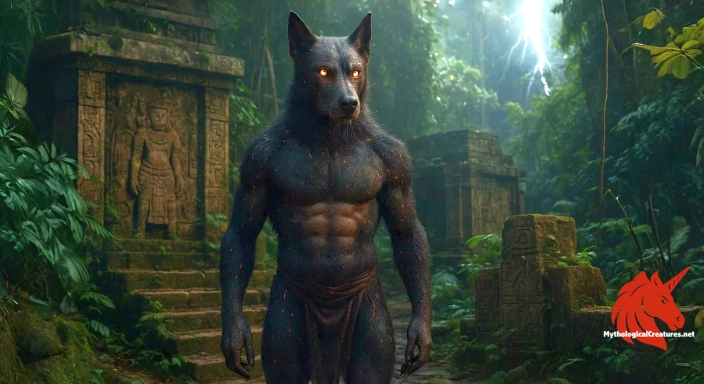
Xolotl: Xolotl is an Aztec god depicted as a dog-headed man, renowned for his dominion over fire and lightning.
Xolotl
Xolotl - Xolotl is a pivotal figure in Aztec mythology, symbolising the dark, transformative aspects of life and death while guiding souls between worlds.
Origins & First Encounters
Xolotl stands as one of the most enigmatic and multifaceted deities within the Aztec pantheon. His unique identity is immediately evident in his striking dog-headed visage, which has captivated the imagination of many. Emerging from a complex tradition where duality played a central role, his origins are steeped in the early religious practices of ancient Mesoamerica. Early depictions and codices attest to his importance as a god connected to fire, lightning, and the often-overlooked realms of death and decay. He is celebrated as the dark twin of the revered Quetzalcoatl, a pairing that symbolises the delicate balance between light and shadow. His role as a guide leading souls safely to the underworld highlights the Aztec understanding of the journey from life to the hereafter. Intrinsically linked with misfortune, sickness, and deformities, Xolotl embodies the imperfections and challenges of mortal existence. The brilliance of the evening star, Venus, also finds a mirror in his association with celestial fire, further underlining his cosmic significance. His presence in rituals and temple art illustrates a culture deeply attuned to the cycles of transformation and rebirth. In every portrayal, Xolotl reminds us of the inevitability of change and the sacred passage between realms.
Source Texts & Tale Variants
Early accounts of Xolotl emerge from a variety of pre-Columbian codices and colonial manuscripts that record the mythological tapestry of the Aztec world. Detailed illustrations in these codices capture his canine features and elaborate iconography, revealing a god whose complexity has been preserved through the centuries. The Florentine Codex and other similar texts provide glimpses of his multifaceted character, emphasising his roles as both a guardian of the dead and a master of elemental forces. Diverse narrative strands offer variant views: some sources portray him solely as a fearsome guide to the underworld, while other interpretations integrate his functions as a deity of misfortune and deformity. Fragmentary inscriptions and temple reliefs further contribute to the rich mosaic of his character, underscoring details that vary across different regions. Local oral traditions have kept these legends alive, adding layers of nuance to his myth beyond the written record. As these primary sources interweave, they highlight the evolving nature of his depictions and the community’s ongoing engagement with his symbolism. The multiplicity of story variants ultimately enriches our understanding of Xolotl as a deity who straddles the boundaries of life, death, and cosmic order. His narrative continues to intrigue both scholars and enthusiasts alike, affirming his status in the enduring lore of the Aztecs.
Form & Powers
In the art of ancient Mesoamerica, Xolotl is unmistakably portrayed with a canine head set upon a human body, creating a surreal and arresting image. His features combine the raw, instinctual power of a dog with the dignified form of a man, symbolising the bridge between the earthly and the divine. The sculpted eyes of his depictions often appear deep and reflective, evoking a sense of eternal wisdom and mystery tied to the underworld. Artists have highlighted elements such as elongated snouts and pronounced ears, which serve to emphasise his connection to the primal forces of nature. Intricate adornments of lightning and flames frequently embellish his form, visually narrating his dominion over fire and celestial energy. Variations in his portrayal—ranging from robust, almost terrifying figures to more ritualistic and refined representations—demonstrate the flexibility of his iconography. Some depictions even hint at subtle amphibian or lizard-like traits, a nod to his link with the axolotl and the transformative aspects of his nature. Every representation captures the essence of a deity who is as much a protector of souls as he is a symbol of cosmic disruption. The physical details woven into his imagery invite the viewer to contemplate the intersection of beauty, chaos, and mortality.
Regional Faces
Regional interpretations of Xolotl reveal a fascinating tapestry of belief that transforms his character according to local spiritual necessities. In central Mexican traditions, he is primarily revered as the solemn guardian of the underworld, a guide whose role in escorting souls is both feared and venerated. Other communities have adapted his myth by emphasising his connections with elemental forces, thereby aligning him more closely with the celestial phenomena observed in their local skies. In some variants, his image merges with that of other underworld deities, creating a composite figure whose attributes echo those of Mictlantecuhtli and other death gods. Local festivals and ritual ceremonies have often appropriated his imagery, with artisans crafting masks and carvings that celebrate his myth in ways unique to their region. This regional adaptation not only celebrates his fearsome aspect but also imbues him with a nurturing quality that reassures adherents in times of life's inevitable transitions. The interplay of these regional nuances demonstrates the fluidity of myth, where a single deity can be reframed to embody both protection and cosmic inevitability. Such variations ensure that Xolotl’s presence remains vibrant, reflecting the indigenous community’s intimate connection with the forces that govern life and death. The regional narratives thus serve as living testaments to his enduring significance in diverse cultural landscapes.
Cultural Parallels
Xolotl’s unique dog-headed form and role as a guide to the dead invite compelling comparisons with similar deities across global mythologies. His function closely echoes that of the Egyptian god Anubis, another canine-headed figure who oversaw the passage of souls into the afterlife. Both deities share the weighty responsibility of navigating the boundary between life and death, highlighting universal themes in humanity’s exploration of mortality. The juxtaposition of celestial elements with earthy, primal features in Xolotl’s portrayals resonates with figures in other cultures who embody both creation and destruction. His association with fire and lightning further aligns him with deities who command elemental energies, bridging the human experience with the divine. The adaptability of his myth, allowing for multiple layers of meaning, mirrors trends observed in various indigenous and global traditions. Such cross-cultural connections underscore a shared symbolic language, where the journey beyond life is both a spiritual and physical transformation. The broader comparative analysis reinforces the idea that despite vast geographic separations, many ancient cultures revered figures who could ease the passage between states of being. In his very essence, Xolotl becomes a testament to the universal human fascination with the mysteries that lie beyond the mortal realm.
Legacy & Modern Evolution
Over centuries, the figure of Xolotl has transformed from a fearsome deity of the ancient Aztecs into a potent symbol in modern cultural and artistic expressions. His image continues to inspire a wide range of creative endeavours, from contemporary art installations to literature that explores themes of transformation and the supernatural. Modern reinterpretations often play with his distinctive canine features, reimagining them in ways that evoke both beauty and an underlying sense of foreboding. The very name Xolotl lives on in the axolotl, a remarkable amphibian whose regenerative capabilities symbolically echo the god’s association with rebirth and transformation. Today, his myth serves as a bridge between the ancient and the modern, inviting new generations to explore the complexity of life, death, and renewal. His depiction in visual media and festivals reaffirms the lasting influence of Aztec mythology on contemporary cultural narratives. The evolution of his image—from sacred texts and temple carvings to digital art and modern literature—highlights the dynamic nature of myth and its continual reinvention. In reinterpreting his symbolism for a modern audience, storytellers emphasize themes of resilience, the cyclical nature of existence, and the ever-present possibility of transformation. Xolotl’s enduring legacy thus stands as a poignant reminder of the transformative power of myth and the timeless resonance of ancient wisdom.
Interesting Fact
The axolotl, a unique neotenic salamander native to Mexico, is named after Xolotl, underscoring his lasting impact on both mythology and modern nomenclature.
Partner with Mythological Creatures
Bring your myth-based world into ours
From game settings to narrative worlds, we work with partners who treat myths with care. Share your project for a potential sponsor slot.
Partner with usQuick Creature Info
Origin:
Associations:
Our Mythic Legendary Rating:

Habitat:
Supernatural Powers:
Physical Attributes:
Abilities:
Behavior:
Lore:
References
Discover Another Mythical Legend You May Not Have Heard Of?
Uncover the mysteries of ancient folklore and expand your knowledge of legendary beings from cultures around the world.
Dare to Meet the Marchosias....
Curated by the Mythological Creatures Team
Series editor: Mythological Creatures Directory
Primary desk: Americas & Indigenous Traditions Desk
(rev. November 2025)