
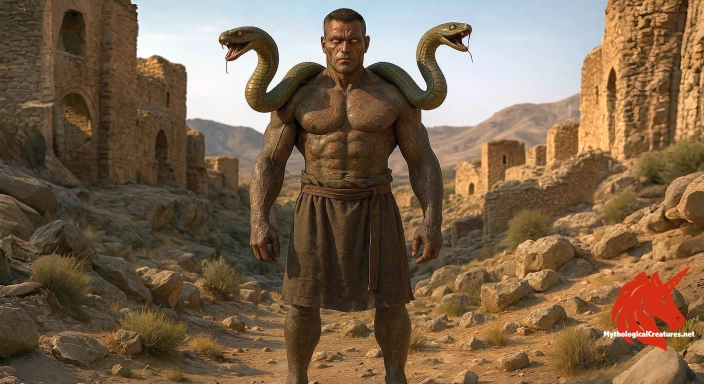
Zahhak: Zahhak, also known as Zahhak the Snake Shoulder, is an infamous figure in Persian mythology renowned for his tyrannical rule and monstrous appearance.
Zahhak
Zahhak - Zahhak represents the corrupting influence of power and the eternal battle between good and evil, serving as a cautionary tale of divine retribution and human fallibility.
the legend in five swipes.
the legend in five swipes.
What are the origins of Zahhak?
Zahhak stands as one of the most formidable and reviled figures in Persian mythology, whose narrative has spanned millennia and pervaded diverse literary traditions. Born from the dark mythic imaginations of ancient Persia, his story encapsulates themes of tyranny, betrayal, and the pervasive influence of malevolent forces. His early depictions revealed him as a demonic ruler with serpentine qualities that symbolised perpetual corruption. His origins are moored in the cosmic struggle between the forces of creation and destruction, embodied in the eternal conflict between Ahura Mazda and Ahriman. Zahhak’s first attestations can be traced back to the sacred texts of the Avesta, where he appears under the name Azhi Dahaka, revealing the intermingling of myth and religious thought. His transformation into a cultural symbol of evil was further elaborated in the grand epic of the Shāhnāmeh, where he emerged as the tyrannical progeny of divine malevolence. The myth of Zahhak resonates with the ancient Iranian worldview, reflecting the existential battle between order and chaos. His legacy continues to evoke both fear and fascination, marking him as an enduring figure in the collective mythos of Persia. The narrative embodies a timeless exploration of the corruptive nature of absolute power and illustrates the complex interplay of light and dark in mythological tradition.
Zahhak: From Oral Tale to Written Record
Zahhak’s tale is woven through a rich tapestry of ancient texts and oral traditions that have preserved his dark legacy. He is prominently featured in the Avesta, where he appears as Azhi Dahaka, albeit in an ambiguous setting that hints at his monstrous nature. The Middle Persian literature also venerates his narrative, where he is known by various names including Dahag and Bēvar Asp, each contributing layers of interpretation. The epic narrative of the Shāhnāmeh by Ferdowsi offers a detailed account of his tyranny and transformation, providing a moral framework that has influenced perceptions of justice and power. Localised folkloric renditions have added alternate variations on his origins, often emphasising the role of divine retribution and the cyclical nature of cosmic order. Textual fragments from Zoroastrian teachings further enhance the myth, as they integrate Zahhak’s lineage with the dark forces of Ahriman. Each account, whether religious or literary, has contributed to the multifaceted characterisation of Zahhak as an emblem of evil. The overlapping variants across sources invite readers to reflect on the broader socio-political and spiritual contexts in which these stories were conceived. This multiplicity of narratives not only enriches the myth but also reveals how each generation reinterprets its symbols of oppression.
Did Zahhak have any weaknesses?
Zahhak is depicted with an imposing physicality that immediately marks him as otherworldly and horrid, set apart from mortal men. His most distinctive feature is the emergence of serpentine appendages from his shoulders, a gruesome symbol of the corruption infesting his very being. The snakes, coiled and writhing, are portrayed as insatiable instruments that mirror his inner thirst for destruction and power. His visage is often rendered as severe and demonic, featuring deep-set eyes and a pallid, almost inhuman complexion. In various artistic depictions, his body is detailed with exaggerated muscular forms and a towering stature, emphasising the grotesque fusion of human and beast. His attire and armour, laced with mystical symbols, further invoke the aura of an ancient and cursed royalty. Artists have frequently illustrated him with rough, textural details that suggest decay, resonating with the idea that his power is both formidable and tainted. The duality of his human and serpentine features creates a visual narrative that encapsulates the eternal struggle between mortal vulnerability and monstrous might. His physical form, thus, is not merely a subject of horror but also a deliberate allegory of how unchecked ambition and malevolence can deform the spirit.
Which regions tell stories of Zahhak?
The myth of Zahhak manifests diversely across various regions within and beyond ancient Persia, adapting to the distinct cultural and spiritual landscapes of each area. In core Persian traditions, Zahhak is intimately linked with Zoroastrian themes and the narrative of a cosmic battle, but neighbouring regions have interpreted his story through their own mythological lenses. In some local Iranian accounts, he is depicted not merely as a tyrant but also as a tragic figure whose downfall vindicates the rightful order of the cosmos. Communities in regions influenced by Mesopotamian folklore have occasionally blended the lore of Zahhak with that of other monstrous deities, amplifying his dreadful characteristics. In these adaptations, his snake-like features are sometimes reimagined, emphasising the venomous nature of his rulership and the curses he embodies. The influence of varying dialects and ritual practices has resulted in slight differences in how his monstrous visage and deeds are portrayed. Folklore performances and theatre practices in provincial settings often highlight the moral lessons intrinsic to his tale, underscoring the importance of resistance against tyranny. Despite regional variations, the central narrative remains consistent—a relentless struggle between divine order and corrupt chaos. These diverse portrayals not only illustrate the adaptability of myth but also serve as vehicles for local expression of universal themes such as justice, power and the human condition.
Zahhak: Similar Beings in World Folklore
Across the spectrum of myth, Zahhak shares intriguing parallels with several iconic figures known for their menacing qualities and the embodiment of corruption. His dual nature, combining human attributes with serpentine features, invites a comparison with the Greek titan Typhon, whose monstrous form also symbolises elemental chaos. Just as Typhon is remembered for terrorising the gods, Zahhak is similarly depicted as a disruptive force challenging divine order in Persia. These figures resonate with other cultural representations of tyranny, where the mutant qualities expressed in their physical forms mirror the degradation of political and moral integrity. In a broader context, the dual imagery of serpents coiled around the shoulders of rulers recurs across various traditions, symbolising unbridled ambition and the inherent perils of hubris. The comparative analysis reveals a universal cautionary motif, wherein the merging of man and beast stands as an allegory for the corruptive influence of absolute power. In both Eastern and Western mythologies, these characters serve as enduring reminders of the struggle between the forces of good and the encroaching shadows of malevolence. This cross-cultural connection underlines a shared human fear of what transpires when natural order is subverted by demonic influences, a narrative that has persisted through centuries. Such resonant themes unify disparate myths under a common narrative arc of downfall and renewal, emphasising the timeless nature of their moral warnings.
Zahhak in Books, Film and Games
The legacy of Zahhak has evolved remarkably from its ancient origins, influencing not only medieval literature but also modern interpretations of tyranny and despair. The transformation of his myth from an oral ephemeral tradition into elaborate epic narratives is a testament to the enduring power of myth in shaping cultural identities. Over the centuries, his story has been revisited by writers, artists, and dramatists alike, each reimagining Zahhak’s monstrous tyranny to reflect contemporary issues of corruption and despotism. His imagery has been particularly potent in symbolising the struggle against autocracy, serving as a cautionary figure in political discourse and artistic expression. Modern adaptations often portray him as a complex character where his grotesque features are juxtaposed with the tragic loss of his own humanity. In contemporary popular culture, interpretations of Zahhak can be found in films, literature, and even graphic arts, each stressing the eternal conflict between enlightened order and oppressive chaos. The evolution of his character illustrates a dialogue between past mythic symbolism and modern socio-political narratives, bridging the ancient with the futuristic. Zahhak's enduring legacy remains a powerful emblem of the consequences of unbridled ambition and the inevitable collapse of malevolent power. His myth continues to inspire discussion on the ethical and moral dimensions of leadership and the universal struggle for justice.
Interesting Fact
Zahhak's myth uniquely intertwines themes of divine punishment and the corrupting nature of power, making his legend a profound exploration of how physical deformities can mirror inner moral decay.
Mythological Treasures
Chinese Beasts: A field guide to the dragons and demon kings of Chinese myth
From river dragons to demon kings, with the legends that shaped five thousand years of storytelling.
Japanese Yokai: A field guide to the spirits and demons of Japanese folklore
Fifteen spirits, with the signs to watch for and what the old tales say to do if you meet one.
Greek Myths: A field guide to the monsters of ancient Greece
Every monster here earned its place in legend, and each gets a full page of artwork and the story behind it.
the legend in five swipes.
For serious mythcraft
Your project belongs among the legends
If your work deepens how people understand, play with, or teach mythology, a sponsor placement here keeps it in front of the right readers all year.
Submit a sponsorship enquiryQuick Creature Info
Origin:
Features:
Associations:
Our Mythic Legendary Rating:

Also Sometimes Known As:
Habitat:
Supernatural Powers:
Physical Attributes:
Abilities:
Behavior:
Weaknesses:
Lore:
Related Creatures, Tales or Lore
- TTyphon
- JJörmungandr
- AApophis
References
Discover Another Mythical Legend You May Not Have Heard Of?
Uncover the mysteries of ancient folklore and expand your knowledge of legendary beings from cultures around the world.
Dare to Meet the Nyami Nyami....
The Mythological Creatures Book Series
Yokai, Greek, Norse, Egyptian & Chinese. Five illustrated field guides to the creatures the old stories either warned or told you about.

Curated by the Mythological Creatures Team
Series editor: Mythological Creatures Directory
Primary desk: Asian & Pacific Myth Cycles Desk
(rev. November 2025)