
Abumi-guchi: Abumi-guchi is a peculiar Japanese yōkai known for its stirrup-shaped mouth and furry appearance.

Abumi-guchi
Abumi-guchi - Abumi-guchi is part of the Edo period collection of yōkai that has significantly influenced modern interpretations of Japanese monsters.
the legend in five swipes.
the legend in five swipes.
Where in the world does the Abumi-guchi come from?
The abumi-guchi, whose name translates as 'stirrup mouth', is an intriguing and enigmatic creature from the rich tapestry of Japanese folklore. Its earliest known depiction appears in the Edo period, when fantastical beings were often portrayed with a blend of natural observation and imaginative invention. Emerging in the pages of Sekien Toriyama’s Gazu Hyakki Tsurezure Bukuro, this furry yōkai quickly established itself as a symbol of the bizarre and the uncanny. The creature’s peculiar anatomy, especially its distinct mouth reminiscent of a stirrup, has set it apart even amongst the diverse pantheon of Japanese monsters. During this era, illustrations and brief mentions served to both entertain and subtly caution readers about the unpredictable natural world. The abumi-guchi came to represent the mysterious intersections of the human realm and the shadowy domains of nature and spirit. Hidden within its innocent fur and unusual features lies an ambiguous character that challenges clear categorisation. As scholars and enthusiasts continue to probe the layers of Edo-period iconography, the abumi-guchi persists as a testament to the imaginative spirit of its time. Its legacy endures in modern retellings, ensuring that this quirky yōkai remains a captivating subject of study and creative reinterpretation.
What are the earliest texts about the Abumi-guchi?
The primary textual record of the abumi-guchi is found in Sekien Toriyama’s celebrated compendium, Gazu Hyakki Tsurezure Bukuro, where a solitary illustration invites expansive interpretation. Early printed works of the Edo period, while succinct in narrative detail, provided enough visual clues to intrigue both contemporaries and later aficionados of yōkai lore. Over time, regional storytellers and subsequent compilations have hinted at its elusive nature, gradually embellishing the creature through oral tradition. Some minor narrative variants suggest that the abumi-guchi might have played a role in nocturnal mischief or offered mystical warnings to those travelling unfamiliar paths. Occasional references in lesser-known folklore collections have reimagined its role, sometimes portraying it as a benign spirit and at other times as an omen of the unknown. These diversified accounts underscore the fluidity of its identity, where a brief illustration spurred a multitude of narrative threads. The inherent ambiguity of its early depiction allowed local folk to adapt its traits to suit cultural and environmental contexts. Modern enthusiasts find this sparse yet evocative source material an open invitation to reinvent and reinterpret the abumi-guchi in contemporary storytelling. The result is a rich tapestry of variants that, while limited in historic documentation, offer fertile ground for mythological exploration.
What does the Abumi-guchi look like?
The abumi-guchi is depicted as a small, furry creature with strikingly unusual facial features that have captivated artists over the centuries. Central to its appearance is the eponymous stirrup-like mouth, an oddity that immediately distinguishes it from other yōkai and imbues it with a sense of both humour and mystery. Its compact body is cloaked in a shaggy coat of fur, which is often rendered in soft, subdued hues that blend with the natural surroundings. Many artistic reinterpretations have accentuated its large, expressive eyes, lending the creature a curious blend of innocence and mischief. A pair of subtly pointed ears and a small, twitching nose further contribute to its whimsical yet eerie visage. Variations in its depiction have captured the agile nature of the yōkai, suggesting a creature built for swift, almost spectral movement through dimly lit landscapes. The texture and style of its fur are depicted in myriad ways—from wild and unkempt to deliberately styled in a manner that hints at domestication or natural camouflage. Even the posture of the abumi-guchi, often shown with a slight hunch or a cautious tilt of the head, reinforces its mysterious character. Its physical form embodies a paradox, balancing between the playful and the foreboding, which has inspired numerous adaptations and visual reinterpretations over time.
Where is the legend of the Abumi-guchi strongest?
Although the abumi-guchi originates from the Edo-period artistic milieu, its depiction has evolved through regional folklore across Japan. In some rural districts, local lore has imbued the creature with the role of a subtle guardian of remote paths and mountain trails, casting it in a more benevolent light. Conversely, urban legends have occasionally recast the abumi-guchi as a mischief-maker, snapping at unsuspecting travellers during twilight hours. Regional adaptations sometimes vary in physical detail, with some areas depicting it as more robust and stout, while others favour depictions that emphasise its slight, elusive build. These variations often mirror the local community’s interpretation of the natural and supernatural, intertwining it with regional customs and beliefs. In the western parts of Japan, for example, artistic renditions may highlight a darker, moodier palette that accentuates its mysterious allure. In contrast, eastern variations might stress its elusiveness and a more ghostly, translucent quality. Despite these differences, the signature stirrup-like mouth remains a steadfast feature throughout all regional interpretations. Such fluidity in characterisation exemplifies how folklore continuously adapts to local cultural contexts, reinforcing the abumi-guchi's role as a mutable symbol of Japan’s varied mythological landscape.
Legends Comparable to That of the Abumi-guchi
The abumi-guchi shares thematic and visual resonances with a number of mythological beings found in diverse cultural traditions. Much like some European folklore creatures whose distorted visages signify liminality between man and beast, the abumi-guchi’s uniquely shaped mouth invites comparisons with other anomalous figures in global myth. Its blend of endearing and uncanny traits is reminiscent of fae or satyr-like entities in Western narratives, where odd physical features symbolise both mischief and an otherworldly wisdom. Similar to Japan’s own tanuki and bakeneko, the abumi-guchi occupies a space where the boundaries of reality and the supernatural blur, echoing the dual nature observed in various animal spirits. This parallel accentuates the universal human fascination with creatures that defy natural categorisation. Moreover, the emphasis on a particular physical quirk—the stirrup-like mouth—parallels other cultural myths that attribute significant symbolic power to unusual bodily characteristics. Though distinct in cultural genesis, these comparative creatures often serve as mediators between the realms of the living and the spirit world, embodying nature’s unpredictable whimsy. Their recurring appearance across mythologies highlights a shared narrative tradition that uses physical oddities to symbolise inner mystery and moral ambiguity. Such cross-cultural connections underscore the enduring appeal of figures that challenge conventional aesthetics, inviting both playful engagement and profound introspection.
What does the Abumi-guchi mean to people today?
During its journey from an isolated Edo-period illustration to a figure of modern cultural imagination, the abumi-guchi has experienced significant reinterpretation and evolution. Over the centuries, its image has been reworked and reimagined by artists, writers, and folklorists, each adding layers of meaning to its already enigmatic persona. Contemporary portrayals often blend the creature’s traditional attributes with modern sensibilities, resulting in appearances in manga, anime, and other popular media. These modern renditions sometimes emphasise its whimsical nature, while in other cases they cast it as a foreboding harbinger of the mystical unknown. As Japanese society’s relationship with its mythic past has shifted, the abumi-guchi has come to symbolize both the charm of ancient lore and the enduring mystery of the unseen world. Cultural festivals and exhibitions celebrating yōkai have embraced the abumi-guchi as a representative of the unpredictable and the extraordinary. Its evolution reflects a broader trend in which traditional folklore is reinterpreted through the lens of contemporary art and narrative. The creature’s re-emergence in digital art and role-playing games has also allowed it to reach new audiences, ensuring that its peculiar legacy continues to inspire fascination and debate. Ultimately, the abumi-guchi remains a compelling reminder of the fluid nature of myth, whose enduring appeal lies in its seamless blend of humour, strangeness, and historical depth.
Interesting Fact
One interesting aspect of the Abumi-guchi is that it is primarily known through its depiction in art rather than through extensive legends, highlighting the importance of visual storytelling in Japanese folklore.
Mythological Treasures
Japanese Yokai: A field guide to the spirits and demons of Japanese folklore
Fifteen spirits, with the signs to watch for and what the old tales say to do if you meet one.
Greek Myths: A field guide to the monsters of ancient Greece
Every monster here earned its place in legend, and each gets a full page of artwork and the story behind it.
Norse Sagas: A field guide to the beasts of the Viking world
Drawn from the saga accounts themselves, with the powers, weaknesses and doom of each being set out.
the legend in five swipes.
Sponsor this space
Tasteful, fixed-fee placements for myth projects
No bidding wars or flashing banners. We offer simple placements for a small set of creators and brands aligned with our readers.
Request further detailsQuick Creature Info
Features:
Our Mythic Legendary Rating:

Also Sometimes Known As:
Physical Attributes:
Lore:
References
Discover Another Mythical Legend You May Not Have Heard Of?
Uncover the mysteries of ancient folklore and expand your knowledge of legendary beings from cultures around the world.
Dare to Meet the Biasd Bheulach....
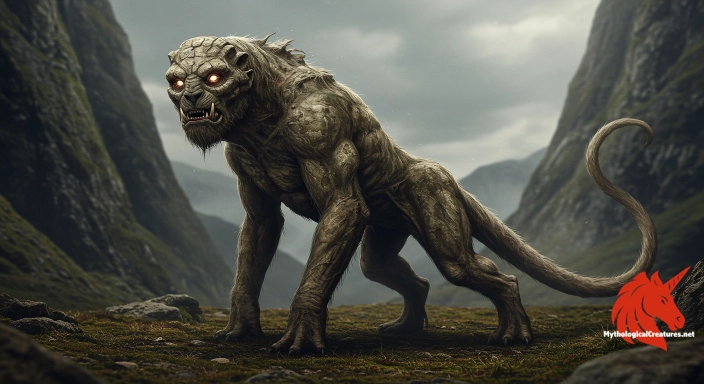
The Mythological Creatures Book Series
Yokai, Greek, Norse, Egyptian & Chinese. Five illustrated field guides to the creatures the old stories either warned or told you about.


Curated by the Mythological Creatures Team
Series editor: Mythological Creatures Directory
Primary desk: Asian & Pacific Myth Cycles Desk
(rev. November 2025)