
Achlys: Achlys is the ancient Greek personification of mist and sorrow, depicted on Heracles' shield.
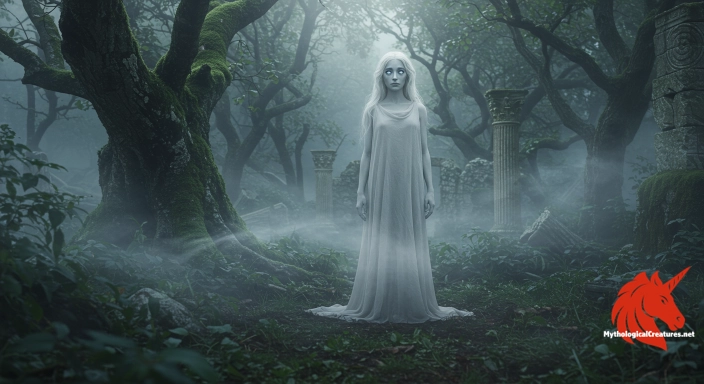
Achlys
Achlys - Embodies the inevitability and obscurity of death, serving as a symbolic reminder of sorrow in mortal life
Origins & First Encounters
Achlys, whose name originates from the ancient Greek word for 'mist', emerges as a striking embodiment of melancholy and enigma within the mythic traditions. She is intricately connected with the intangible realms of sorrow and is often portrayed as an ephemeral force that blurs the boundary between the natural and the divine. Her early appearances in Hesiodic poetry—as seen on the shield of Heracles—signal a complex intermingling of heroic narrative and spectral symbolism. The allure of her image lies not in a fixed identity but in a fluid representation that intertwines elemental fog with the emotional depths of human despair.
Her myth finds its roots in the early poetic and artistic expressions of ancient Greece, where personifications of nature and emotion often converged. The figure of Achlys is celebrated for encapsulating the transient quality of life, as well as the inevitable sorrow that shadows mortal existence. Interpretations of her character invite reflections on the ephemeral nature of joy and the inscrutable force of loss. Through millennia, Achlys has served as a timeless symbol, enriching the tapestry of myth with her subtle yet evocative presence.
Source Texts & Tale Variants
Ancient texts serve as the primary wellspring for understanding Achlys, beginning with her depiction in the Hesiodic Shield of Heracles. In this context, she hints at an underlying narrative of sorrow woven into the heroic tradition. The term 'achlys' also appears in Homer where it describes the mist that blinds mortal eyes in moments of death, thereby blending literal natural phenomena with symbolic resonance. Such literary accounts suggest a deliberate ambiguity that encourages multiple layers of interpretation.
Roman sources extend her legacy further, casting her in the mould of Caligo—a progenitor linked to primordial chaos. Nonnus, in his Dionysiaca, transforms her role yet again by offering a portrayal imbued with witch-like mystique. These variant depictions across texts underline a fluid mythos where the boundaries between a personified deity and a natural event remain tantalisingly elusive. The richly variegated narrative of Achlys thus reflects the dynamic interplay of tradition and creativity in ancient literature.
Form & Powers
Visually, Achlys is envisioned as a being of insubstantial form, her appearance echoing the shifting patterns of morning mist. She emerges not as a conventionally structured deity but rather as a series of undulating vapours that suggest both beauty and transient sorrow. Ancient artistic interpretations frequently depict her with soft, shifting contours that mirror the weightless, elusive nature of fog. The interplay of light and shadow within her form conveys an aura of subdued luminescence that is as captivating as it is melancholic.
In representations on mythic artefacts such as Heracles’ shield, Achlys is amalgamated with themes of despair and mourning. Her eyes, when rendered, exude a reflective quality that intimates depths of untold grief, while her overall silhouette hints at both fragility and the relentless flow of time. Despite the scarcity of detailed anatomical descriptions, the prevailing imagery conveys a spectral presence that is in constant flux—a representation of sorrow made manifest. Through these artistic choices, the visual language of Achlys reinforces her status as an ever-changing symbol of ephemeral melancholy.
Regional Faces
Across the ancient Mediterranean world, Achlys has been adapted to reflect the distinctive cultural narratives of her regions. In her Greek context, she is intricately bound to the ideas of fog and sorrow, resonating with the poetic meditations on human mortality and the delicate balance between life and death. The Greek tradition invites an interpretation of her form as a metaphor for not only physical obscurity but also the overwhelming experience of inner grief. This localized vision underscores the interplay between nature’s transient beauty and emotional vulnerability.
In contrast, the Roman adaptation of her myth reconfigures her identity by intertwining it with the figure of Caligo, thereby emphasising models of primordial chaos and the cyclical nature of creation. Localised art and literature across regions further adapt her image, merging indigenous symbolism with ancient myth. These regional reinterpretations have allowed her core attributes to persist while acquiring nuanced layers specific to local cultural and spiritual needs. Such a divergence, yet interconnected unity, ensures that the essence of Achlys continues to reverberate through diverse cultural landscapes.
Cultural Parallels
Achlys stands in remarkable dialogue with a range of mythological figures whose attributes mirror the ephemeral and sorrowful aspects of her character. Her Roman counterpart, Caligo, embodies a similar sense of mystical obscurity, reinforcing the motif of chaos that often underscores the ancient narratives of creation. Like the personification of Lethe in Greek mythology, which depicts the forgetfulness that shrouds human experience, Achlys manifests the interplay of visibility and loss. The symbolic resonance of mist that she carries is echoed in other cultural traditions which celebrate nature as a mirror to the human spirit.
Further comparisons can be drawn with shadowy entities across mythologies that explore the thresholds between life and the afterlife. Whether in the form of Celtic or Norse spectral presences, these figures invite parallels with Achlys in their roles as mediators of transience and inner transformation. The recurring themes of obscurity, change, and latent sorrow find shared expression in the myths of many cultures, making her a compelling study in cross-cultural symbolism. In comparative analysis, Achlys emerges as a thematic bridge—a vessel through which different cultures interpret the ineffable nature of mourning and existential uncertainty.
Legacy & Modern Evolution
Over the centuries, the myth of Achlys has evolved dramatically, transitioning from an abstract embodiment of mist on heroic shields to a broader emblem of existential uncertainty. Early accounts rooted in Greek poetic traditions have given way to reinterpretations that infuse her myth with modern sensibilities regarding loss and transformation. The shifting narrative of Achlys has invited new layers of meaning, as later artistic and literary works cast her as a symbol of the shadowy realms that lie between life and oblivion. In this dynamic evolution, her presence attests to the timeless human fascination with the ephemeral and the ineffable.
Contemporary artists and writers have reimagined Achlys as both a muse and a metaphor—a figure that encapsulates the modern encounter with grief and impermanence. Her image recurs in digital art, literature, and music, where the interplay of light and darkness continues to evoke the complexities of the human condition. These modern adaptations not only preserve her original traits but extend them, offering innovative interpretations that resonate with today’s existential concerns. As a result, the legacy of Achlys endures, bridging the ancient with the modern and reaffirming the enduring power of myth to illuminate the inner landscapes of sorrow and hope.
Interesting Fact
An intriguing aspect of Achlys is her dual representation as a natural, mist-like phenomenon and as a witch-like figure, blurring the lines between abstract personification and an active mystical force.
Partner with us
Sponsor this space
Reach thousands of mythology enthusiasts with a curated placement on our creature pages.
Learn about sponsorshipQuick Creature Info
Origin:
Associations:
Our Mythic Legendary Rating:

Habitat:
Supernatural Powers:
Physical Attributes:
Abilities:
Behavior:
Weaknesses:
Lore:
Related Creatures, Tales or Lore
- CCaligo
- LLethe
- NNyx
References
Discover Another Mythical Legend You May Not Have Heard Of?
Uncover the mysteries of ancient folklore and expand your knowledge of legendary beings from cultures around the world.
Dare to Meet the Kuchisake-onna....
Curated by the Mythological Creatures Team
Series editor: Mythological Creatures Directory
Primary desk: Hellenic & Ancient Mediterranean Desk
(rev. November 2025)