
Amesemi: Amesemi is a Kushite protective goddess renowned for her distinct iconography, including a falcon-shaped crown and a crescent moon.
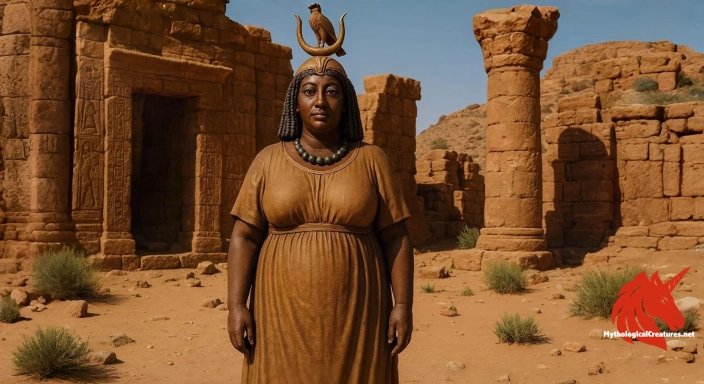
Amesemi
Amesemi - Amesemi embodies the fusion of Kushite and Egyptian religious traditions and is revered as a protector within the Kushite pantheon.
Origins & First Encounters
Amesemi emerges from the ancient Kushite cultural mosaic as a protective goddess whose presence was both powerful and nurturing. She is venerated as the consort of Apedemak, the mighty lion-god, situating her at the heart of a dynamic divine partnership. Her worship was rooted in the Nubian traditions that flourished in the regions of Meroe and Naqa, where artistic depictions and religious festivities celebrated her guardianship. Early representations of Amesemi are found in majestic temple reliefs, where her image is interwoven with symbols of celestial protection and earthly abundance. Her iconography—especially the distinctive crown featuring a falcon or a crescent crowned by a falcon—signifies a unique blend of indigenous symbolism and neighbouring cultural influences. The corpulent form in which she is depicted reflects the traditional aesthetic ideals of Meroitic art, emphasising fertility and prosperity. Her role as a divine protector is further highlighted by the narrative of safeguarding the community against malevolent forces. The enduring admiration for Amesemi speaks to the resilience and sophistication of ancient Kushite spiritual traditions.
Source Texts & Tale Variants
Primary evidence of Amesemi’s veneration is etched into the ancient reliefs of the Lion Temple at Naqa, where she is portrayed in harmonious association with other prominent deities. In these artistic canvases, her striking headpiece and elegant attire are rendered with a clarity that underscores her celestial importance. She is frequently depicted alongside figures such as Isis, Mut, Hathor, and Satet, indicating a fascinating convergence of religious iconography across cultural boundaries. Stelae found in the temple of Amun in Naqa add another layer of insight, featuring her alongside the Kandake Amanishakheto, which reinforces her royal and protective attributes. In the sparse written records of the period, her narrative sometimes melds with other local deities, giving rise to a complex tapestry of myth and ritual. Oral traditions have also maintained fragments of her story, embellishing the visual records with diverse interpretations and local nuances. This multiplicity of sources not only illuminates her character but also invites further inquiry into the syncretic nature of ancient Kushite beliefs. The varied depictions across different media have helped preserve the essence of Amesemi’s myth, making her a subject of enduring fascination.
Form & Powers
Amesemi is vividly depicted as a goddess of formidable presence, with her robust, corpulent form symbolising both fertility and strength. Her head is crowned with a remarkable headdress that takes the form of a falcon or a crescent moon crowned by a vigilant falcon, highlighting her celestial ties. The elaborate crown is a central motif, serving as both a protective emblem and a conduit for her divine qualities. She is traditionally adorned in a flowing robe of cloth, worn gracefully over simple undergarments, which underscores her earthly yet regal nature. A short necklace composed of large beads adds a striking detail to her appearance, infusing her image with both elegance and vibrancy. An intriguing aspect of her depiction is the presence of a secondary set of hands, a feature that symbolically enhances her all-encompassing guardianship. Detailed artistic renditions capture the texture of her garments and the intricate design of her crown, offering a window into the finesse of Kushite craftsmanship. Variations in her portrayal, as seen in different reliefs and stelae, further accentuate the thoughtful integration of aesthetic form and symbolic meaning in her representations.
Regional Faces
Regional variations in the depiction of Amesemi underline the diverse artistic interpretations prevalent across ancient Nubia. In the heartlands of Kush, especially in Meroe, her image is consistently portrayed with a robust and nurturing form, reflecting local ideals of beauty and fertility. In the Naqa region, her appearance is carefully integrated into temple reliefs, where she is depicted in concert with deities of both Kushite and Egyptian provenance. The distinctive style of her headgear, whether presented as a falcon-shaped crown or a crescent topped by a falcon, is rendered with slight variations that underscore local aesthetic preferences. Such regional adaptations amplify the symbolism embedded in her iconography, ensuring that each portrayal resonates with the spiritual and cultural identity of its community. Local artisans often imbued her attire with subtle embellishments that reflected indigenous motifs, differentiating her from similarly named figures in neighbouring cultures. These differentiated portrayals served not only to celebrate her divine role but also to cement her status within the local pantheon. Through these variations, the vibrant legacy of Amesemi continues to offer insights into the complex interplay of art, culture, and spirituality in ancient Nubia.
Cultural Parallels
Comparative analysis reveals that Amesemi shares many intrinsic qualities with protective deities from neighbouring cultural traditions. Her role as a guardian of life and embodiment of fertility finds echoes in goddesses such as Isis, whose nurturing presence similarly ensured cosmic balance and human prosperity. Unlike the svelte portrayals typical of Egyptian depictions, Amesemi’s more corpulent form is a deliberate artistic choice that underscores local aesthetic traditions and the celebration of abundance. This focus on corporeal strength and maternal prosperity aligns her with other indigenous deities whose physicality symbolises the earth’s fertility. The unusual addition of a second set of hands in her iconography has parallels in other mythological traditions, where multiple limbs are invoked as symbols of omnipotence and far-reaching influence. Cross-cultural comparisons suggest that while her attributes are unique, they also resonate with a broader ancient understanding of divine protection. Such thematic similarities illuminate the ways that neighboring cultures influenced each other in their depictions of powerful feminine archetypes. In this light, Amesemi stands as a striking example of the fluid boundaries between mythological traditions, a testament to shared spiritual concerns across diverse societies.
Legacy & Modern Evolution
The evolution of Amesemi’s image over time reflects a rich historical trajectory that spans from ancient tribal worship to modern reinterpretations of Kushite heritage. Early artistic depictions, carved into the walls of majestic temples, established her as a central figure in the spiritual landscape of Nubia. As centuries passed, her robust form and unique iconography were adapted by successive generations, each infusing her image with contemporary cultural significance. Modern scholars and artists continue to find inspiration in her attributes, reimagining her role as a symbol of protection and fertile abundance. Exhibitions and museum collections now frequently include her depictions, where the intricate details of her crown and additional limbs are celebrated as masterpieces of ancient artistry. Contemporary interpretations have also embraced her as a potent symbol of female strength and cultural resilience. In the realm of literature and art, she is often cited as an emblem that bridges ancient mysticism with the focus on modern identity and heritage. The lasting legacy of Amesemi underscores not only the adaptability of myth but also the timeless appeal of a goddess who encapsulates the spirit of protection, fertility, and enduring beauty.
Interesting Fact
A unique feature of Amesemi's iconography is her depiction with a second set of hands, setting her apart from her contemporaries and symbolising her extraordinary divine capabilities.
Support the directory
Promote your myth project and fund more research
Sponsor placements help keep this directory growing and free to use while giving your work a focused, relevant audience.
Learn how sponsorship worksQuick Creature Info
Associations:
Our Mythic Legendary Rating:

Habitat:
Supernatural Powers:
Physical Attributes:
Abilities:
Behavior:
Lore:
References
Discover Another Mythical Legend You May Not Have Heard Of?
Uncover the mysteries of ancient folklore and expand your knowledge of legendary beings from cultures around the world.
Dare to Meet the Dushara....
Curated by the Mythological Creatures Team
Series editor: Mythological Creatures Directory
Primary desk: Hellenic & Ancient Mediterranean Desk
(rev. November 2025)