
Amphisbaena: The Amphisbaena is a mythological serpent from Ancient Greek mythology, recognised for its unique dual-headed form.
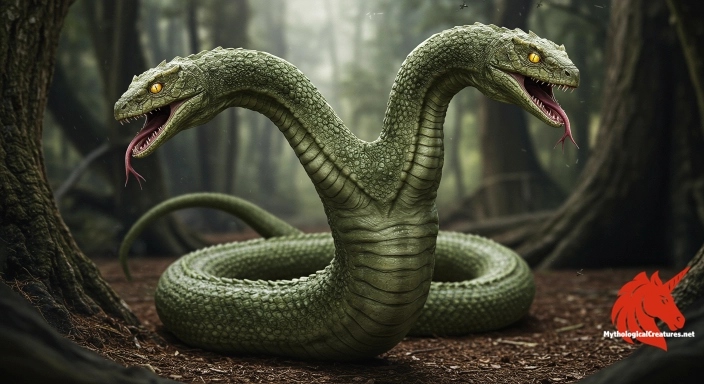
Amphisbaena
Amphisbaena - Symbolises duality and the mysterious aspects of nature, notable for its unique anatomical structure and ant-eating behaviour.
the legend in five swipes.
the legend in five swipes.
When was the Amphisbaena first written about?
A curious figure among mythological narratives, the amphisbaena is celebrated for its extraordinary duality. Rooted in ancient Greek lore, this ant‐eating serpent is renowned for having a head at each end of its elongated, sinuous body. Emerging from a rich tapestry of myth, early literary allusions and artistic depictions attest to its mysterious allure and signify its role as more than a mere beast. Its very name fuses the Greek words for ‘both ways’ and ‘to go’, signalling an existence that defies the usual linearity of movement. Often dubbed the "Mother of Ants," the creature’s obscure dietary habit has lent it an enigmatic status beyond that of ordinary reptiles. Ancient chroniclers and oral traditions alike celebrated its uncanny form, imbuing it with symbolic significance that ranged from regeneration to the balance of opposites. In classical thought, its dual heads were interpreted as gateways to understanding the interplay between beginnings and endings. The creature, therefore, embodies a fusion of the physical and the metaphysical, inviting contemplation on the nature of duality itself. Even in the modern age, the amphisbaena continues to intrigue scholars and storytellers who seek to unravel its layered symbolism.
The Source Texts Behind the Amphisbaena
Examination of ancient texts reveals that the amphisbaena has been a subject of fascination across millennia. Classical sources, including the works of Pliny the Elder, mention it with a blend of wonder and scepticism, offering one of the earliest attestations of its dual‐headed form. Variants of the tale flourish in both Greek and Roman literature, each narrative colouring its origins and peculiar nature in a unique light. Medieval bestiaries further enriched its legend, intertwining the creature’s image with moral allegories and spiritual connotations. Later folklore added additional dimensions, with storytellers attributing to it magical properties and an enduring life force. Several accounts even suggest that if one head were to be severed, the other would continue unimpeded, symbolising an unyielding resilience. Its ant‐eating habit is recounted with both literal detail and metaphorical nuance, highlighting an unexpected ecological role. Over centuries, local adaptations and reinterpretations have woven the amphisbaena into the cultural fabric of diverse regions. These layered narrative strands underscore not only its literary persistence but also its capacity to evolve through shifting cultural and historical contexts.
What abilities did the Amphisbaena have?
In vivid depictions, the amphisbaena is portrayed as a sinuous serpent whose structure is dominated by the unusual presence of a head at each end, creating a symmetry that is both eerie and mesmerizing. Its body is typically rendered with glossy, iridescent scales that shimmer in the light, suggesting an otherworldly vitality. Ancient illustrations vary in their portrayal, with some recognising a modest creature while others attribute to it a formidable, elongated form that accentuates its mythic prowess. Each head is depicted in striking detail, complete with keen, perceptive eyes and a delicate arrangement of fang‐like teeth that emphasise its predatory nature. There are accounts that hint at subtle differences between the two heads, possibly reflecting contrasting temperaments or supernatural functions. The creature’s muscular yet flexible body is ideally suited for both terrestrial slithering and subterranean exploration, bridging the gap between the seen and unseen. Its dual vision, as it were, seems to symbolise an ability to perceive multiple dimensions or realms. Some narratives suggest that its forked structure enables it to navigate the labyrinth of nature with a unique, almost preternatural awareness. This intricate anatomy, set apart from that of ordinary reptiles, firmly anchors the amphisbaena in the realm of myth and marvel.
Amphisbaena: The Same Figure in Different Places
Across the rich expanse of mythological traditions, the amphisbaena has been reimagined in numerous regional contexts, each endowing it with distinctive local flavours. In its Greek origins, it is often portrayed as a mysterious denizen of shadowy woodlands or subterranean passages, symbolising the hidden forces of nature. Roman interpretations sometimes shifted the focus towards its alleged regenerative capabilities and its role as an ominous herald of change. In medieval European bestiaries, the creature evolved into an allegorical figure, one that encapsulated moral dualities and spiritual lessons within its double‐headed guise. In certain Latin American adaptations, European classical motifs intermingled with indigenous folklore, adding tropical hues and unique narrative twists to its legend. Eastern traditions have occasionally aligned its form with other serpentine deities, thereby emphasising its role within a broader pantheon of dualistic forces. Its portrayal is not confined solely to the physical realm; in some accounts, the amphisbaena transitions into a symbolic or even spiritual entity embodying balance. Regional artists and writers have further varied its depiction, altering details like size, colour, and temperament to better align with local mythic symbolism. Collectively, these diverse portrayals highlight the creature’s adaptive legacy across cultures and its ability to resonate with a wide array of symbolic meanings.
How does the Amphisbaena compare to figures in other traditions?
Comparative mythological analysis shows that the amphisbaena shares striking similarities with a number of dual-natured entities from various cultural traditions. The two-headed aspect of the creature naturally invites comparisons with figures such as the Roman god Janus, whose bifacial depiction embodies the notions of beginnings and transitions. By mirroring the concept of duality, the amphisbaena is sometimes seen as a symbol of past and future converging in a single entity. Similar dual‐headed serpentine beings appear in select East Asian and South American folklores, where the theme of symmetry carries profound cultural significance. In a broader context, the regenerative aspects of the amphisbaena find a kindred spirit in the myth of the Hydra, suggesting a persistent motif of renewal in Greek narratives. Its unique ant‐eating habit also parallels lesser-known legends where the consumption of minute creatures is imbued with symbolic ritual significance. Such cross-cultural comparisons enrich our understanding of how different societies conceptualise balance and duality. The creature therefore stands at a crossroads of myth, connecting disparate traditions that explore the tension and harmony between opposing forces. These shared motifs of duality and transformation underscore a universal fascination with creatures that challenge ordinary perceptions of nature.
What does the Amphisbaena mean to people today?
The evolution of the amphisbaena’s image stretches from the classical chronicles of Greek and Roman antiquity to its vibrant reinterpretation in medieval illuminated manuscripts and beyond. Early portrayals, replete with wonder and mystique, established a foundation of dualistic symbolism that has since been reinvented across the ages. During the Renaissance, as natural philosophy began to flourish alongside renewed mythic interest, the creature was re‐examined with a blend of scientific curiosity and artistic exuberance. Modern fantasy literature and role‐playing games have routinely drawn upon its iconic dual‐headed form, reimagining the amphisbaena as both a formidable adversary and a symbol of multifaceted power. Contemporary art and digital media have embraced its enigmatic allure, presenting it as a marker of transformation and the complexity of natural order. Its image, whether appearing in graphic novels or as part of cryptozoological debates, continues to spark both creative reinterpretation and academic discourse. As society’s relationship with myth evolves, the amphisbaena remains a mutable symbol, bridging the ancient with the modern. Its persistent presence in cultural narratives serves as a poignant reminder of the enduring human fascination with the mysterious and the multifarious. Ultimately, the legacy of this dual-headed serpent is one of perpetual reinvention, embodying a timeless narrative of balance and change.
Interesting Fact
A unique aspect of the Amphisbaena is that its two-headed design challenges the conventional notion of predatory focus, suggesting a form of duality and independence not seen in typical serpentine creatures.
Mythological Treasures
Greek Myths: A field guide to the monsters of ancient Greece
Every monster here earned its place in legend, and each gets a full page of artwork and the story behind it.
Japanese Yokai: A field guide to the spirits and demons of Japanese folklore
Fifteen spirits, with the signs to watch for and what the old tales say to do if you meet one.
Norse Sagas: A field guide to the beasts of the Viking world
Drawn from the saga accounts themselves, with the powers, weaknesses and doom of each being set out.
the legend in five swipes.
For serious myth projects
Feature your work alongside the legends
From academic works to story-rich games, we highlight projects that respect world mythologies. Talk to us about a measured, long-term placement.
Start a conversationQuick Creature Info
Origin:
Features:
Associations:
Our Mythic Legendary Rating:

Also Sometimes Known As:
Habitat:
Supernatural Powers:
Physical Attributes:
Abilities:
Behavior:
Lore:
Related Creatures, Tales or Lore
- HHydra
- OOuroboros
- BBasilisk
References
Discover Another Mythical Legend You May Not Have Heard Of?
Uncover the mysteries of ancient folklore and expand your knowledge of legendary beings from cultures around the world.
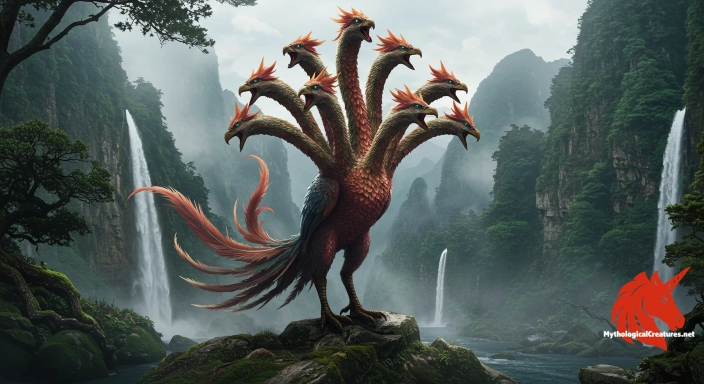
Dare to Meet the Nine-headed bird....
The Mythological Creatures Book Series
Yokai, Greek, Norse, Egyptian & Chinese. Five illustrated field guides to the creatures the old stories either warned or told you about.

Curated by the Mythological Creatures Team
Series editor: Mythological Creatures Directory
Primary desk: Hellenic & Ancient Mediterranean Desk
(rev. November 2025)