
Apep: Apep, also known as Apophis, is the ancient Egyptian deity embodying darkness and chaos.
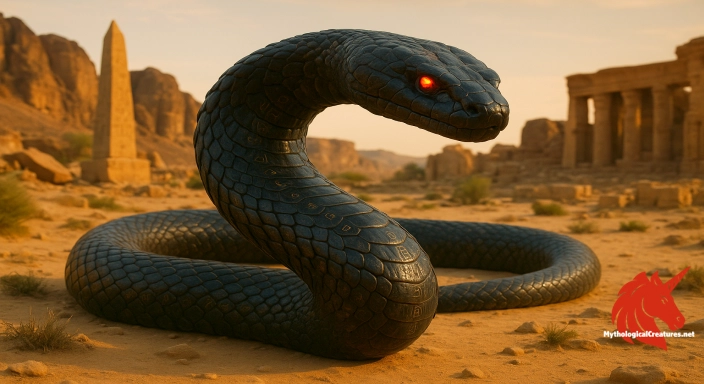
Apep
Apep - Represents the eternal struggle between order (Ma'at) and chaos, challenging the cosmic balance upheld by Ra.
Origins & First Encounters
Apep emerges from the deep well of ancient Egyptian myth as a potent embodiment of chaos and disruption, a figure whose dark presence has captivated imaginations for millennia. Born from the religious need to personify the forces that threatened the stability of the cosmos, he became an ever-present antagonist to the principles of order and truth embodied by Maat. His earliest mentions are found in some of the most venerable religious texts and rituals, where his role as a cosmic adversary is unmistakable. In an era when the battle between light and darkness held profound cultural significance, Apep symbolised the relentless struggle against the established order. His mythological roots stretch back to dynastic times, evolving alongside the monumental religious and societal currents of ancient Egypt. As an opponent of Ra, the radiant bringer of life and order, he was both feared and acknowledged as a necessary counterbalance in the cosmic scheme. The enduring narrative of Apep captures the essence of existential conflict, encapsulating the tension that exists between creation and destruction. His legacy, entrenched in the art and temple inscriptions of Egypt, continues to echo the ancient understanding of life’s dualities.
Source Texts & Tale Variants
The figure of Apep is richly documented across a range of ancient sources, where his menacing form and disruptive influence are depicted in vivid detail. Hieroglyphic inscriptions within temple complexes and tomb walls present him as the primordial force of darkness, often portrayed in vivid scenes of cosmic combat with Ra. Egyptian funerary texts, such as segments of the Book of the Dead, utilise his image to symbolise the ever-looming peril that must be subdued for order to be maintained. Variations of his myth appear in diverse ritualistic manuscripts that illuminate the interplay between light and its antithesis. Regional priesthoods interpreted his presence through local narratives, each adding unique accents to his legendary persona. During the New Kingdom and later periods, the accounts of his nocturnal assaults on the sun god were elaborated to reflect both literal and metaphorical battles between order and chaos. Some textual traditions portray him as a shape-shifting entity, capable of assuming multiple forms to bewilder his foes. The amalgamation of these sources paints a complex picture of Apep, intertwining cosmological allegory with the lived experiences of the ancient Egyptians.
Form & Powers
In the visual arts of ancient Egypt, Apep was most commonly depicted as a colossal serpent, a being whose form conveyed both fluidity and an unyielding menace. His sinuous body, often rendered with mesmerizing undulations and intricate scale patterns, suggested tremendous size and unbound ferocity. Artists embraced the challenge of encapsulating his essence by imbuing his eyes with a fiery intensity and his fangs with the promise of imminent destruction. At times, his form was accentuated by added ornamental details, such as coils that intertwine in unfathomable configurations, reinforcing his connection to the primordial chaos that pervades the underworld. This reptilian image served as a powerful visual shorthand for the disruption of cosmic order. Depictions varied in magnitude, with some portrayals embracing an almost abstract representation that stressed the symbolic nature of his power rather than strict anatomical accuracy. Occasional renderings even merged elements of other feared creatures, amplifying his otherworldly and terrifying presence. His ever-shifting imagery allowed for multiple interpretations, each amplifying his role as the living personification of disorder.
Regional Faces
Across the expanse of ancient Egypt, the portrayal of Apep experienced subtle regional modifications that reflect diverse local beliefs and artistic traditions. In the arid landscapes of Upper Egypt, his image was often intertwined with desert motifs, emphasising the isolation and vastness of the night. In contrast, communities along the fertile Nile incorporated more elaborate iconographic elements that linked his presence to the seasons and the cyclical nature of the river’s inundation. Greco-Roman influences introduced the name Apophis and occasionally reshaped his character to resonate with classical ideals of cosmic antagonism. Localised cult practices sometimes imbued his myth with extra layers of mysticism, framing him as a necessary force that indirectly maintained cosmic balance through his opposition to light. In some communities, protective amulets and rituals sought specifically to counteract his menace, showcasing an intimate awareness of his symbolic power. These regional adaptations not only catered to local sensibilities but also allowed his myth to be woven into the fabric of everyday spiritual life. This diversity in depiction highlights how a single mythic figure could both unite and reflect the cultural plurality of ancient Egyptian society.
Cultural Parallels
Apep stands shoulder to shoulder with chaos entities from various mythological frameworks, exemplifying a universal struggle between order and dissolution. His existence echoes that of figures like the Greek Typhon, who similarly embodied the tumult of nature and the persistent threat to divine order. Comparative mythology often draws parallels between his serpentine form and legends such as the Norse Jormungandr, underscoring a common cultural motif of the serpent as a harbinger of disruption. In other traditions, the concept of a primal force of darkness mirrors that of the biblical Leviathan, underscoring a shared metaphorical language in describing the forces that work against creation. These intertextual connections reveal not only thematic similarities but also a broader human preoccupation with the dynamics of chaos versus harmony. While Apep is deeply rooted in the specific cosmology of ancient Egypt, his narrative resonates through diverse cultures that grapple with the balance between creative order and destructive entropy. His myth serves as an archetypal template, inviting modern interpretations that explore how chaos is both feared and revered. Through such cross-cultural analyses, Apep emerges as a symbol that bridges ancient narratives with contemporary understandings of duality.
Legacy & Modern Evolution
Over the centuries, the representation of Apep has undergone a remarkable evolution, reflecting shifting cultural priorities and artistic sensibilities. In the earliest eras, his depiction was closely tied to the literal dangers of the night and the tangible threat to cosmic order, a message as clear as the sun’s daily rebirth. As Egypt’s political and religious landscapes transformed, so too did the narrative of this formidable serpent, gradually becoming a rich tapestry woven with layers of allegory and metaphor. The Hellenistic period introduced new dimensions to his character, aligning him with broader Mediterranean mythological themes through his renaming to Apophis. In modern times, Apep’s symbolism has transcended the bounds of traditional myth, inspiring artists, writers, and filmmakers to explore the perennial clash between order and chaos. Contemporary reinterpretations frequently cast him as both a literal and metaphorical antagonist, a dark mirror to the forces of light and civilisation. His legacy has even permeated popular culture, where his image is often invoked to represent the uncontrollable aspects of nature and the human condition. Museums and cultural exhibitions continue to highlight his ancient depictions, while academic discourses delve into the complex symbolism he embodies. This continuous evolution of Apep’s character underscores the timeless appeal of myth as a medium to explore the essential dynamics of existence.
Interesting Fact
Interestingly, Apep's nightly conflict with Ra symbolised the recurring cycle of destruction and renewal in ancient Egyptian cosmology.
Quick Creature Info
Origin:
Associations:
Our Mythic Legendary Rating:

Also Sometimes Known As:
Habitat:
Supernatural Powers:
Physical Attributes:
Abilities:
Behavior:
Weaknesses:
Lore:
Related Creatures, Tales or Lore
References
Discover Another Mythical Legend You May Not Have Heard Of?
Uncover the mysteries of ancient folklore and expand your knowledge of legendary beings from cultures around the world.
Dare to Meet the Manannán mac Lir....

Curated by the Mythological Creatures Team (rev. May 2025)