
Brimo: Brimo is the vengeful and terrifying epithet of several Greek underworld goddesses, embodying a furious and inexorable aspect.
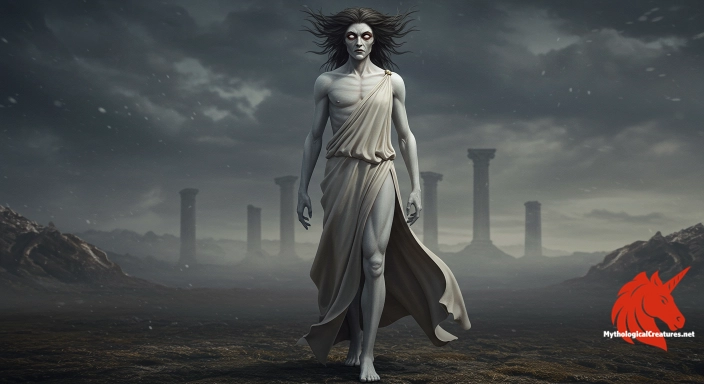
Brimo
Brimo - Represents the terrifying, vengeful aspect of the underworld and bridges identities of Hecate, Persephone, Demeter, and Cybele, underscoring ancient Greek interpretations of death and retribution
Origins & First Encounters
In the sprawling tapestry of ancient Greek myth, Brimo emerges as a potent and multifaceted figure whose very name denotes anger and terror.
This epithet, meaning 'angry' or 'terrifying', was applied to deities such as Hecate, Persephone, Demeter, and Cybele, all of whom bore connections to death and the underworld.
The origins of Brimo are deeply embedded in the chthonic traditions of the Greeks, reflecting a reverence for the forces of nature that are both creative and destructive.
Her early attestations are found in regions like Thessaly and Thrace, where local dialects and religious practices imbued the word with sacred significance.
Belief in her wrath and formidable presence offered explanations for the mysterious workings of the underworld and the unpredictable cycle of life and death.
The complex cultural context in which Brimo was revered reflects the Greeks’ acute awareness of the boundaries between life and the realm of the dead.
She symbolised not just destruction, but also the balance necessary to maintain cosmic order.
Her storied past invites modern readers to consider the interplay between fear and respect in ancient spiritual traditions.
Source Texts & Tale Variants
Ancient texts present a rich, if sometimes fragmentary, tapestry of the myth surrounding Brimo.
Her name appears across various literary sources including the Orphic hymns, hymns of the Eleusinian Mysteries, and the imaginative poetry of Lycophron in the Alexandra.
Some narratives identify her closely with the lunar goddess Hecate, while others see her as a dark aspect of Demeter in the wake of filial loss and vengeful passion.
In the mysterious Erebus of ancient Greece, texts such as those by Hippolytus recount how Brimo's birth heralded the emergence of powerful underworld energies.
There are also accounts in the Greek magical papyri, where incantations invoking Brimo illustrate her essential role in rituals of catabasis.
The colourful variant where Hecuba is transformed into one of Hecate’s hounds further highlights the fluidity of her legendary character.
A number of later texts even offer parodic renditions, as seen in Lucian of Samosata’s Oracle of the Dead, where Brimo’s once fearsome reputation is subjected to a sardonic twist.
This multiplicity of sources reveals how Brimo served as a catchall label for various fearsome, chthonic deities and their complex narratives in antiquity.
Form & Powers
Descriptions of Brimo, though often shrouded in abstract symbolism, paint a portrait of a deity whose physical form exudes both beauty and menace.
She is typically envisioned with a dark, mysterious mien, her eyes burning with an inner fire that mirrors the relentless rage attributed to her name.
The imagery surrounding her often includes flowing, shadow-like garments and a visage partially obscured by the mists of the underworld.
Artistic depictions, when they appear, suggest that her features can shift from the somber elegance of a mourning mother to the fierce countenance of a vengeful force.
This duality is underscored by symbols such as serpentine motifs and lunar crescents that adorn her attire, linking her physically to the cycles of nature and rebirth.
There are hints that her appearance may echo that of a dark hound or a spectral wolf, especially in contexts where her association with Hecate is emphasised.
Such variations in her representation imply that Brimo was not confined to a single iconographic pattern, but rather embodied the dynamic interplay of beauty and terror.
Her overall physicality is constructed as both awe-inspiring and profoundly unsettling, perfectly mirroring the formidable forces she represents.
Regional Faces
Regional traditions played a significant role in shaping how Brimo was understood and venerated throughout the ancient Greek world.
In Thessaly and Thrace, where the term originated, Brimo was closely linked with local deities and the mystique of the underworld, firmly rooting her identity in the landscape itself.
Local cults in these areas celebrated her as a capricious goddess who controlled fate and the cycles of growth and decay.
In contrast, in Attica the word Brimo did not find a native resonance, and the deity was largely interpreted through the lens of neighbouring traditions, sometimes being subsumed under other familiar names like Hecate or Demeter.
This regional variation reflects a common ancient practice of sharing and adapting deities’ attributes over cultural boundaries.
At Pherae in Thessaly, intricate rituals and Orphic influences further enriched her worship, blending agricultural prosperity with the sobering aspects of death.
Distinctive local adaptations often lent Brimo a more personal and grounded presence, aligning her with the cycles of nature observed by rural communities.
Such variations underscore the fluidity of myth, where a single divine epithet could be reinterpreted to suit the nuanced needs of diverse cultural environments.
Cultural Parallels
Brimo occupies a unique niche in ancient myth, yet her characteristics find echoes in numerous deities across diverse cultural landscapes.
Her fierce and vengeful nature draws comparisons with the Furies of later Roman myth, who similarly represented inexorable retribution.
In other traditions, deities such as the Celtic Morrigan or the Norse Hel echo her connection with the darker aspects of life and death.
The dual nature of her being, as both a nurturing force and a terror-inducing presence, resonates with later conceptualisations of female divinity in various cultures.
This juxtaposition of life-giving and menacing attributes can be seen as a mirror to similar figures in other ancient religious systems, where the protective and punitive aspects of a single goddess were inseparably intertwined.
Scholars have noted that her fluidity in identity allowed her to bridge roles typically assigned to both mother figures and avenging spirits.
The cross-cultural parallels extend to the use of dark, enigmatic symbolism that permeates representations of underworld deities across Europe and the Mediterranean.
By comparing Brimo with these analogous figures, one may appreciate her as part of a broader tradition that interrogates the ambivalence of divine power in regulating the natural and metaphysical worlds.
Legacy & Modern Evolution
Over the centuries, the figure of Brimo has evolved in response to shifting cultural, religious, and literary trends.
In the earliest periods, she was revered as a potent embodiment of the raw forces of the underworld, dictating both impending doom and transformative renewal.
Her feared aspect found acceptance in sacred mysteries, where her role in rituals underscored the necessity of acknowledging death as a precursor to rebirth.
Later, as scepticism and satire became fashionable, texts like Lucian’s parody reimagined Brimo with a tone that both lampooned and acknowledged her ancient gravitas.
This evolution reflected broader social shifts, wherein the terrifying aspects of ancient deities were reinterpreted through the lens of human vulnerability and irony.
In modern times, Brimo’s legacy endures in various reinterpretations within art, literature, and occult practices, where her dual nature inspires explorations of both feminine power and existential dread.
The rich tapestry of her myth continues to stimulate scholarly debate and inspire creative adaptations in contemporary media.
Her enduring symbolism reminds us that the ancient fears and hopes encapsulated in myth still echo powerfully in the modern imagination.
Interesting Fact
Brimo’s identity is fluid and multifaceted, as she represents the shared, fearsome qualities of several underworld deities, combining elements of terror with nurturing aspects linked to the cycle of death and rebirth.
For myth educators and toolmakers
Built a resource for mythology learners?
If you offer courses, teaching tools, or research platforms focused on myth and folklore, consider a discrete placement on our reference pages.
Introduce your resourceQuick Creature Info
Origin:
Associations:
Our Mythic Legendary Rating:

Also Sometimes Known As:
Habitat:
Supernatural Powers:
Physical Attributes:
Abilities:
Behavior:
Lore:
Related Creatures, Tales or Lore
References
Discover Another Mythical Legend You May Not Have Heard Of?
Uncover the mysteries of ancient folklore and expand your knowledge of legendary beings from cultures around the world.
Dare to Meet the Bieresel....
Curated by the Mythological Creatures Team
Series editor: Mythological Creatures Directory
Primary desk: Hellenic & Ancient Mediterranean Desk
(rev. November 2025)