
Charybdis: Charybdis is a fearsome sea monster from Greek mythology known for her deadly whirlpool that endangers passing ships.
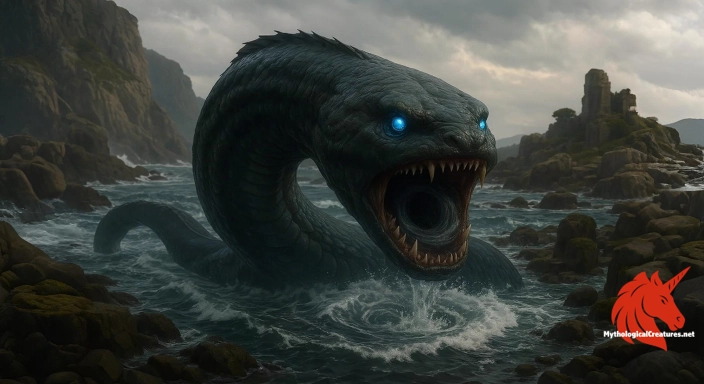
Charybdis
Charybdis - Charybdis embodies the peril of uncontrolled natural forces and has influenced the idiom 'between Scylla and Charybdis', symbolising a choice between two evils.
Origins & First Encounters
Charybdis emerges as one of the most fearsome entities in classical mythology, a formidable sea monster shrouded in mystery and dread. Her myth is deeply rooted in ancient Greek tradition, where narratives highlight her catastrophic influence on maritime travel. Often seen as a personification of nature’s unpredictable wrath, she was believed to generate colossal whirlpools that endangered both seafaring vessels and heroic ambitions. Certain traditions suggest a cursed origin, where divine indignation transformed a once-benign being into the monstrous form recognised in epic tales. Early attestations in ancient poetry and oral lore reveal her as a symbol of both nature’s beauty and its latent terror. Mariners braving the turbulent waters near the Strait of Messina regarded her as an inescapable peril, emblematic of nature’s capriciousness. Her legend serves as a powerful metaphor for the daunting choice between two equally dangerous outcomes. Over time, the myth of Charybdis has transcended geographical boundaries, resonating with the universal human experience of encountering the sublime fury of nature.
Source Texts & Tale Variants
Ancient epic poems and classical narratives provide a fragmented yet compelling insight into the life and menace of Charybdis. Epic works such as Homer’s Odyssey and Virgil’s Aeneid cement her role as a relentless force that challenges the bravest of seafarers. Literary sources from antiquity often leave her origins deliberately ambiguous, allowing later storytellers to elaborate on her character. Some versions depict her as a being transformed by divine retribution, while others hint at an inherent connection to the natural forces of the sea. The recurring pairing with Scylla in numerous accounts adds layers of complexity, presenting mariners with a dual threat that has become emblematic in myth. Oral traditions, passed down through generations of coastal communities, have enriched her tale with vivid details and imaginative flourishes. Minor textual variations across different regions underscore the adaptability of her myth and its capacity to absorb local colour. Retellings throughout the classical and medieval periods have further expanded her narrative, preserving her as an enduring personification of maritime peril. Each variant, while differing in detail, reinforces her status as a symbol of nature’s unpredictable fury.
Form & Powers
Charybdis is vividly imagined as an immense, amorphous presence that distorts the very fabric of the sea around her. She is most commonly depicted with a vast, gaping maw that intermittently sucks in and disgorges enormous volumes of water, creating formidable whirlpools. Descriptions of her physique vary, yet a recurring theme is her embodiment of elemental chaos—a living nexus of water and darkness. Some accounts hint at the existence of multiple appendages or tentacle-like protrusions that enhance her otherworldly appearance. Her dimensions are often portrayed as boundless, aligning her physical form with the immeasurable power of the deep. Artistic interpretations frequently capture her in the midst of churning foam and tumultuous waves, highlighting the stark contrast between her destructive might and the serene expanse of the ocean. The interplay of light and shadow in these depictions further accentuates an aura of primordial terror. While details may differ from one account to another, the consensus is clear: her form is both awe-inspiring and terrifying, a natural phenomenon given tangible shape.
Regional Faces
The myth of Charybdis, while originating in ancient Greek lore, has developed distinct regional variations across the Mediterranean and beyond. In the Strait of Messina, where actual whirlpools pose real dangers to seafarers, her legend became intertwined with local geographical phenomena. Mediterranean coastal communities at times reimagine her not merely as a monster but as a powerful water spirit—capable of both destruction and, in rare interpretations, even protection. Sicilian and Italian traditions have infused her tale with indigenous colour, adapting the narrative to reflect local environmental challenges and cultural beliefs. In northern European adaptations, her story often melds with broader allegorical themes that underline humanity’s perennial struggle against the forces of nature. Variations in her depiction—from subtle shifts in appearance to differing moral implications—illustrate how folklore can be shaped by local experiences and superstitions. These regional accounts frequently underscore the role of natural phenomena in inspiring myth, transforming environmental hazards into enduring cultural symbols. Each variant serves as a reminder that the ancient narrative of Charybdis is as mutable and dynamic as the sea itself. By embracing diverse perspectives, these adaptations enrich her legacy and highlight the universality of maritime fear.
Cultural Parallels
Charybdis has been compared with a host of legendary sea creatures that embody nature’s unbridled power across different cultures. Much like the Norse Kraken or the biblical Leviathan, she personifies the mystery and terror of the deep, illustrating man's futile attempts to tame uncontrollable natural forces. Her dual appearance alongside Scylla has set a precedent for portraying nature’s dangers as a pair of equally formidable threats. While Scylla lurks near the rocky shores, Charybdis dominates the open waters as a swirling vortex of death and destruction, highlighting the balance between visible and hidden perils. Such dualistic imagery is mirrored in various mythologies that employ paired antagonists to symbolise the inescapable choices confronting humanity. Similar creatures in other traditions, whether water dragons or monstrous serpents, reinforce universal themes of chaos versus order. Comparative analysis reveals that diverse societies have long sought to encapsulate their environmental anxieties through the personification of natural disasters. These cross-cultural mythic parallels underscore a shared instinct to explain the inexplicable forces of the sea. Ultimately, Charybdis stands among a pantheon of maritime monsters, each uniquely tailored to express the timeless conflict between human endeavour and nature’s havoc.
Legacy & Modern Evolution
The image of Charybdis has evolved significantly over the centuries, shifting from a literal threat in ancient texts to a broader symbol of nature’s relentless unpredictability. Early depictions emphasised her role as a direct danger to mariners, while later interpretations embraced her as an allegory for the uncontrollable forces lurking in the natural world. During the Renaissance, artists and writers began to blend scientific inquiry with myth, portraying her as a complex metaphor for chaos, rebirth, and the duality of existence. In modern times, her narrative has expanded to encompass themes of environmental catastrophe and the existential vulnerability of civilisation. Literary works and films have reimagined her as a dynamic force that both terrifies and inspires, reflecting contemporary concerns about the impact of nature on human life. The enduring idiom of being caught “between Scylla and Charybdis” continues to resonate, symbolising the perennial dilemma of choosing between two difficult outcomes. Her myth has also found new relevance in discussions about climate change and ecological uncertainty, where the ancient terror of the sea serves as a stark reminder of nature’s might. As a cultural touchstone, Charybdis bridges the gap between classical allegory and modern environmental discourse, testifying to the lasting power of myth in our understanding of the world.
Interesting Fact
Charybdis is not only a mythological monster but also a personification of natural maritime hazards, highlighting the ancient Greeks' deep fear of the unpredictable sea.
For serious mythcraft
Your project belongs among the legends
If your work deepens how people understand, play with, or teach mythology, a sponsor placement here keeps it in front of the right readers all year.
Submit a sponsorship enquiryQuick Creature Info
Origin:
Features:
Associations:
Our Mythic Legendary Rating:

Also Sometimes Known As:
Habitat:
Supernatural Powers:
Physical Attributes:
Abilities:
Behavior:
Lore:
Related Creatures, Tales or Lore
References
Discover Another Mythical Legend You May Not Have Heard Of?
Uncover the mysteries of ancient folklore and expand your knowledge of legendary beings from cultures around the world.
Dare to Meet the Syn....
-e26b08ee-ee6e-4f16-9375-4b7d43706c49_small.webp "Depiction of Syn")
Curated by the Mythological Creatures Team
Series editor: Mythological Creatures Directory
Primary desk: Hellenic & Ancient Mediterranean Desk
(rev. November 2025)