
Church grim: The Church grim is a guardian spirit from English and Nordic folklore, primarily appearing as a black dog.
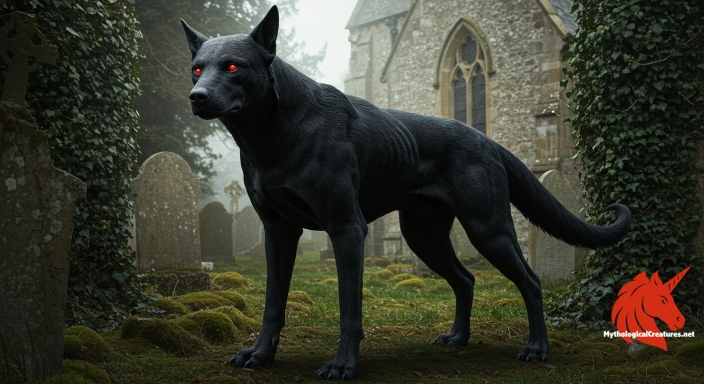
Church grim
Church grim - Symbolises the protection of sacred church sites and the blending of pagan and Christian traditions
the legend in five swipes.
the legend in five swipes.
Where does the story of the Church grim begin?
The church grim is a mystical guardian spirit that has long been woven into the fabric of English and Nordic folklore, where it is seen as a protector of sacred churchyards and hallowed ground. Its origins are steeped in a time when the boundary between the natural and supernatural was blurred by the presence of divine forces in everyday life. Earliest attestations of the creature appear within medieval narratives and local legends that stress its role in safeguarding the spiritual sanctity of churches. The grim is usually depicted as a formidable black dog, yet its form is not fixed, often transforming to suit different local lore. It is regarded as the vigilant overseer of churchyards, a being that commands respect and discretion through its solemn duty to ward off desecration. The creature’s presence is intricately linked to the Christian belief in sacredness, offering a spiritual bulwark against sacrilege and disrespect. Its enduring image in folklore serves as both a warning and a reassurance, embodying the communal need for order in sacred spaces. Over time, the coming together of pagan animal symbolism and Christian ritual aesthetics helped solidify the church grim’s place in regional mythology. Its story continues to resonate in rural communities, where whispered tales about shadowy figures remind listeners of the sanctity of tradition. In modern renditions, even the term has evolved to describe earthly pets that carry on the legend in a more benign manner.
Church grim: How the Tale Was Told and Retold
Historical manuscripts and oral traditions provide the fragmented yet captivating evidence of the church grim’s existence, with references scattered through the annals of medieval folklore. Various manuscripts mention a spectral creature that guards churchyards, a detail that vividly captures the fusion of lore and liturgy in rural communities. Compilations of folklore from the 19th century offer different narrative strands, each emphasising aspects of divine protection and mystery. Although no single primary source encapsulates the entire myth, collections of ballads and regional tales recurrently allude to a black canine figure that punishes sacrilege. In Nordic accounts, the grim is occasionally interwoven with stories of other spectral animals, hinting at wider mythological connections. Some lesser-known ecclesiastical records hint at supernatural interventions near church boundaries, further deepening its aura. Oral renditions, often passed down through generations, have adapted the tale to meet local needs and communal fears. These narrative variants provide insights into how the myth changed as communities shifted from pagan to Christian practices. The diversity of versions illustrates that the creature’s role as a guardian was both a literal and symbolic representation of protection. Ultimately, the persistent echoes found in various folklore collections attest to the enduring power of this mythic sentinel.
Church grim: Physical Form and Supernatural Powers
The church grim is most commonly depicted as a large, imposing black dog whose sleek, dark fur seems to absorb the faintest light of dusk and dawn. Its eyes are often described as glowing with a supernatural intensity, hinting at an inner fire that illuminates its silent vigilance. In many accounts, the creature’s form is both fluid and enigmatic, capable of adopting the guise of other animals should the need arise. Such transformations might reveal a raven or even a shadowy stallion, each appearance echoing the creature’s deep connection with the natural world. Variations in its physical description suggest that in some traditions it towers over ordinary hounds, evoking both awe and a hint of terror. The precise outline of its features—whether the sharply pointed ears, the lean muscular build, or the glistening coat—serves to underline its role as an unyielding guardian. It is said that under the shroud of night, its form takes on an almost ethereal quality that blurs the line between the corporeal and the ghostly. Local lore sometimes notes that its paws leave behind impressions of faint, luminous tracks on the moist earth of churchyards. Such descriptions convey a creature that is as much a spirit of nature as it is a supernatural watchdog. The intricate physical portrayals invite the imagination to visualise a being that bridges the material and metaphysical realms in every aspect of its appearance.
What regional forms of the Church grim exist?
Across the varied landscapes of England and the Nordic regions, the church grim assumes characteristics that mirror the local cultural and environmental contexts. In England, the creature is closely tied to the somber ambience of ancient churchyards, where its dark canine form personifies the vigilance of longstanding ecclesiastical traditions. In contrast, Nordic versions of the myth sometimes veil the grim in the mysteries of the cold, with hints of ice and shadow that recall the region’s austere natural beauty. Rural narratives in both regions portray a being that is as much a part of the land as the weathered stone of ancient churches, albeit with subtle differences in temperament and presentation. English tales often imbue the creature with a stern presence, emphasising its role in warding off those who dare defile sacred space. Meanwhile, Scandinavian folklore may present the grim with a slightly more ambiguous nature, one that is as capable of benevolence as it is of enforcing divine retribution. Urban adaptations have further reshaped its image, equating the myth with modern pet dogs that carry a vestige of the ancient guardian. The diversity in the creature’s portrayal underlines how regional sensibilities mould folklore, with varying degrees of fear, respect, and affection. Local customs and rites have often incorporated subtle references to the church grim, reaffirming its status as a cultural emblem. In every adaptation, the core motif of a vigilant protector remains constant, even as details shift to reflect regional identity.
What parallels exist to the Church grim in other traditions?
The church grim stands alongside a host of comparable guardian spirits in European folklore, where spectral canines frequently appear as both omens and protectors. Its likeness to the notorious Black Shuck and the Barghest demonstrates a shared motif in which dark, canine figures embody the mysterious forces that hover at the boundary between the mortal and the divine. Such comparative analysis reveals that while many of these legends revolve around a menacing presence, the church grim is uniquely intertwined with the sanctity of specific religious spaces. In contrast to more malevolent interpretations of similar creatures, the church grim is charged with the protective duty of maintaining the spiritual purity of a sacred ground. Cross-cultural reflections show that while some regions perceive the creature as a harbinger of doom, others view it as a benevolent overseer with a more nuanced and layered personality. The interplay between these narratives highlights a fascinating symbiosis between themes of divine retribution and communal guardianship. Even in distant traditions, analogous figures surface—a testament to the universal appeal of the protective animal spirit. The recurring imagery of a loyal, dark guardian serves as a bridge linking diverse mythologies, be they Celtic, Germanic, or Scandinavian. In comparing these cultural manifestations, one finds that the church grim’s role is both highly specific in its context and broadly emblematic of the human need for metaphysical protection. Such a multifaceted character affirms the timeless nature of myth as a reflection of societal values and existential fears.
How has the image of the Church grim evolved?
The historical evolution of the church grim is a tale of adaptation and reinvention, mirroring the shifts in social and religious thought across the centuries. In its early medieval depictions, the creature was a fearsome overseer whose spectral presence enforced sacred boundaries with a stern vigilance. As time passed, its portrayal softened in some narratives, transforming into a guardian whose role embraced both warning and benevolence. Literature and folklore from various eras have reimagined the church grim, ensuring its survival as a potent symbol of communal heritage and spiritual endurance. Modern interpretations now often reflect a playful yet respectful nod to the myth, with local communities even associating their beloved pet black dogs with the ancient guardian spirit. Contemporary art and media have reinvented the creature in a variety of aesthetic modes, from eerie illustrations to cinematic appearances that capture its dual nature as protector and enigma. This evolution speaks to a broader cultural shift in how ancient legends are celebrated and understood in a modern context. The church grim continues to evoke a connection to a past where the spiritual and the natural were inextricably intertwined, offering a narrative that is both captivating and comforting. Its legacy persists not only in traditional retellings but also in new creative works that reinterpret old symbols for new generations. Ultimately, the church grim remains a dynamic emblem of the perpetual dialogue between heritage and modernity, a reminder that ancient spirits can still light the way in contemporary mythmaking.
Interesting Fact
An interesting observation is that modern pet black dogs in churchyards are sometimes nicknamed church grims, maintaining a link to their mythological roots.
Mythological Treasures
Norse Sagas: A field guide to the beasts of the Viking world
Drawn from the saga accounts themselves, with the powers, weaknesses and doom of each being set out.
Egyptian Legends: A field guide to the gods and monsters of ancient Egypt
Guardians of the living and devourers of the dead, with the role each played in judgement.
Chinese Beasts: A field guide to the dragons and demon kings of Chinese myth
From river dragons to demon kings, with the legends that shaped five thousand years of storytelling.
the legend in five swipes.
For serious myth projects
Feature your work alongside the legends
From academic works to story-rich games, we highlight projects that respect world mythologies. Talk to us about a measured, long-term placement.
Start a conversationQuick Creature Info
Features:
Associations:
Our Mythic Legendary Rating:

Habitat:
Supernatural Powers:
Physical Attributes:
Abilities:
Behavior:
Lore:
Related Creatures, Tales or Lore
References
Discover Another Mythical Legend You May Not Have Heard Of?
Uncover the mysteries of ancient folklore and expand your knowledge of legendary beings from cultures around the world.
Dare to Meet the Etinsib Ziwa....

The Mythological Creatures Book Series
Yokai, Greek, Norse, Egyptian & Chinese. Five illustrated field guides to the creatures the old stories either warned or told you about.


Curated by the Mythological Creatures Team
Series editor: Mythological Creatures Directory
Primary desk: Northern & European Folklore Desk
(rev. November 2025)