
Chuvash dragon: The Chuvash dragon, also known as Verechelen, is a legendary winged, fire-breathing, and shapeshifting dragon from Chuvash mythology.
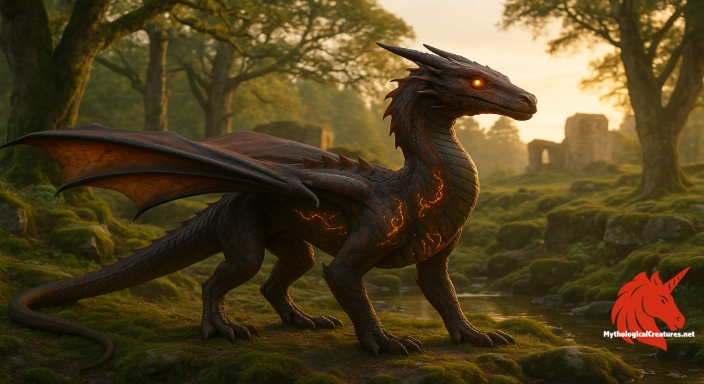
Chuvash dragon
Chuvash dragon - Represents the connection between the Chuvash people and their ancient mythological past, distinguishing itself from Turkic dragon myths.
Origins & First Encounters
The Chuvash dragon, often known as Verechelen, embodies a rich blend of mystique and ancient heritage. Its legend draws from the storied past of the ancestral Chuvash people who regarded the creature as both guardian and enigma. Believed to be a winged, fire-breathing and shapeshifting entity, it holds a unique place in the mythology of Volga Bulgaria. The very name, meaning 'invisible snake', reflects its elusive nature and transformative abilities. Stories of the dragon have been passed down through generations in oral traditions and local lore. It is celebrated in countless myths that weave the natural world with the supernatural. Its presence is often interpreted as a symbol of unseen forces that govern the boundaries between life and the mystical. Adorned with both fearful and awe-inspiring traits, the dragon has captured the imagination of communities throughout the region. Thus, the Chuvash dragon endures as a powerful emblem of transformation and the enduring legacy of ancient cultural narratives.
Source Texts & Tale Variants
Folkloric manuscripts and oral histories have preserved the tales of the Chuvash dragon through centuries. Ancient texts provide only fragmentary glimpses of the dragon, with much of its lore transmitted orally through generations. Ritual chants, folk songs and mythic recitations often capture the mutable nature of this winged beast. Variations of the story depict the creature in diverse roles, ranging from a benevolent protector to an omen of natural chaos. Some narratives present Verechelen as a guardian spirit, whose fiery breath symbolises both destruction and rebirth. Other versions recount its shapeshifting abilities, allowing it to assume forms that blur the line between human and beast. Traditional storytellers have infused the legend with regional nuances that reflect local attitudes and experiences. While written records in local chronicles are sparse, piecemeal references in folk art and ritual practices underscore its significance. The multiplicity of these accounts enriches our understanding of the dragon as both a mythological enigma and a cultural touchstone.
Form & Powers
The Chuvash dragon is depicted as a majestic and formidable creature with a sinuous, elongated body. Its wings, often portrayed as vast and membranous, grant it an aura of transcendence as it soars across turbulent skies. Every scale on its body shimmers with hues reminiscent of molten metal or deep, iridescent colours that shift with the light. The dragon’s eyes are often described as penetrating and wise, conveying both ancient knowledge and fierce intensity. Its formidable jaws and powerful fangs are capable of unleashing streams of fire, a testament to its fiery nature. Legends also recount that its body can morph into various shapes, underscoring its shapeshifting powers. Depending on the narrative, the creature's size fluctuates between that of a colossal beast and a more modest, yet no less potent, entity. Subtle details such as barb-like scales along its spine and a sinuous tail lend it an air of both beauty and menace. In every depiction, the Chuvash dragon exudes an enigmatic blend of grace and ferocity that has captivated imaginations for generations.
Regional Faces
Regional interpretations of the Chuvash dragon reveal a tapestry of diverse cultural influences across the Volga region. In some local traditions, the creature is portrayed as an ethereal guardian of sacred waterways and ancient groves. Other community accounts imbue the dragon with a more fearsome aspect, where its fiery nature serves as a warning against proud transgressions. The creature’s epithet 'invisible snake' is particularly emphasised in tales that celebrate its elusive presence and mysterious disappearances. Local variations often merge elements of Turkic mythology with indigenous folklore, yielding distinctive visual and behavioural traits. Some stories depict it with pronounced reptilian features, while others highlight a more anthropomorphic form that signals wisdom and adaptability. The environmental narrative also shifts with local geography, where the creature may be associated with both arid steppes and verdant riverbanks. Each regional version adds layers of symbolism that mirror the community’s relationship with nature and the ineffable. These variations collectively enrich the mythos of the Chuvash dragon as a quintessential embodiment of both local lore and universal mystery.
Cultural Parallels
The Chuvash dragon finds cultural kinship with numerous draconic figures across a vast expanse of Eurasian mythologies. Comparable to the Turkish Zilant in its fiery attributes, its legend, however, is uniquely intertwined with the heritage of Volga Bulgaria. It shares similarities with the benevolent dragon figures of Chinese lore, albeit with a temperamental twist that reflects regional mythic energies. Much like the serpentine creatures in Norse and Eastern European legends, it is a symbol of an interlaced relationship between nature’s bounty and its unpredictability. The creature’s shapeshifting ability resonates with global myths of transformative deities that defy mortal expectations. Its representation as both feared and revered mirrors the dualistic nature of many mythological beings that walk the boundary between chaos and order. Echoes of its myth appear in hybrid forms where the lines between animal and human are blurred, a motif found in various traditional narratives. Such cross-cultural connections underscore a shared human endeavour to encapsulate the mysteries of the natural world in symbolic forms. The comparative study of these legends reveals a timeless narrative where elemental power and compassion coexist in a majestic entity.
Legacy & Modern Evolution
Over the centuries, the portrayal of the Chuvash dragon has gracefully transitioned from whispered ancestral myths to a widely recognised cultural symbol. Earlier incarnations of its story were deeply embedded in local oral traditions and ritualistic practices among the ancestral Chuvash. In the modern era, artistic renderings and literature have reimagined the dragon as an emblem of resilience and enigmatic beauty. Recent reinterpretations highlight its shapeshifting abilities as metaphors for cultural transformation and identity fluidity. Festivals and cultural events across the region have adopted the figure, celebrating it as a vibrant reminder of ancient heritage. The evolution of its iconography reflects both a preservation of historical narratives and a dynamic adaptation to contemporary sensibilities. Modern storytellers and visual artists have infused the legend with fresh symbolism, often portraying the creature amidst a richly detailed modern landscape. This revival underscores a broader cultural movement that honours mythological heritage while exploring its significance in today's world. Thus, the enduring legacy of the Chuvash dragon continues to inspire awe and dialogue, bridging the ancient past with modern creative expression.
Interesting Fact
Despite its fearsome abilities, the Chuvash dragon is celebrated as a symbol of transformation and cultural identity, embodying the paradox of being both visible in its fiery displays and invisible in its elusive nature.
Partner with us
Sponsor this space
Reach thousands of mythology enthusiasts with a curated placement on our creature pages.
Learn about sponsorshipQuick Creature Info
Associations:
Our Mythic Legendary Rating:

Also Sometimes Known As:
Habitat:
Supernatural Powers:
Physical Attributes:
Abilities:
Behavior:
Lore:
Related Creatures, Tales or Lore
- ZZilant
- EEuropean Dragon
- LLung (Chinese Dragon)
References
Discover Another Mythical Legend You May Not Have Heard Of?
Uncover the mysteries of ancient folklore and expand your knowledge of legendary beings from cultures around the world.
Dare to Meet the Peisenor....

Curated by the Mythological Creatures Team
Series editor: Mythological Creatures Directory
Primary desk: Northern & European Folklore Desk
(rev. November 2025)