
Comus: Comus is the Greek god of festivity and revelry, depicted as a winged youth or satyr.
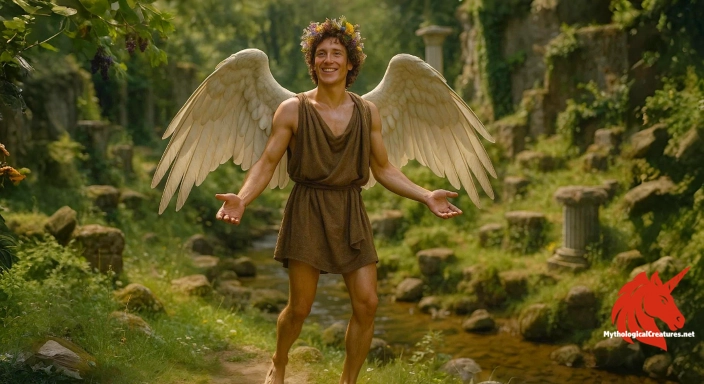
Comus
Comus - Represents the uninhibited spirit of celebration and the inversion of societal norms
Origins & First Encounters
Comus is a fascinating figure of Greek mythology who symbolises the spirit of festivity and revelry, embodying the exuberance of nocturnal celebrations. His origins are intertwined with the cult of Dionysus, where he functioned as the intimate cup-bearer during elaborate feasts. The imagery of Comus often presents him as a youthful, ethereal figure with delicate wings or with the mischievous appearance of a child-like satyr. His myth, emerging in later antiquity, reflects a period of cultural transformation and the blending of earlier traditions. The active participation in his annual celebrations, which involved the unusual swapping of clothes between genders, highlighted the subversion of everyday norms. His portrayal with a wreath of vibrant flowers accentuates the dual nature of beauty and intoxicated abandon in his character. Emblematic of both divine revelry and the raw vitality of human celebration, his presence bridges the realms of the orderly and the ecstatic. Comus carries with him an aura of mystery, inviting both joyous participation and reflective indulgence in life’s pleasures. His legacy continues to intrigue scholars with its blend of innocence and unbridled mischief. This enduring myth offers a window into the complexities of human desire for freedom and festive abandon.
Source Texts & Tale Variants
The narrative of Comus is predominantly drawn from sources that emerged in later antiquity rather than from the earliest classical texts. His myth surfaces in literary and artistic works that sought to capture the essence of Dionysian rites, imbuing the festivals with a distinctive air of ecstatic celebration. Many of these accounts were part of an evolving oral tradition later immortalised in written records, emphasising the vibrant spirit of his character. Ancient texts depict the curious practice of communal clothing exchange during his festivities, a detail that has sparked a variety of interpretations over time. The portrayal of Comus has often been interwoven with the broader tapestry of Bacchic rites, thus reinforcing his identity as an embodiment of revelry. Different story variants present him alternately as a divine joy-bringer and a mischievous instigator. Artistic impressions in vase paintings and frescoes further enriched his myth, providing visual evidence that couples myth with ritual practice. The multiplicity of his narrative variants reflects a dynamic and evolving interpretative tradition that was open to local reinterpretation. These diverse narratives offer a multifaceted view of a character whose essence is intimately tied to the celebration of life. The evolution of his story across texts underscores the adaptability and enduring appeal of mythological symbolism in ancient culture.
Form & Powers
Images of Comus are rendered with vivid details that evoke both a celestial charm and a down-to-earth exuberance. He is customarily portrayed as a winged youth, his delicate appendages symbolising a transcendence above ordinary human limitations. Often depicted with the playful features of childhood, his visage exudes both innocence and a hint of mischievous abandon. His eyes are frequently described as sparkling with a glimmer of liquid mirth, suggestive of his close association with the intoxication of joy. The wreath of flowers he wears is intricately detailed, often illustrated with an array of blossoms that range from fiery reds to gentle blues, accentuating his link to nature's bounty. Artistic representations show him poised at the edge of inebriation, his posture languid and evocative of a state between consciousness and wild abandon. Some depictions emphasise a rustic, almost satyr-like quality in his appearance, blending youthful beauty with earthy, animalistic elements. Variations in his portrayal reveal a subtle spectrum in his physicality, from a delicate, ethereal form to a more robust, elemental representation. His minimal attire and the emphasis on natural adornments further reinforce his integration with the untamed spirit of revelry. Each artistic detail, from the tilt of his head to the flourish of his wings, contributes to an unforgettable image that has resonated through centuries.
Regional Faces
The figure of Comus exhibits a range of regional nuances that reflect the diversity of local cultural expressions across the ancient Mediterranean. In classical Greek settings, his celebrations were marked by unique rituals such as the exchange of garments, making his festivals both a celebration of liberality and a commentary on societal conventions. His character was adapted in various Greek regions to align with local customs, where he sometimes assumed a more mischievous or even subversive role. In Roman artistic and literary traditions, Comus was often portrayed with an added layer of decadence, his association with wine and revelry further accentuated by the flourishing Bacchic festivals. The regional interpretations varied not only in his appearance but also in his symbolic resonance, reflecting local attitudes towards excess and indulgence. Certain local traditions portrayed him as a benign spirit of the night, one who encouraged freedom and spontaneity without dire consequence. In northern European literary adaptations, his image was softened, becoming a more allegorical representation of seasonal rebirth and carefree abandon. Despite these variations, the essence of Comus as a conduit of ecstatic celebration remained intact, linking diverse cultural interpretations. His multifaceted depictions illustrate how local values and artistic preferences shaped his mythos over time. Across regions, the enduring iconography of Comus serves as a bridge between ancient ritual practices and the universal human celebration of joy.
Cultural Parallels
The myth of Comus finds a resonant echo in a broad spectrum of mythological figures associated with celebration and the breaking of societal restraints. His role as a facilitator of revelry aligns him with other deities from the Dionysian tradition, each embodying the potent combination of divine ecstasy and mortal folly. Distinct similarities can be identified with Pan, another emblematic deity of nature and rustic merriment whose image is often associated with leaping, laughter, and liberation. Both Comus and satyrs such as Silenus share a connection to the influence of intoxication and the allure of spontaneity found in celebratory rituals. Furthermore, his intertextual presence in later European literature bridges a gap between ancient myth and the modern conception of individualism and festivity. His character mirrors that of tricksters found in various cultural traditions, where the eccentricity of fun challenges normative boundaries. Comparative analysis with corresponding figures from Near Eastern and Celtic traditions reveals recurring motifs, such as the celebration of nature’s bounty and the subversion of conventional norms. These cultural parallels attest to the universal appeal of mythic archetypes that celebrate the transient pleasures of life. The shared symbolism of the floral wreath and languid, unbridled demeanour further reinforces the interconnected nature of this celebratory iconography. In viewing these cross-cultural echoes, one recognises Comus as part of a broader mythological tapestry that continues to inspire both admiration and caution.
Legacy & Modern Evolution
The narrative of Comus has undergone significant evolution, mirroring the shifting cultural landscapes from antiquity to the modern era. His early portrayal as a winged youth teetering on the brink of drunkenness has been reimagined by successive generations, each infusing his image with contemporary cultural nuances. During the Renaissance and later periods, artists and writers revisited his myth, incorporating elements of both classical tradition and modern sensuality. His character has often been utilised to explore themes of liberation, the ephemeral nature of pleasure, and the paradox of joy versus chaos in human experience. In modern literary works and theatrical productions, Comus is portrayed as a symbol that encapsulates both the allure and the pitfalls of unrestrained indulgence. Contemporary reinterpretations frequently draw attention to his dual nature, reflecting an interplay between innocence and decadence. Artistic representations have increasingly emphasised his embodiment of the transient nature of revelry, a motif that resonates in today's fast-paced cultural milieu. Modern festivals and art installations sometimes echo the ancient rites associated with his myth, celebrating a legacy that transcends time and place. His evolving image in visual and literary arts underscores the enduring fascination with mythic figures who challenge societal norms. In reinterpreting his story for new audiences, Comus remains a potent symbol of both creative inspiration and the ever-present tension between order and pandemonium.
Interesting Fact
An interesting observation is that during festivals dedicated to Comus, the ritual exchange of clothes served as a symbolic inversion of social order, challenging traditional gender roles and cultural expectations.
For serious mythcraft
Your project belongs among the legends
If your work deepens how people understand, play with, or teach mythology, a sponsor placement here keeps it in front of the right readers all year.
Submit a sponsorship enquiryQuick Creature Info
Origin:
Features:
Associations:
Our Mythic Legendary Rating:

Also Sometimes Known As:
Habitat:
Supernatural Powers:
Physical Attributes:
Abilities:
Behavior:
Lore:
References
Discover Another Mythical Legend You May Not Have Heard Of?
Uncover the mysteries of ancient folklore and expand your knowledge of legendary beings from cultures around the world.
Dare to Meet the Nongthang Leima....

Curated by the Mythological Creatures Team
Series editor: Mythological Creatures Directory
Primary desk: Hellenic & Ancient Mediterranean Desk
(rev. November 2025)