
Daidarabotchi: Daidarabotchi is a colossal yōkai from Japanese mythology, renowned for its immense size and the legendary ability to resemble a mountain range when sleeping.
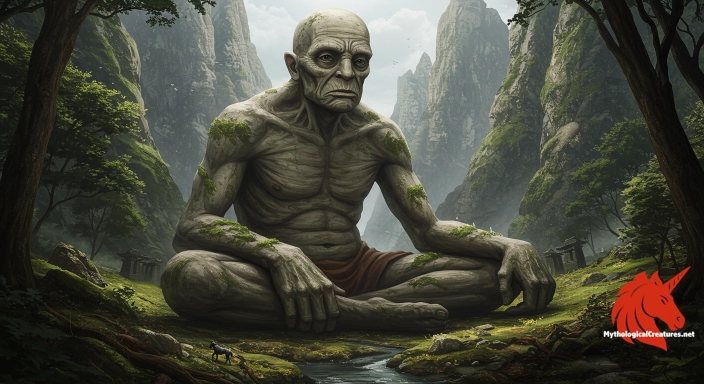
Daidarabotchi
Daidarabotchi - Daidarabotchi serves as a reminder of nature's immense power and the thin line between the living and the natural world in Japanese folklore.
Origins & First Encounters
Daidarabotchi is celebrated in Japanese mythology as a colossal yokai whose very existence blurs the line between the animate and the elemental. Born from an age when nature itself was seen as a series of living deities, this creature has been woven into folklore as an embodiment of the earth's boundless power. Legend has it that his dormant form creates vast mountain ranges, a notion that has intrigued communities for generations. He emerges from the collective imagination of rural storytellers and has been adapted by many regions to explain the origins of their most enduring landscapes. The myth of Daidarabotchi offers a glimpse into an era when the unexplained phenomena in nature were interpreted as the actions of divine giants. His presence in early folklore signals a time when the natural world was both revered and feared for its uncontrollable might. Over centuries, he has come to symbolize the raw and unpredictable energy beneath the peaceful façade of the countryside. The enduring legacy of Daidarabotchi continues to capture the human fascination with the unknowable forces of nature.
Source Texts & Tale Variants
The roots of the Daidarabotchi myth can be traced back through a rich tapestry of folklore transmitted orally in Japan’s rural heartlands. While early records might be sparse, numerous local chronicles and illustrated compendiums have alluded to the giant’s wondrous feats. Some Edo period manuscripts and folklore collections, though not always explicit, hint at a being whose sleeping form was mistaken for mountain ranges. The variability in these ancient texts mirrors the spread of regional interpretations, each adding new facets to his character. Over time, story variants emerged that focused on his transformative powers over the landscape rather than only his fearsome appearance. Folk narratives and artistic depictions both complement and contradict one another, revealing a flexible myth that adapts to local needs. This evolution in the myth is perhaps a reflection of the broader, shifting perceptions of nature and its forces. The multifaceted portrayal in both written and oral traditions further cements Daidarabotchi’s role as a dynamic and enduring element of Japanese myth.
Form & Powers
Visions of Daidarabotchi often evoke an image of overwhelming scale—a giant whose form merges with the very terrain he is said to sculpt. His body is frequently depicted as an immense mass of rock and earth, drawing parallels with the rugged mountain ranges he purportedly creates. Physical descriptions suggest a form so vast that each limb can be equated with a series of hills or valleys, with details highlighting textures that resemble ancient, weathered stone. His exterior is sometimes imagined as a patchwork of geological layers, with surfaces that appear both formidable and intricately aged. In some artistic renditions, his skin glimmers faintly with embedded minerals, offering a mystical shimmer reminiscent of a twilight landscape. The eyes, when they do appear in illustrations, are vast and enigmatic, providing a window into a timeless soul. This monumental creature is not only defined by his size but also by the interplay of light and shadow upon a surface that mimics the uneven terrain of Japan’s celebrated highlands. Variations in artistic style ensure that while the core idea remains the same, each depiction of Daidarabotchi offers a unique perspective on his physical grandeur.
Regional Faces
Daidarabotchi’s myth has been interpreted differently across various regions of Japan, each local culture adapting his features to its unique environmental narrative. In the mountainous regions of central Japan, he is often portrayed as a guardian whose slumber gives rise to the peaks and ridges that define the horizon. Farther north, where seismic activity is a daily reminder of nature’s unpredictability, legends depict him with a more volatile presence, with his stirring infusing the earth with tremors and sudden shifts. In areas of the south, subtle variations emerge, wherein the giant is sometimes revered as a benevolent force behind the fertility of the land and seasonal prosperity. Each region harnesses the image of Daidarabotchi to articulate its local encounters with natural disasters and geological wonders. These regional tales often serve to explain not only the formation of the landscape but also the cyclical nature of life, mirroring local agricultural practices and seasonal changes. The diversity in his portrayal highlights how a single mythic figure can embody a spectrum of attributes—from creation to destruction—depending on regional beliefs. Thus, Daidarabotchi remains a chameleon-like figure, equally at home in a tale of benevolence as in one of formidable natural force.
Cultural Parallels
The colossal Daidarabotchi finds kindred spirits in many global mythologies, where giant beings often serve as personifications of natural forces. Much like the Greek Titans or the jötnar of Norse legend, he represents the raw, unfettered energy of the earth, capable of both creation and devastation. In these cross-cultural narratives, the act of a giant influencing the land often symbolises the intimate bond between humanity and nature, a relationship marked by reverence and caution. The similarities extend to stories where a giant’s actions result in the formation of geographical features, echoing the themes of mountain creation found in various world traditions. Despite these parallels, Daidarabotchi retains a distinct identity, particularly through his integration with the Japanese spiritual landscape and the rich tradition of yokai lore. His mythological function as both a literal and symbolic mountain range during sleep sets him apart from other giant figures, underscoring a unique cultural response to the awe of nature. Comparative studies reveal that although many cultures anthropomorphise the forces that shape their world, the intricate blend of imagination and environmental explanation embodied by Daidarabotchi remains uniquely Japanese. This cross-cultural dialogue enriches our understanding of how ancient peoples across the globe perceived and revered the natural world.
Legacy & Modern Evolution
Over the centuries, the myth of Daidarabotchi has evolved in tandem with changing cultural attitudes toward nature and the supernatural. In earlier accounts, he was often feared as an uncontrollable force—a giant whose sleep could inadvertently reshape the land and cause natural calamities. As Japan progressed through different historical periods, his image softened from that of a harbinger of disaster to a more complex symbol that encapsulates both the awe of nature and humanity’s resilience. Modern adaptations in literature, film, and even anime have reimagined him as both a formidable guardian and a whimsical reminder of nature’s timelessness. These contemporary retellings highlight his multifaceted identity by interweaving elements of environmental caution with a sense of wonder and respect. The enduring allure of Daidarabotchi lies in his ability to embody the profound mysteries behind the landscapes of Japan—a motif that resonates deeply in today’s era of environmental awareness. His myth continues to inspire artists and storytellers who seek to capture that balance between fear and fascination. As discussions around natural disasters and environmental conservation gain urgency, Daidarabotchi’s legacy is increasingly invoked as a metaphor for the majestic and unpredictable spirit of the natural world.
Interesting Fact
An intriguing aspect of Daidarabotchi is its ability to seamlessly integrate with natural landscapes, blurring the boundaries between a living yokai and the very mountains it mimics.
For myth educators and toolmakers
Built a resource for mythology learners?
If you offer courses, teaching tools, or research platforms focused on myth and folklore, consider a discrete placement on our reference pages.
Introduce your resourceQuick Creature Info
Associations:
Our Mythic Legendary Rating:

Also Sometimes Known As:
Habitat:
Supernatural Powers:
Physical Attributes:
Abilities:
Behavior:
Lore:
Related Creatures, Tales or Lore
- JJörmungandr
- LLeviathan
- GGiant Oni
References
Discover Another Mythical Legend You May Not Have Heard Of?
Uncover the mysteries of ancient folklore and expand your knowledge of legendary beings from cultures around the world.
Dare to Meet the Pua Tu Tahi....
Curated by the Mythological Creatures Team
Series editor: Mythological Creatures Directory
Primary desk: Asian & Pacific Myth Cycles Desk
(rev. November 2025)