
Dhṛtarāṣṭra: Dhṛtarāṣṭra is a major Buddhist deity known as the Upholder of the Nation and one of the Four Heavenly Kings.
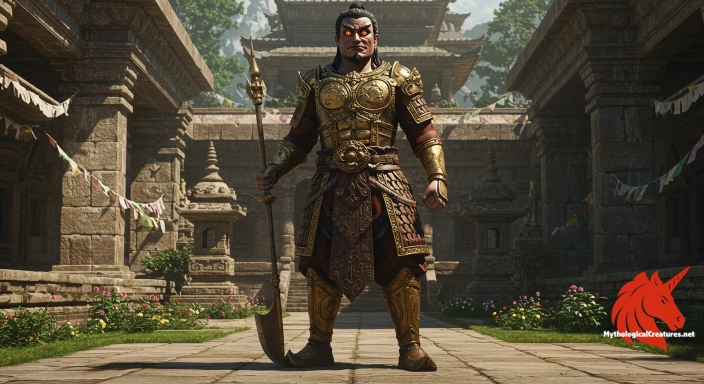
Dhṛtarāṣṭra
Dhṛtarāṣṭra - Revered as a celestial guardian, he upholds national order and defends the Buddhist realm from chaos.
Origins & First Encounters
Dhṛtarāṣṭra is a revered guardian deity in Buddhism celebrated for his role as one of the Four Heavenly Kings. He is historically rooted in ancient Indian traditions and emerges in early Buddhist texts as a protector of kingdoms and moral order. His name, meaning 'Upholder of the Nation', underscores his vital duty in defending both the physical and spiritual realms. He is first attested in classical Buddhist scriptures where his vigilant oversight of sacred spaces is detailed. Over centuries, his image has become entwined with the cultural identity of Buddhist communities, reflecting the merging of spiritual guardianship and national pride. His portrayal as a stalwart sentinel symbolises the virtues of loyalty and unyielding strength. The deity’s origins blend indigenous Indian values with the transformative appeal of Buddhist doctrine. His enduring presence in art and liturgy continues to inspire awe and reverence in temples across Asia.
Source Texts & Tale Variants
Ancient Buddhist canon texts provide some of the earliest attestations of Dhṛtarāṣṭra’s role as a safeguard against malevolent forces. Early discourses and sutras often describe his duties and divine qualities among the ranks of the celestial guardians. Pali texts used in Theravāda traditions mention him under variant names, underscoring the fluidity of his mythic character over time. In Chinese Buddhist literature, where he is frequently referred to by his local epithet Chíguó Tiānwáng, his story is embedded within elaborate temple narratives. Numerous inscriptions and pictorial records have been preserved in ancient monasteries, celebrating his protective vigour. Regional folk traditions have built upon these early scriptural foundations, weaving local legends that accentuate his martial prowess and benevolent oversight. Varying traditions present subtle differences in the recounting of his exploits, from epic battles with demons to ceremonial blessings at temple gateways. As such, his myth has evolved into a rich tapestry of narrative variants that continue to flourish in both scholarly texts and popular folklore.
Form & Powers
In artistic depictions, Dhṛtarāṣṭra is portrayed as an imposing figure radiating strength and dignified authority. His countenance is often set in a calm yet vigilant expression, and his eyes convey both compassion and resolute determination. Richly adorned in celestial armour, he wears intricately detailed regalia that blends ornate motifs with practical martial design. His traditional crown and ceremonial diadem are frequently decorated with symbolic emblems that echo his divine mandate. In many representations, he is depicted holding a sceptre or banner that signifies his role as the upholder of national order. The interplay of light and shadow in his portrayals emphasises his dual nature as both a fearsome warrior and a benevolent protector. His robust build and noble bearing affirm his status as a celestial sentinel guarding the thresholds of sacred realms. The fusion of Indian and East Asian artistic influences is evident in the nuanced details of his attire, reflecting centuries of cultural interplay and adaptation.
Regional Faces
Across different regions, the portrayal of Dhṛtarāṣṭra exhibits subtle yet significant variations shaped by local cultural influences. In India, early iconography presents him as a stern warrior imbued with spiritual finesse, reflecting an ancient ethos of protection and cosmic order. In East Asia, especially within Chinese and Japanese Buddhist traditions, his identity is interwoven with local artistic conventions, where he is often known as Chíguó Tiānwáng or Jikokuten. His depiction in these regions is frequently characterised by elaborate ceremonial style, featuring ornate costumes and grandiose expressions of authority. Southeast Asian interpretations sometimes incorporate indigenous motifs, with local artisans blending traditional Buddhist elements with native symbolic art. Tibetan representations emphasise intricate patterns and vibrant colours that further differentiate his character from regional counterparts. Diverse narrative accounts in scriptural texts and temple bas-reliefs enrich his portrayal, highlighting adaptations that harmonise with regional spiritual practises. These nuances underscore how local cultural contexts have broadened and imbued his myth with additional layers of meaning over time.
Cultural Parallels
Dhṛtarāṣṭra’s role as a guardian deity finds intriguing echoes in various mythologies across the world, reflecting a universal appeal of protective spirits. His vigilant guardianship resonates with Hindu deities who sustain cosmic order, and he shares conceptual parallels with the fierce dvarapalas that safeguard sacred portals in Indian temple architecture. In comparative terms, his function is reminiscent of the Western archetype of the guardian angel, whose presence reassures communities in times of adversity. East Asian traditions further align him with other celestial beings who both protect and symbolise the spirit of national integrity. His mythological traits harmonise with those of martial deities, such as Athena in Greek mythology, who epitomise wisdom and martial prowess in defending society. Comparative analysis reveals that across cultures, a blend of physical might and moral guardianship is a recurring theme. The synthesis of these cross-cultural elements reinforces the idea that societal values of duty and protection transcend individual mythologies. Such parallels enable a richer understanding of how diverse traditions have independently crafted narratives around similar archetypal figures who uphold both celestial and earthly order.
Legacy & Modern Evolution
From his origins in ancient Buddhist texts to his current status in modern religious practices, Dhṛtarāṣṭra has undergone a remarkable evolution. Through centuries of artistic reinterpretation and cultural exchange, his image has expanded from a primarily scriptural figure to a celebrated guardian in temple iconography. His role has been adapted to meet the spiritual and social needs of various eras, thereby bridging the ancient and the contemporary. Over time, regional and sectarian influences have endowed his character with a colourful array of symbols, ranging from martial weaponry to serene expressions of compassion. In modern Asian society, his depictions continue to grace temple corridors and artwork, often serving as a vivid reminder of enduring protective power. Contemporary devotees invoke his legacy during festivals and ritual ceremonies, embracing both his historical significance and revitalised cultural symbolism. His myth stands as a living tradition, inspiring creative reinterpretations in literature, cinema, and popular art while sustaining a dialogue with age-old values. The evolution of his portrayal reflects a dynamic interplay between historical continuity and modern reinterpretation, ensuring that his protective spirit remains ever relevant.
Interesting Fact
Despite his ancient origins and significant role in Buddhist cosmology, Dhṛtarāṣṭra is depicted in diverse artistic forms across cultures, reflecting a rich tapestry of regional interpretations.
Mythology-aligned partners
Showcase your myth-friendly brand here
Run a store, studio, or platform that lives in the world of myth and folklore? A curated sponsor panel on these pages may fit.
Explore partnership optionsQuick Creature Info
Features:
Our Mythic Legendary Rating:

Also Sometimes Known As:
Habitat:
Supernatural Powers:
Physical Attributes:
Abilities:
Behavior:
Lore:
References
Discover Another Mythical Legend You May Not Have Heard Of?
Uncover the mysteries of ancient folklore and expand your knowledge of legendary beings from cultures around the world.
Dare to Meet the Valefar....
Curated by the Mythological Creatures Team
Series editor: Mythological Creatures Directory
Primary desk: Asian & Pacific Myth Cycles Desk
(rev. November 2025)