
Egg ghost: The Egg ghost is a spectral entity from Korean folklore renowned for its egg-like appearance and ominous presence.
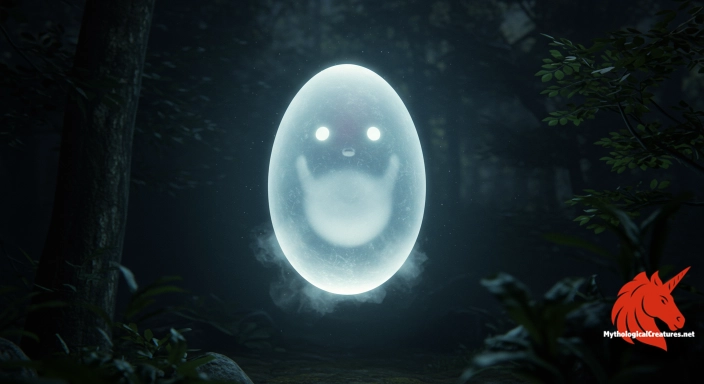
Egg ghost
Egg ghost - Within Korean mythology, the Egg ghost is a feared spectre whose appearance is an omen of death, and it is sometimes associated with the concept of mujagui, or 'childless ghosts,' highlighting cultural concerns over ancestral rites.
the legend in five swipes.
the legend in five swipes.
When was the Egg ghost first written about?
Emerging as a striking yet enigmatic figure in Korean folklore, the egg ghost, known locally as dalgyal guishin, captivates the imagination with its uncanny resemblance to an egg. Its origins are steeped in a tradition of spiritual uncertainty, where it is often linked to the neglect of proper ancestral rites and the unresolved anguish of the departed. The ghost’s visage, devoid of arms, legs, or any facial features, creates an immediate sense of otherworldliness and mystery. Tales of its appearance have been passed down through generations, imbued with a blend of dread and fascination. Despite its sparse literary attestation, this spectral entity has secured a distinct cultural niche as a portent of ill fate. It is said that encountering the egg ghost heralds a dire outcome, intertwining life, death, and misfortune in a single glance. Its presence underscores deep-seated concerns regarding the importance of memorial practices and the respect owed to ancestors. With each retelling, the egg ghost continues to evolve as a symbol of spiritual incompleteness and the unpredictable nature of the supernatural.
Which books and scrolls describe the Egg ghost?
Traditional Korean folklore and oral narratives serve as the primary sources for our understanding of the egg ghost. While formal literary accounts are limited, shamanistic rituals and gut performances have kept its story alive over centuries. Localised storytelling in rural communities reveals multiple variants of the myth, ranging from ominous doomsayers to elusive spirits that vanish at will. Some narratives emphasise that the creature can alternate between taking the form of an egg and manifesting as a ghostly apparition, enhancing its mysterious allure. The concept of the egg ghost is occasionally intertwined with that of the mujagui, or childless ghost, reinforcing the idea of a spirit left without due honour. Despite the scant written documentation in classical texts, these oral traditions have provided a fertile ground for various interpretations and regional adaptations. Over time, ritualistic recitals and community gatherings have contributed to a complex tapestry of myth, where minor textual details open doors to expansive narrative possibilities. Such multi-layered storytelling ensures that even fragmentary sources contribute significantly to our broader comprehension of this eerie symbol.
What abilities did the Egg ghost have?
The egg ghost is defined by its unmistakable form, which closely mirrors that of a simple egg, setting it apart from more typical human or animal apparitions. Its surface is smooth and unblemished, lacking the irregularities or textures that would evoke any semblance of a corporeal being. With no arms, legs, or recognisable facial features such as eyes, nose, or mouth, its outline suggests a perpetual state of incompleteness and ambiguity. Some depictions portray it as having a subtle luminescence, an eerie glow that heightens its otherworldly presence in dark settings. The absence of detail in its anatomy invites a myriad of interpretations, from a deliberate erasure of individuality to an emphasis on its ethereal nature. Variations in size are occasionally noted, with certain accounts describing it as either diminutive and unassuming or, paradoxically, overwhelmingly large when portending calamity. The minimalistic design of the ghost reinforces the idea that it exists beyond the limits of physical form, embodying the blurred boundaries between life and death. This deliberate vagueness in its physical traits not only augments its mystique but also symbolises the elusive quality of the spirit world. Every aspect of its design contributes to a visual archetype that is both unsettling and iconic in Korean ghost lore.
Egg ghost: Regional Differences in the Legend
Throughout the Korean peninsula, regional interpretations of the egg ghost lend unique dimensions to its myth. In some northern villages, for instance, local lore sometimes depicts the ghost as a benign yet cautionary figure, subtly warning communities of neglected traditions. Conversely, in other areas the creature is cast as a formidable harbinger of death, its appearance serving as an ominous sign of forthcoming misfortune. Rural narratives often weave the legend into broader seasonal and cultural practices, particularly during times when the veil between the living and the spirit world is said to thin. In certain locales, the egg ghost is credited with an ability to shapeshift, transforming into an innocuous egg to elude human detection until its moment to reappear arrives. These localised adaptations reflect the dynamic interplay between community beliefs and the broader fabric of Korean myth. The differences in its portrayal underscore the significant role of regional ritual, historical context, and communal memory. This fluidity in interpretation ensures that the myth is continually reshaped in accordance with local cultural values and societal concerns.
Which other cultures tell a story like that of the Egg ghost?
An exploration of the egg ghost in a broader mythological context reveals fascinating parallels with similar entities across East Asia. Comparable to faceless and formless apparitions in Japanese ghost lore, the egg ghost embodies the motif of a spirit unbound by traditional physicality. Both traditions utilise minimalist features to underscore themes of impermanence and the consequences of neglected spiritual duties. In the same vein as the mujagui—a type of ghost born from the absence of familial descendants—the egg ghost reflects the cultural imperative of performing ancestral rites. Its sparse physical presentation invites comparisons with other cultures where a lack of corporeal detail symbolises the dissolution of identity in the afterlife. The cross-cultural dialogue between these legends highlights a shared concern with the proper treatment of the dead and the dangers inherent in spiritual neglect. This analysis reveals that, while culturally distinct, these spectral figures serve similar functions as moral and cautionary representatives in their respective societies. The egg ghost, much like its counterparts, invites reflection on the societal norms surrounding death, memory, and the continuation of heritage.
Where does the Egg ghost appear in films and games?
Historically, the egg ghost has undergone subtle yet telling transformations in both depiction and significance. Early portrayals were deeply entwined with traditional shamanistic practices, emphasising its role as a dire consequence of abandoned funerary customs. Over time, as modernity reshaped cultural narratives, the ghost became a versatile symbol—one that has been reimagined in literature, film, and art. Today, the egg ghost appears not only as a harbinger of death but also as an enigmatic metaphor for the abandonment of heritage and the erosion of communal memory. Modern reinterpretations often blend elements of horror with moments of inadvertent humour, reflecting deep societal ambivalence about the past. In contemporary media, its minimalist form and spectral presence are leveraged to explore themes of isolation and existential uncertainty. Cultural historians have also begun to reassess its legacy, recognising the ghost as an integral part of Korea’s intangible heritage. This evolution in portrayal illustrates a broader trend of adapting ancient myth for today’s audiences, ensuring that the egg ghost remains a relevant and haunting figure in modern folklore.
Interesting Fact
Interestingly, the Egg ghost is sometimes associated with the concept of mujagui—spirits without descendants—underscoring cultural anxieties about ancestral remembrance and the care of departed souls in Korean tradition.
Mythological Treasures
Greek Myths: A field guide to the monsters of ancient Greece
Every monster here earned its place in legend, and each gets a full page of artwork and the story behind it.
Norse Sagas: A field guide to the beasts of the Viking world
Drawn from the saga accounts themselves, with the powers, weaknesses and doom of each being set out.
Egyptian Legends: A field guide to the gods and monsters of ancient Egypt
Guardians of the living and devourers of the dead, with the role each played in judgement.
the legend in five swipes.
Support the directory
Promote your myth project and fund more research
Sponsor placements help keep this directory growing and free to use while giving your work a focused, relevant audience.
Learn how sponsorship worksQuick Creature Info
Origin:
Features:
Associations:
Our Mythic Legendary Rating:

Also Sometimes Known As:
Habitat:
Supernatural Powers:
Physical Attributes:
Abilities:
Behavior:
Lore:
References
Discover Another Mythical Legend You May Not Have Heard Of?
Uncover the mysteries of ancient folklore and expand your knowledge of legendary beings from cultures around the world.
Dare to Meet the Faun....

The Mythological Creatures Book Series
Yokai, Greek, Norse, Egyptian & Chinese. Five illustrated field guides to the creatures the old stories either warned or told you about.
Curated by the Mythological Creatures Team
Series editor: Mythological Creatures Directory
Primary desk: Asian & Pacific Myth Cycles Desk
(rev. November 2025)