
Ethiopian pegasus: The Ethiopian Pegasus is a legendary two-horned, winged horse from Ethiopian lore, depicted in medieval bestiaries.
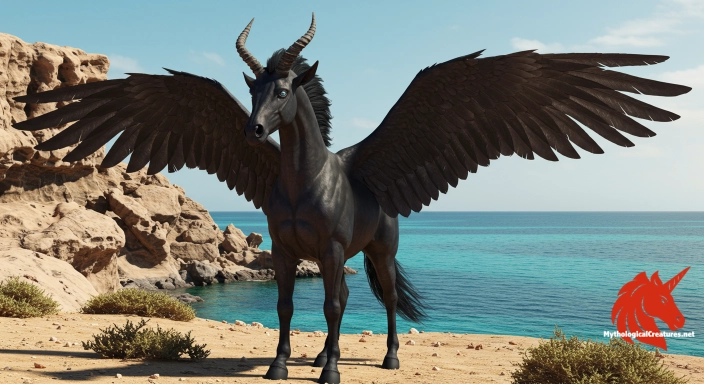
Ethiopian pegasus
Ethiopian pegasus - Represents the blending of fact and myth, and the exotic nature of distant lands in medieval literature.
Origins & First Encounters
The Ethiopian pegasus emerges from the depths of medieval lore as a striking emblem of both celestial beauty and mysterious origins. Its earliest mention appears in the writings of Pliny the Elder, who depicted it as a breed of two-horned, winged horses hailing from the remote lands of Ethiopia. The creature inhabits an island in the Red Sea off the coast of Eritrea, which only heightens its allure as a being from a hidden corner of the world. Its existence in medieval bestiaries bridges the realms of natural history and myth, captivating audiences with its unusual features and enigmatic presence. The narrative surrounding this pegasus speaks to the medieval fascination with exotic and fantastical fauna. Tales of its elegant flight and noble bearing have been woven into the cultural fabric of both African and European storytelling traditions. Crafted in the minds of scribes and travellers, its image encapsulates an intersection of wilderness, divinity, and the unexplored mysteries of the ancient world. This enduring icon continues to resonate as a symbol of the unfathomable magic that bridges the ordinary with the divine.
Source Texts & Tale Variants
Historical accounts of the Ethiopian pegasus are primarily derived from medieval bestiaries and the natural histories that circulated among ancient scholars. Pliny the Elder’s mention of the creature set a precedent for its continued reinterpretation, ensuring that its legend was preserved through centuries. Subsequent manuscripts enriched the narrative, often incorporating additional details and imaginative flourishes that extended beyond the original description. Various texts, ranging from travel accounts to illuminated religious manuscripts, captured the essence of its two-horned form and mystical wings. In some story variants, the creature assumes roles that blend natural wonder with allegorical significance, further cementing its place in myth. Different regions and eras added layers to its mythos, resulting in a tapestry of accounts that sometimes diverge creatively while remaining anchored to its exotic origins. Folkloric records mention the pegasus as both a harbinger of fortune and a custodian of secret wisdom. Through these diverse sources, the Ethiopian pegasus has emerged as a composite figure, its legend continuously evolving while retaining a core of mystery and wonder.
Form & Powers
The Ethiopian pegasus is portrayed as a majestic steed whose anatomy defies the conventions of ordinary horses. Its sleek, muscular body is cloaked in a luminous coat that appears to shift with subtle iridescence, evoking the colours of sunset and desert sands. Distinctively, the animal features two gracefully curving horns that protrude from its head, accentuating its regal and slightly unearthly character. Expansive, feathered wings sprout from its shoulder region, each plume detailed with intricate patterns that suggest both strength and delicate artistry. The creature’s eyes are often depicted as deep and observant, radiating an intelligence that seems to pierce through the veil of time. Although it is comparable in size to a large stallion, many portrayals imbue it with an almost supernatural presence that magnifies its physical stature. Delicate frills along its flanks and subtle ridges on its legs add layers of detail that emphasise both beauty and power. This harmonious blend of defined musculature, graceful form, and otherworldly embellishments marks the Ethiopian pegasus as one of the most striking figures in mythological bestiaries.
Regional Faces
Regional interpretations of the Ethiopian pegasus illustrate how local traditions can colour a myth with distinct cultural hues. In Ethiopian folklore, similar winged steeds are often interlaced with narratives of divine intervention, natural abundance, and sacred symbolism reflective of the region’s vibrant heritage. Tribes and local historians have sometimes depicted the creature as an emissary from the gods, its appearance heralding significant events or seasonal blessings. In contrast, medieval European accounts embraced its exotic nature, embellishing its features to accentuate the allure of a far-off, mystical land. Communities bordering the Red Sea infuse the legend with maritime mysticism, suggesting that the beast not only soars the skies but also guards ancient maritime secrets. Variations in descriptions—ranging from subtle differences in horn curvature to variations in wing span—highlight the adaptability of the myth across different geographies. In some local narratives, the Ethiopian pegasus is revered as a protective spirit, while in others it encapsulates the raw, untamed power of nature. These regional adaptations underscore the fluidity of myth-making, where a singular creature adapts its form and significance to resonate with a diverse array of cultural identities.
Cultural Parallels
Comparative mythology reveals intriguing parallels between the Ethiopian pegasus and other legendary equine beings throughout history. Its elegant wings and imposing horns bear a resemblance to the classical Pegasus of Greek lore yet distinguish themselves with an exotic twist and a distinctly dual-horned design. Similar mythical creatures in Persian and Islamic traditions also serve as emissaries bridging the realms of the mortal and the divine. Such winged horses, regardless of origin, generally symbolise freedom, transcendence, and the ephemeral nature of glory. The Ethiopian pegasus shares common ground with creatures like the griffin, where a fusion of animal parts gives rise to an entity that embodies both power and mystique. In many cultures, these composite beings serve as metaphors for representing the union of human aspiration and the unpredictable forces of nature. Cross-cultural analysis suggests that despite variations in form, the underlying symbolic role of these creatures remains remarkably consistent. Through these comparative lenses, the Ethiopian pegasus is positioned as a unique yet universally resonant figure, emblematic of the enduring human fascination with the miraculous and the transcendent.
Legacy & Modern Evolution
The myth of the Ethiopian pegasus has experienced a profound evolution from its earliest mentions in classical texts to its vibrant portrayals in modern fantasy literature and art. Initially recorded as a peculiar creature in ancient natural histories, its image was gradually embellished through centuries of transmission and reinterpretation. Medieval bestiaries rendered it with a blend of awe and mystery, positioning it as an exotic specimen from the far reaches of the known world. In the modern era, creative reinterpretations have recast the pegasus as a symbol of untamed freedom and the ethereal, often appearing in novels, films, and artistic representations that fuse myth and technology. Contemporary narratives frequently imbue this creature with allegorical significance, linking it to themes of transformation, transcendence, and the transcendental power of nature. Modern fantasy and role-playing games have embraced its striking form, spotlighting its dual horns and expansive wings as emblems of otherworldly resilience. The creature now stands as a bridge between the rich tapestry of ancient myth and the inventive spirit of today's imaginative arts. As the Ethiopian pegasus continues to inspire creative minds, its legacy endures as a multifaceted icon of beauty, mystery, and the endless allure of the mythic.
Interesting Fact
An intriguing feature of the Ethiopian Pegasus is its two-horned design, which differentiates it from its more widely-known single-horned Pegasus counterpart, signifying a unique evolutionary twist in mythical depictions.
Limited sponsor opportunity
One slot, carefully chosen partners
We only feature a small number of relevant sponsors at any time. If you create serious myth content, we would like to hear from you.
Partner with usQuick Creature Info
Origin:
Features:
Associations:
Our Mythic Legendary Rating:

Habitat:
Supernatural Powers:
Physical Attributes:
Abilities:
Behavior:
Lore:
Related Creatures, Tales or Lore
References
Discover Another Mythical Legend You May Not Have Heard Of?
Uncover the mysteries of ancient folklore and expand your knowledge of legendary beings from cultures around the world.
Dare to Meet the Minairó....
Curated by the Mythological Creatures Team
Series editor: Mythological Creatures Directory
Primary desk: African & Diaspora Traditions Desk
(rev. November 2025)