
Fulla: Fulla is a goddess in Germanic mythology known as the trusted attendant and confidante of Frigg.
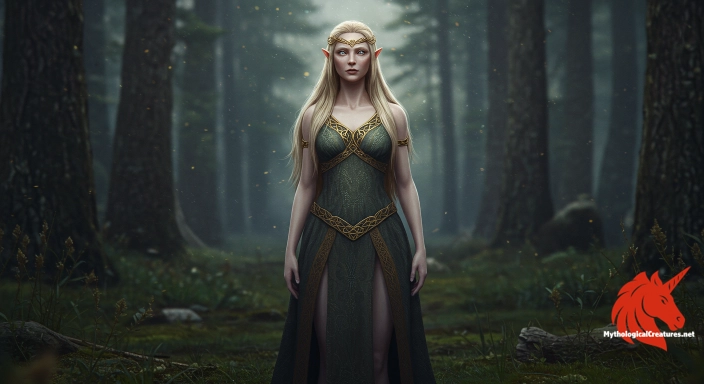
Fulla
Fulla - Fulla is significant as the confidante of Frigg and as a guardian of divine secrets and sacred objects, reflecting themes of bountifulness and protection within the pantheon.
the legend in five swipes.
the legend in five swipes.
The Beginnings of Fulla
Fulla is a multifaceted goddess whose name, derived from Old Norse and possibly meaning 'bountiful', suggests an innate connection to the forces of abundance and renewal. She emerges in early Germanic mythology as a subtle yet essential figure, whose presence is interwoven with the domestic and divine realms. Her first attestation can be traced to medieval compilations such as the Poetic Edda and the Prose Edda, where her service to the greater goddess Frigg is emphasised. Within these texts, Fulla is entrusted not only with the care of sacred objects but also with the safeguarding of intimate secrets. Her role as a confidante and attendant reflects the nuanced gender roles and spiritual hierarchies of ancient Norse society. The cultural context in which she is revered points to a tradition that valued both practicality and mysticism in divine affairs. In many accounts, her modest yet dignified presence serves as a reminder of the hidden strengths that support the cosmic order. Her myth, although not central to the pantheon, offers insights into the complex interplay of duty, grace, and divine benevolence. Over the centuries, Fulla has come to symbolise the understated power of service in the celestial realm.
What do the old texts say about Fulla?
The primary sources for Fulla's mythology are rooted in the ancient texts that have shaped our understanding of the Norse pantheon. Her role is documented in the Poetic Edda, where she appears in the context of the divine household, performing tasks that underscore her reliability and wisdom. The Prose Edda, compiled by Snorri Sturluson in the 13th century, further chronicles her association with Frigg and her attendant responsibilities. Skaldic poetry also offers references to her, adding layers to the portrayal of her domestic and mystical duties. A key element of her narrative emerges from continental traditions, where the Old High German text known as the "Horse Cure" Merseburg Incantation refers to her as Volla. In this incantation, she is depicted as playing an active role in the healing of a wounded foal, thereby expanding the scope of her myth. These varied sources attest to her longstanding presence in Germanic tradition and highlight the diverse roles she played across different texts. The discrepancies and convergences in these accounts have spurred rich scholarly debate on her character. Collectively, these sources illuminate the multifaceted aspects of Fulla's identity and her enduring significance in ancient lore.
The Described Form of Fulla
Although the ancient texts offer only limited details, Fulla’s physical depiction is marked by distinctive attributes that have captured the imagination of scholars and artists alike. Foremost among these is the golden band she is said to wear, a symbol that conveys both elegance and a connection to divine abundance. This gleaming adornment is often interpreted as an emblem of her role in the maintenance and transmission of sacred knowledge. Artistic impressions suggest that her attire reflects a blend of practicality and celestial splendour, echoing the dual nature of her responsibilities. The association with Frigg’s ashen box and footwear further hints at a meticulous attention to ritual detail in her presentation. Many imaginative reconstructions portray her with a serene countenance and subtle grace, attributes that underscore her role as a quiet guardian. The light reflected in her golden band is sometimes seen as mirroring the cycles of harvest and nature’s bounty. In these depictions, every element of her appearance is imbued with a deeper symbolic resonance, linking her physical traits to the broader themes of fertility and prosperity. Even with sparse documentary evidence, the visual cues connected to Fulla evoke an enduring narrative of understated beauty and sacred duty.
Fulla: Local Variations in the Story
Interpretations of Fulla demonstrate intriguing regional variations that highlight the richness of Germanic myth. In the Norse tradition, she is primarily portrayed as a devoted attendant to Frigg, embodying the ideals of domestic care and the preservation of divine secrets. Conversely, within the continental Germanic narratives, particularly in the Old High German context, she appears as Volla—a figure imbued with a broader sphere of influence that includes ritual healing. This continental perspective emphasises her role in the natural cycles of renewal and restitution, as seen in the healing of the wounded foal. Local traditions have thus adapted her character to resonate with the distinct spiritual needs of each community. In Scandinavian depictions, the focus is on her subtle efficiency and the quiet exchange of confidences, while continental folklore often attributes to her a more active force in magical rites. The interplay between these regional adaptations mirrors the dynamic evolution of myth as it traverses cultural boundaries. Variations in iconography, such as the style of her headgear or the nature of her sacred duties, further illustrate the synthesis of local and pan-Germanic influences. Through these diverse lenses, Fulla emerges as a goddess whose essence is both enduring and adaptable to different cultural narratives.
Fulla: Counterparts Around the World
Fulla’s mythological role invites comparison with a number of attendant deities found throughout various world traditions. Her function as a guardian of domestic sanctity and a keeper of secret wisdom draws parallels with lesser-known figures in the Greek and Roman pantheons. While full-fledged goddesses like Hestia or Vesta oversee the hearth, Fulla’s presence complements the larger narrative by ensuring that even the smallest details of divine life are attended to. Her association with Frigg mirrors other mythic relationships where a major deity is supported by a trusted subordinate, a motif common in Indo-European mythologies. This dynamic reflects a universal tendency to acknowledge the importance of behind-the-scenes forces that maintain cosmic order. The golden band she wears has similarly been symbolically linked to the idea of hidden, yet potent, power—a theme shared with various other mythological figures. In comparing her with attendants in Celtic or Slavic traditions, a common thread of nurturing and protective strength becomes apparent. Such cultural parallels highlight the shared values that permeate ancient societies, recognising the significance of roles that, while not central, are indispensable. Altogether, these cross-cultural connections enrich our understanding of Fulla, portraying her as a figure whose subtle influence echoes through myriad mythic narratives.
How has Fulla changed over time?
The legacy of Fulla has evolved considerably over the centuries, reflecting both historical shifts in belief and modern reinterpretations of ancient myth. Traditionally confined to the background of the divine assembly, her role was one of quiet service and custodianship. However, contemporary perspectives have begun to re-evaluate her contributions, casting her as a symbol of feminine resilience and latent power. Modern artistic and literary works have shifted the focus from her ancillary duties to a broader representation of wisdom, healing, and renewal. Within neo-pagan communities, Fulla is often invoked as a guardian of natural cycles and a keeper of ancestral secrets, linking past and present spiritual practices. This reimagining elevates her from a mere attendant of Frigg to an icon in her own right, celebrated for her enduring influence. The reinterpretation of her myth highlights the fluidity of mythological narratives and their ability to adapt to contemporary cultural contexts. As scholars and devotees continue to explore her character, Fulla’s subtle but profound impact on the divine order is increasingly appreciated. Her evolving portrayal stands as a testament to the dynamic interplay between tradition and modernity, ensuring that ancient voices continue to resonate in today’s spiritual landscape. Ultimately, Fulla’s historical evolution illustrates how myths can transcend their original boundaries to inspire diverse and transformative meanings across the ages.
Interesting Fact
An interesting fact about Fulla is her dual attestation in both Norse and Old High German traditions, underscoring the deep cultural exchange within early Germanic societies.
Mythological Treasures
Norse Sagas: A field guide to the beasts of the Viking world
Drawn from the saga accounts themselves, with the powers, weaknesses and doom of each being set out.
Chinese Beasts: A field guide to the dragons and demon kings of Chinese myth
From river dragons to demon kings, with the legends that shaped five thousand years of storytelling.
Japanese Yokai: A field guide to the spirits and demons of Japanese folklore
Fifteen spirits, with the signs to watch for and what the old tales say to do if you meet one.
the legend in five swipes.
For authors, artists, and makers
Created something from the realm of myth?
If your book, deck, game, or artwork draws from legendary creatures and lore, you can showcase it here in a tasteful, year-round placement.
Share your projectQuick Creature Info
Features:
Associations:
Our Mythic Legendary Rating:

Also Sometimes Known As:
Habitat:
Supernatural Powers:
Physical Attributes:
Abilities:
Behavior:
Lore:
References
Discover Another Mythical Legend You May Not Have Heard Of?
Uncover the mysteries of ancient folklore and expand your knowledge of legendary beings from cultures around the world.
Dare to Meet the Fūjin....
The Mythological Creatures Book Series
Yokai, Greek, Norse, Egyptian & Chinese. Five illustrated field guides to the creatures the old stories either warned or told you about.


Curated by the Mythological Creatures Team
Series editor: Mythological Creatures Directory
Primary desk: Northern & European Folklore Desk
(rev. November 2025)