
Gagoze: Gagoze is a fearsome Japanese oni yōkai known for his monk-like appearance and legendary status in folklore.
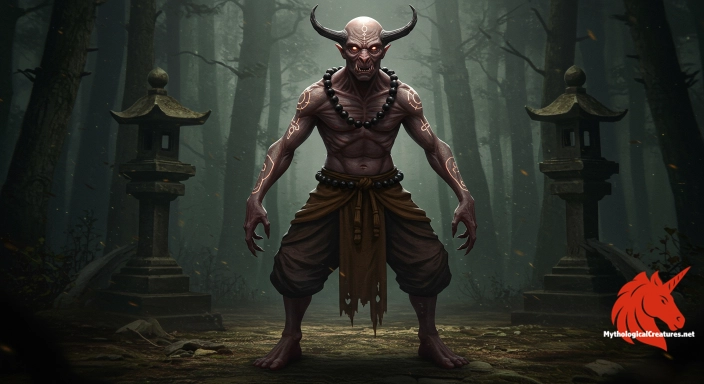
Gagoze
Gagoze - Gagoze exemplifies the blending of religious imagery with demonic lore in classical Japanese culture
Origins & First Encounters
Gagoze is a captivating yōkai whose origins are steeped in the religious and supernatural traditions of early Japan, particularly around the hallowed precincts of Gangō-ji in Nara Prefecture. Emerging during the Asuka period, its first attestation mirrors a time when spiritual belief and the mystical coexisted in everyday life. Known by several names including gagoji, guwagoze, gangō, and gangōji no oni, this entity epitomises a blend of orthodox religious ritual and the uncanny world of demons. Its presence in folklore helps bridge the gap between the sanctified rituals of Buddhist monasticism and the terror inspired by the unknown. The creature’s early mentions in texts like the Nihon Ryōiki have cemented its role in Japan’s rich mythological tapestry. Intricate legends portray Gagoze as both a cautionary omen and a protector of sacred grounds. The synthesis of spiritual reverence and ominous portent is a testament to the dynamic nature of early Japanese folklore. Overall, Gagoze serves as a prime example of how historical narratives interweave the sacred with the supernatural.
Source Texts & Tale Variants
The primary narratives surrounding Gagoze have been preserved through a variety of ancient texts and folklore traditions, making it a central figure in early yōkai literature. One of the earliest detailed accounts appears in the Heian period compilation Nihon Ryōiki, particularly in the story involving a boy of extraordinary strength linked to thunder’s rejoicing. Complementary sources like the Honchō Monzui contribute additional layers to its multifaceted mythos. Several story variants attribute differing roles and demeanours to the creature, suggesting that it might have functioned as either a fearsome adversary or a benevolent guardian depending on the telling. Over the centuries, oral traditions have enriched these written accounts, allowing the tale of Gagoze to shift subtly with each retelling. The texts capture a range of supernatural abilities, echoing themes of divine retribution and cosmic balance. Variations in narrative emphasise the complexity of its origins and the symbolic interplay between light and shadow in ancient spiritual beliefs. Collectively, these sources present Gagoze as a figure whose story is as diverse as the cultural milieu from which it originated.
Form & Powers
Visual depictions of Gagoze present a striking fusion of the monastic and the monstrous, revealing a being that defies straightforward categorisation. In classical artwork, notably in the Gazu Hyakki Yagyō by Toriyama Sekien, it is portrayed as an oni draped in the humble attire of a Buddhist monk. This unusual combination of sacred vestments with demonic features creates an image that is both awe-inspiring and disconcerting. Detailed illustrations often accentuate features such as pronounced horns, fierce eyes, and a rugged, muscular physique, embodying both spiritual wisdom and latent menace. The creature’s skin tone is variably rendered, with some interpretations favouring deep, earthy hues while others suggest a vivid, almost supernatural redness. Accentuating its dual nature, Gagoze is sometimes depicted carrying ritualistic symbols or a staff, hinting at its connection to natural forces like thunder and the elements. Its posture and expression are typically imbued with intensity, leaving an indelible impression of power and mystery. These varied physical details underscore the layered symbolism behind its appearance, inviting viewers to explore the interplay between sanctity and chaos.
Regional Faces
While Gagoze is most closely linked to the Gangō-ji temple in Nara, its mythological portrayal has been adapted and reshaped in diverse regional contexts across Japan. Localised traditions have enriched the narrative by embedding additional supernatural attributes and even reassigning its moral alignment in certain areas. In some regions, the creature is revered as a protective force, a guardian whose formidable presence safeguards sacred sites from malevolent influences. Elsewhere, its image is more ambiguous, reflecting both the protective qualities and the potentially vengeful aspects of an otherworldly being. Regional artists and storytellers have infused their own cultural symbols into the iconography of Gagoze, resulting in unique visual interpretations and narrative embellishments. This localisation process has allowed the creature’s legend to resonate with varied local audiences, each emphasising different facets of its mythos. The adaptation often mirrors local religious practices, drawing parallels between Gagoze and native deities or spirits. Ultimately, these regional variations serve to reinforce the idea that the boundaries of myth are porous, continuously shaped by the cultural and spiritual needs of each community.
Cultural Parallels
The character of Gagoze stands out among yōkai due to its distinctive combination of monastic garb and oni-like ferocity, inviting intriguing comparisons with figures in other mythological traditions. Its dualistic nature reflects a broader cultural pattern where beings embody both the sacred and the sinister, much like certain guardian deities in East Asian lore. Similar to the multifaceted images of figures such as Shuten-dōji, Gagoze encapsulates the paradox of a creature that is at once a protector and a harbinger of retribution. This blending of spiritual piety with demonic aspects is also visible in various Chinese and Korean narratives that explore the fine line between enlightenment and danger. The creature’s ambiguous role resonates with the archetype of trickster or dilemma figures found in both Eastern and Western mythologies. In comparative studies, Gagoze has been evaluated alongside symbolic entities that challenge conventional dichotomies, illustrating the universal motif of transformation and the coexistence of opposites. Its imagery, combining religious symbolism with raw, natural force, mirrors themes found in both ancient and modern narratives. Thus, the study of Gagoze offers valuable insights into how mythological figures can transcend cultural boundaries and encapsulate shared human anxieties about the unknown.
Legacy & Modern Evolution
The enduring legacy of Gagoze is evident in its remarkable evolution from ancient manuscript accounts to modern reinterpretations within popular culture. Historically, this yōkai emerged as a potent symbol during periods when the convergence of Buddhism and native beliefs lent a supernatural quality to everyday spiritual practices. Over time, artistic renditions by masters such as Toriyama Sekien have solidified its place as a staple figure in the canon of Japanese folklore. In subsequent centuries, Gagoze has evolved beyond a mere figure of fear, gradually taking on attributes of a cultural icon utilised in festivals, literature, and art exhibitions. Modern portrayals often reimagine the creature through the lens of contemporary media such as anime, manga, and video games, where its complex nature is celebrated as both mystical and multi-dimensional. These reinterpretations have sparked renewed scholarly and popular interest, encouraging a dialogue between historical myth and modern creativity. The transformation of Gagoze from a cautionary tale into a figure of cultural reinvention highlights the fluidity and resilience of myth. Consequently, Gagoze remains an enduring emblem of the rich, transformative power of folklore, symbolising the historical dialogue between tradition and modernity.
Interesting Fact
One of the most intriguing aspects of Gagoze is his monk-like appearance, which uniquely blends religious iconography with the traditional demonic features of an oni, setting him apart in the realm of yōkai.
Reach myth fans
Connect your myth-driven brand with this audience
Our readers are writers, educators, gamers, and collectors who care about mythology. Enquire about a limited sponsor placement on creature pages.
Enquire about sponsorshipQuick Creature Info
Features:
Associations:
Our Mythic Legendary Rating:

Also Sometimes Known As:
Habitat:
Supernatural Powers:
Physical Attributes:
Abilities:
Behavior:
Weaknesses:
Lore:
Related Creatures, Tales or Lore
- SShuten-dōji
- IIbaraki-dōji
- NNamahage
References
Discover Another Mythical Legend You May Not Have Heard Of?
Uncover the mysteries of ancient folklore and expand your knowledge of legendary beings from cultures around the world.
Dare to Meet the Melite....
-d60ad104-436c-438b-8762-739f5219c62f_small.webp "Depiction of Melite")
Curated by the Mythological Creatures Team
Series editor: Mythological Creatures Directory
Primary desk: Asian & Pacific Myth Cycles Desk
(rev. November 2025)